Morocco
Travel Tips
Getting Around Morocco
It can be a bit difficult to offer effective guidance on how to get around a place without understanding the wants, standards, and objectives of other travelers. It is also true, however, that travelers often choose more expensive options because they are unaware of the cheaper ones, or don’t know how to navigate them. I will here give some information I learned while traveling that may help those willing to take a chance on local transportation modes around Morocco that aren’t pre-canned.
The municipal bus system in Marrakech was extremely easy to use. The schedule and routes were loaded into Google Maps. As such, choosing the public transportation option in that app will show you the routing options and stops that will take you where you are going. The buses could be crowded. At commuter time, some routes were standing room only. The buses are air conditioned, and they only cost four dirhams. You pay the driver directly in cash. There is no haggling.
El Jadida, Casablanca, Fes, and Meknes all also had a city bus system. Of these, only Casablanca’s was usable through Google Maps. I was unable to find a route map or schedule for any of the others. Locals must just know where the lines go. I used the bus in Fes a couple of times, but it was a gamble. I got on a bus that looked like it was going in the right direction. I guessed right, and got about where I needed to go for 2 ½ dirhams. The next day, I waited for a bus with the same number and reversed the same route. I never was able to figure it out well enough to rely on it.
Morocco also has both “petit” and “grand” taxis. The petit taxis are for local trips. They seem to be legally regulated to carry no more than three passengers and all have the same type of car. They are always red. Other travelers have reported being scammed by cab drivers. In my only experience with a petit taxi, I tried to ask how much to go to the airport, and he simply told me in French that he had a meter. I saw him reset it when we left, so it was a non issue. He drove me about two miles to the train station when I was leaving Fes, and the city bus didn’t show up when I expected. The meter registered only 10 ½ dirhams (just over a dollar). That was more than fair, and I paid him a bit more than this.
Grand taxis go from one city to another. They meet in various places around larger cities, and all meet in the same place in smaller towns. A “captain” there directs passengers to the next available car going to their destination. These are kind of like small mini vans that all hold six passengers. They won’t leave until they fill, or at least until someone has paid for all six seats. They don’t cram them full like colectivos in Latin America, but you can’t rely on them running on a schedule. You can, if you are desperate, negotiate a full grand taxi yourself. That often seems to cost more than the sum of the six seats for some reason.
I learned while in Morocco that ride sharing apps are illegal. That’s not to say you can’t still use them. I got some very good rates using the Indian app InDrive, which I had from previous visits to that country. Unlike Uber, you still pay the driver in cash. The key feature here is that the app saves you from having to haggle or argue over the price. You offer a certain price for your ride, and drivers can accept it or not. They also have the option to counter, but once the bargain is struck, that’s the price. You have the option to tip, of course. My InDrive cars also always had a seat belt. This seemed about 50/50 or less in the grand taxis. One InDriver for example, drove me all the way from the Meknes train station to the entry gate of Volubilis – about a 40 minute drive – for 100 dirhams ($10.80 at the time of writing).
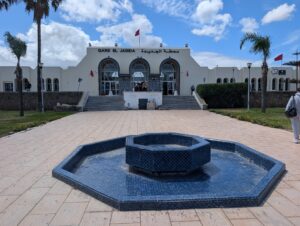
I used trains on five different occasions during my time in Morocco. I found them to be very reliable. They were nearly always on time. It was easy to get to and through the train stations. They all had big, electronic light boards with information on the departing and arriving trains in both French and Arabic. I don’t read either, but I could always tell from the French version what was happening with my train, and which platform I needed to go to in order to find my train. I did need to pay attention in the station or on the platforms, though, because there is no indication on the train itself as to which number it is, or the destination.
All of the trains I used had air conditioning. On the first, it didn’t work well. On all the rest, the temperature was quite pleasant. Many of the trains look pretty dated, though a few of the commuter lines seem to have more modern looking double-decker cars. ONCF runs the train system. They have a separate website (ONCF Voyages) that actually sells the tickets. You can navigate this website in English. They sell tickets for both first and second class. The difference in price is almost negligible. It cost me 205 dirhams, for example, to take the second class trains from El Jadida to Fes (about a five to six hour trip). A first class ticket would have cost 290 or 295 (about thirty dollars versus twenty-one. On the older trains the main difference is the size of the seat. Second class cars have compartments that seat eight (four abreast facing forward and four facing rearward). First class cars seat six in wider chairs. I did not get a new car on my first class trip from Fes to Nador. My only complaint about that seat was that the padding, meant to make the seat more comfortable, was made for someone at least a foot shorter than me. The padded “wings” meant to allow you to rest your head and maybe take a nap hit me right in the shoulder blades. It was hard, then, to sit straight. They seemed fine for everyone else. Second class seats in new cars are 2×2, and there is not really an adequate arm rest. My seat mate from El Jadida to Casablanca – a little guy – pretty much insisted on using the entire arm rest as he watched his Arabic anime cartoons on full volume the entire distance.
There is one other key difference between first and second class Moroccan train tickets. On long haul rides, like that from Casablanca to Fes or Fes to Nador, you will be assigned a seat number whether you are in first or second class. On shorter, commuter routes, a second class ticket does not guarantee you a seat. It’s general admission, and they can and will oversell the tickets. It only happened once, but I had to stand with my luggage the entire 1:40 leg from Casablanca to El Jadida. Admittedly, this happened during a Moroccan holiday in which a disproportional number of Moroccan tourists were headed to that beach town. It does happen, though. It’s something to be aware of.
Vendors very occasionally will come by trying to sell a small variety of drinks or snacks at a pretty inflated price. It’s nothing like buying stadium food in the U.S., but it’s pretty expensive by Moroccan standards. The food in the train station has a lot more variety, but is still more expensive than it should be. I just made sure to visit the grocery store – or the candy girl – before boarding.
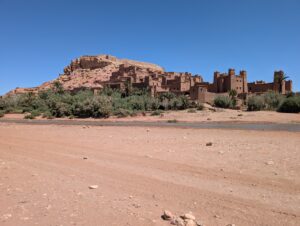
There are apparently inexpensive domestic flights within Morocco, but I can’t speak to those, I didn’t need any. I used an organized tour to get me to several remote places around Ait Ben Haddou on one occasion. The tour was inexpensive. I learned, however, that Morocco isn’t that hard to navigate independently. Knowing a little French would help exponentially in this. Even without this, however, it is safe and cost effective to use buses, trains and taxis in Morocco.