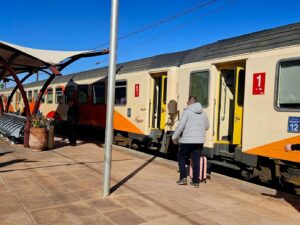
It took me over an hour to make it back to the train station and another 45 minutes to get back to Fes. I could not locate the bus I needed to get back, so I decided to grab supper at a cafe out near the train station for a change. My tagine was made from meatballs and egg this time, a more rudimentary preparation, but it was only 45 dirhams. The water and bread were free, unlike in other tourist places in Marrakech and even Fes. I wanted some dessert afterward, and so walked back toward where I thought the bus would be. I still couldn’t find it. I did run across a dried fruit, nut, and candy shop with a friendly young lady who was not busy, and patient enough to use the translation app to help me understand the nuances of what she was selling. I grabbed 200g each of pistachios, caramelized cashews, and fekas. Fekas are little cut up cookies. They had been rolled out flat to be crispy and looked like sort of flat croutons. There were different colors, which I correctly ascertained were different flavors. At the recommendation of the vendor, I opted for the “original” flavor. From the looks of the thing, I thought it would be savory, but it was sweet. Like many other middle eastern desserts, fekas are not overwhelmingly sweet. One of the other flavor options was thyme, and the third option I cannot remember.
I really had a hankering for ice cream. Ice cream is often expensive in developing countries. It can be downright difficult to find as small shops are barely willing to keep their refrigerators below room temperature. They are usually not air conditioned, so even meltable things like chocolate candy bars are relegated to the fridge. I have gotten into the habit of feeling the sodas before buying, as they are more often than not, warm. It is especially rare to even find a shop with a freezer. If they do have one, it may only contain ice. I saw on the map that about a mile off, there was a Carrefour Market (a European grocery store chain). THEY would certainly have quarts of ice cream and often ran them on sale. I decided if I was going to have to hike home anyway, I might as well drop by the Carrefour.
That turned out to be a bit of a mistake. I was successful in finding an ice cream quart for 19 dirhams (about $2). This Carrefour, however, was in a mall and was something like a Walmart Supercenter. I had seen one other like this in Doha, Qatar. This one at the mall in Fes was completely crammed with visitors. I could hardly even get in. Stephanie knows I am reluctant to even enter a less trafficked Walmart in the USA if I just need a couple of things. I thought my ice cream would melt before I got to the cashier in this Fes Carrefour. It was difficult to tell where the lines even separated from one register to the next. The women seemed to expect to be let through in front of all men. I let a couple of ladies cut me in line, but then correctly calculated that at that rate, I might never get through. The next couple who tried to squeeze in front of me, I boxed out like I was working for a basketball rebound. One more lady slid her items in front of mine on the belt. I didn’t fight it, but I probably didn’t have the most gentlemanly expression.
It all worked out fine in the end. It was almost two more miles back to my hostel. I wondered if there would be any ice cream left by the time I got home. I had to extract it from the bag with the nuts and fekas to prevent a huge mess. By the time I sat down to eat it, about 2/3 to ¾ of it was still frozen. That was probably as much ice cream as I ought to have eaten at once, anyway.
As I sat eating my ice cream, another guest was awaiting Ayoub, the hostel host. This guy was a cyclist from England. He was making a several day trip on his gravel frame bike over the Atlas mountains, through parts of the Sahara, and back over the mountains in a circuit. It sounded like quite an adventure. I don’t think I could manage the climbing in that kind of bike trip. I never got around to asking him whether he was camping out, or “credit card” touring. I assumed the latter, since I did not see him carrying enough gear to camp, and I saw no panniers. I had a good visit with Brook in the morning. He was not as old as me, but not a twenty year old kid either. He was also a tad unusual in the hostel guest community as a relatively conservative person, politically. He shared my appreciation of Western Civilization, while still being sympathetic to those who have not fared well under colonization or equally benefited from the spread of market economies. History is full of gray areas, there are seldom guys with white or black hats, as postcolonial theory would have you believe.