Marrakech
Souqs, Woodwork, & Lots of Tourists
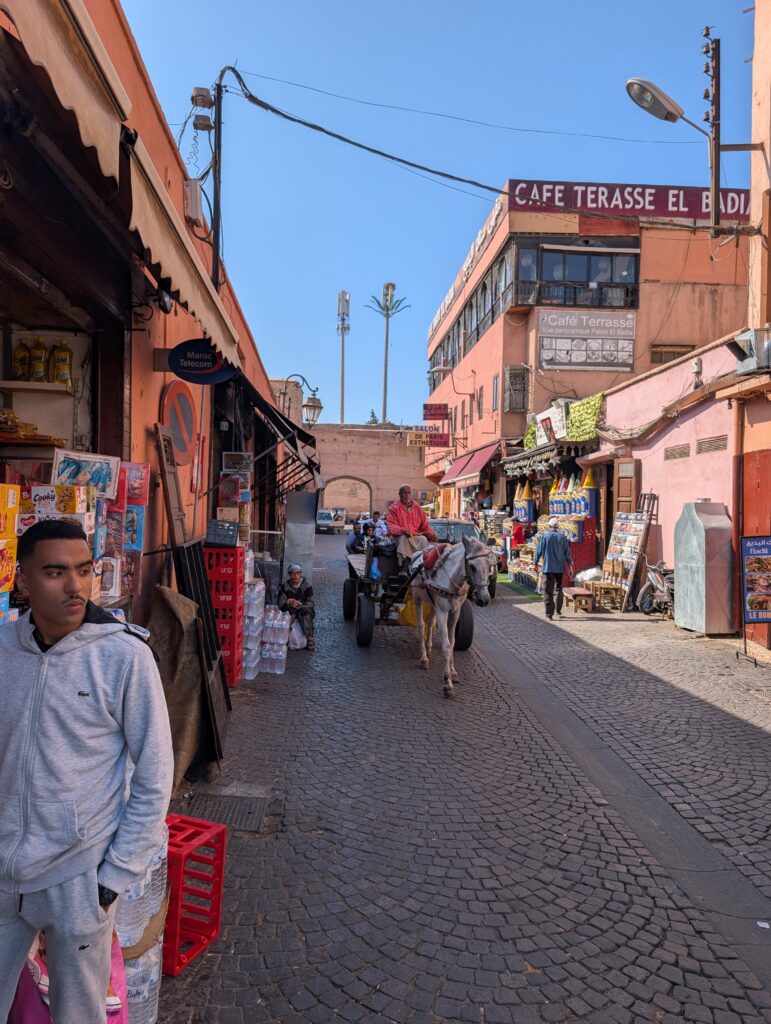
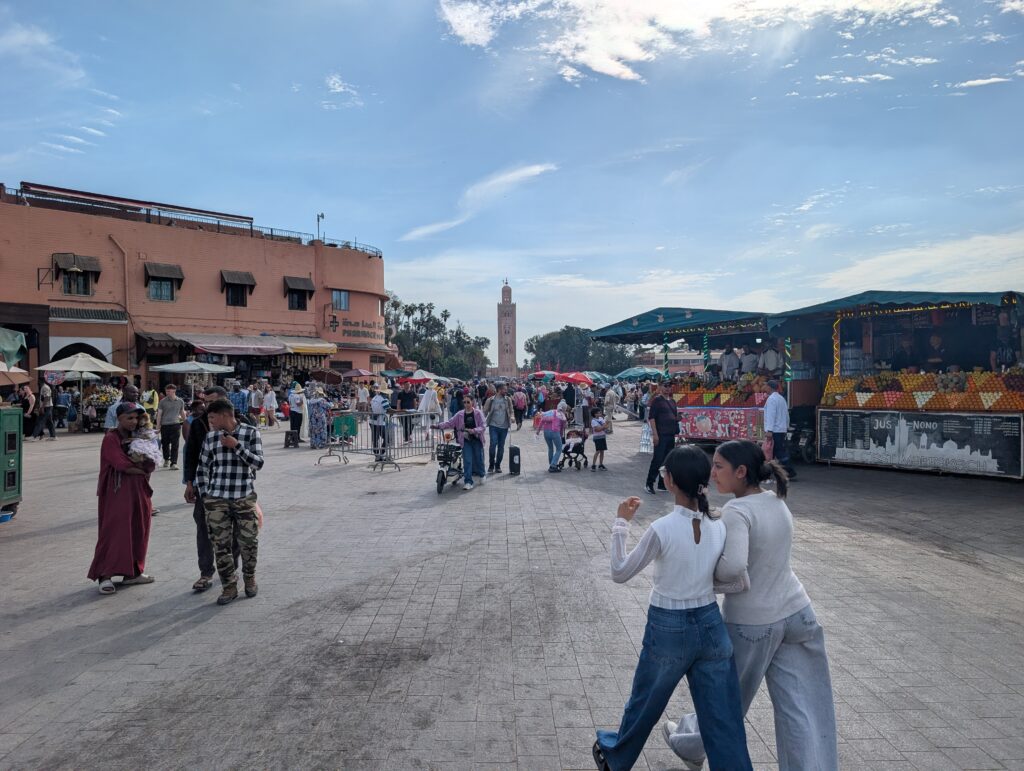
I set out on foot for my hostel. It was too far to walk, so I planned to take a bus to the city center. There is a direct bus to and from the airport in Marrakech for 30 dirhams (about $3), and several other lines that run the same route, but begin about 400 yards from the gate. Those are 4 dirhams, so I walked outside and caught one of those. It was crowded, but in about 10 minutes, I was dropped at the Koutouba Mosque right next to the Jemaa el Fnaa (the main square of the medina – the heart of old town Marrakech).
It was about another three quarters of a mile to the hostel from there, in an area almost entirely dedicated to markets and foot traffic. I walked this, and arrived still quite early. It wasn’t yet 8:00 a.m., but the hostel advertised a 24 hour help desk. I rang the bell. No one answered. Eventually another guest exited, and pointed me to reception. No one was there, either, so I sat down to rest for a moment and get my bearings. I needed to map out what I would see that day. Since I was afoot, I would need to visit sites in an order that made geographic sense.
While I figured out what order I should walk, and when the different attractions opened, a hostel employee emerged from the kitchen and offered me breakfast! I protested that I hadn’t even checked in, and hadn’t reserved or paid for the previous night. “No matter,” said the young man, and promptly brought me the small breakfast of an egg, a pastry, and a couple of different kinds of flatbread with butter and orange marmalade. I thanked him heartily, and continued at my work as I munched on the food.
Most of the local palaces, madrasas, and other historic sites did not open until 9:00. I found one that opened at 8:00 and so decided to begin there. I would visit two palaces, and a set of old tombs known for their funerary architecture in the morning. I’d grab some lunch, then visit a madrasa, and if I still had the energy, a garden. There were no Churches of Christ in Morocco, but I found another protestant group meeting. I was curious about how they navigated the anti-Christian laws in Morocco, so I would head there in the evening, both to worship, and to learn about their operating model. Most visitors recommended an hour or at most an hour and a half for the attractions, so all of this seemed doable, if ambitious after a red eye flight.
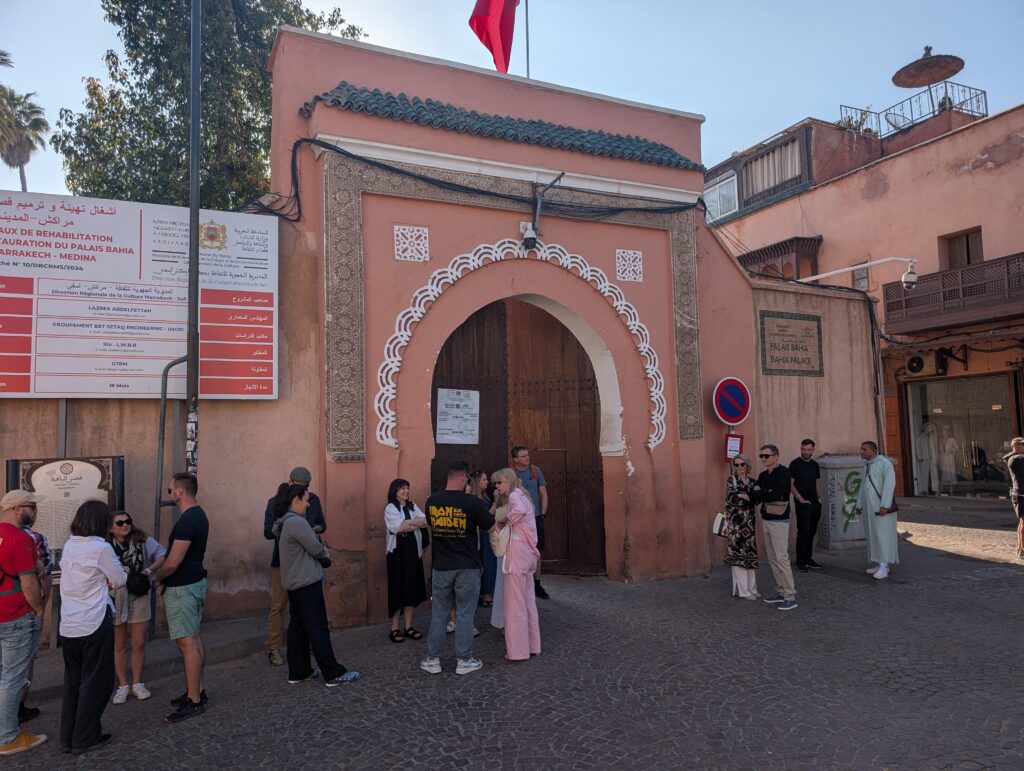
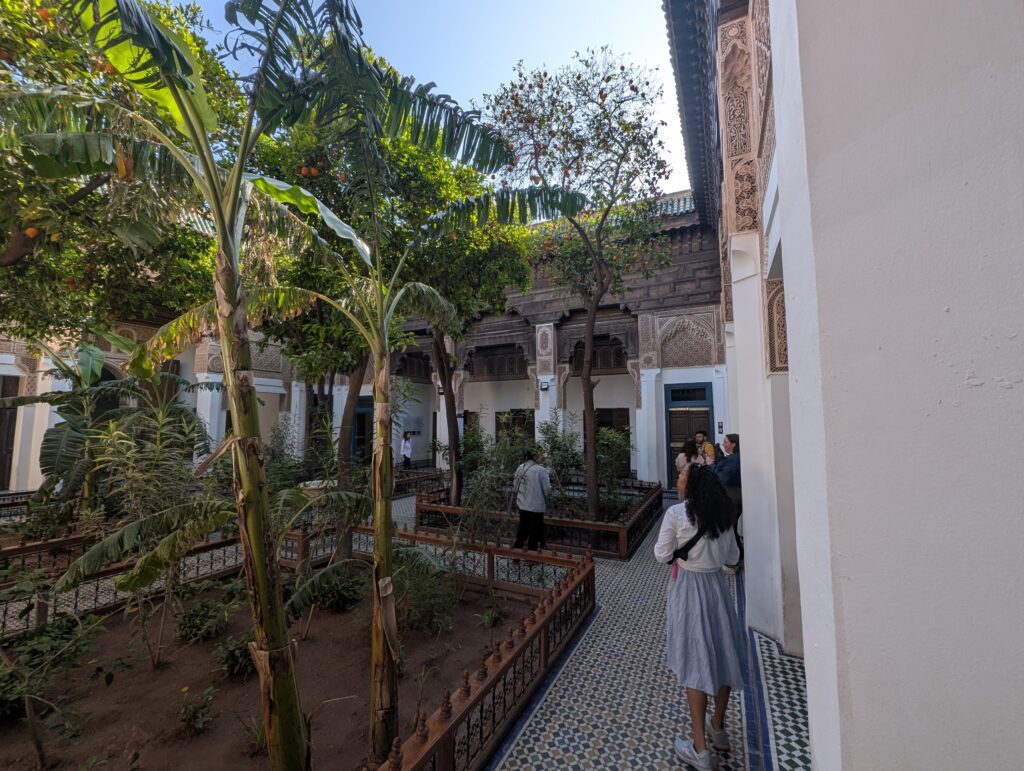
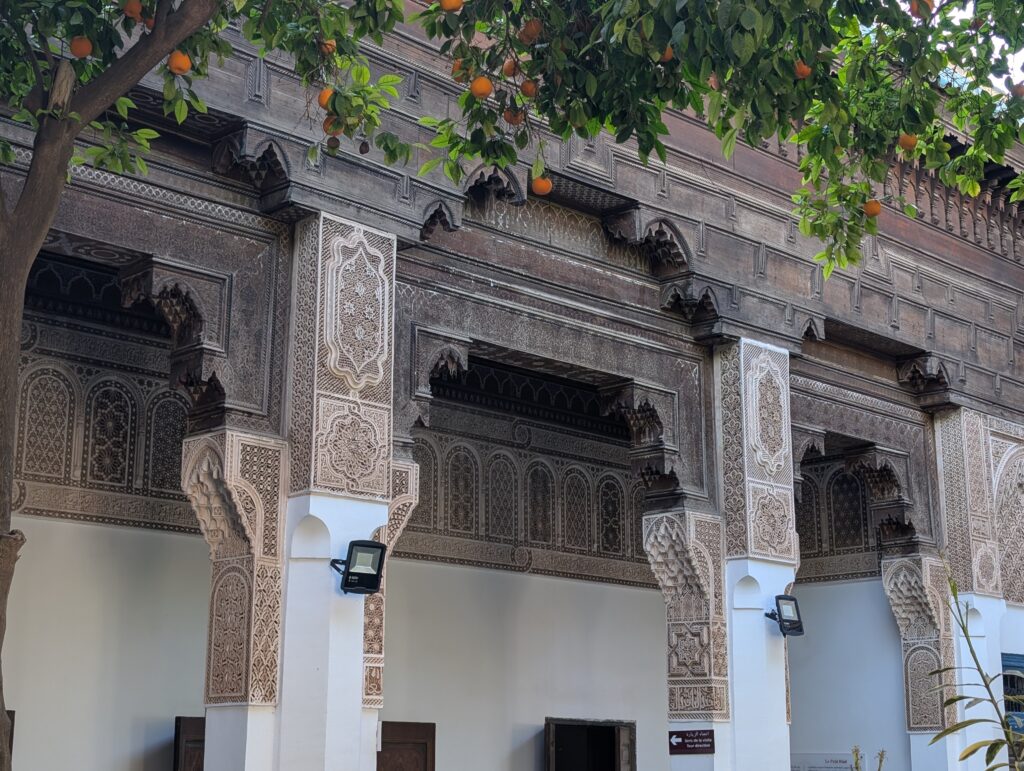
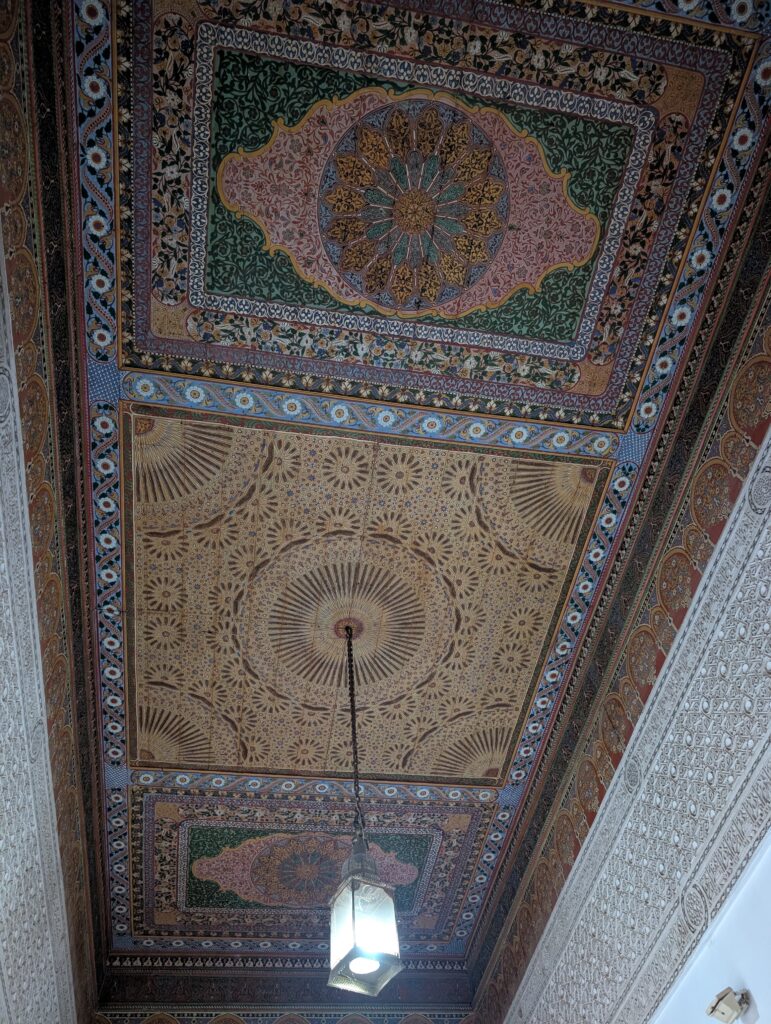
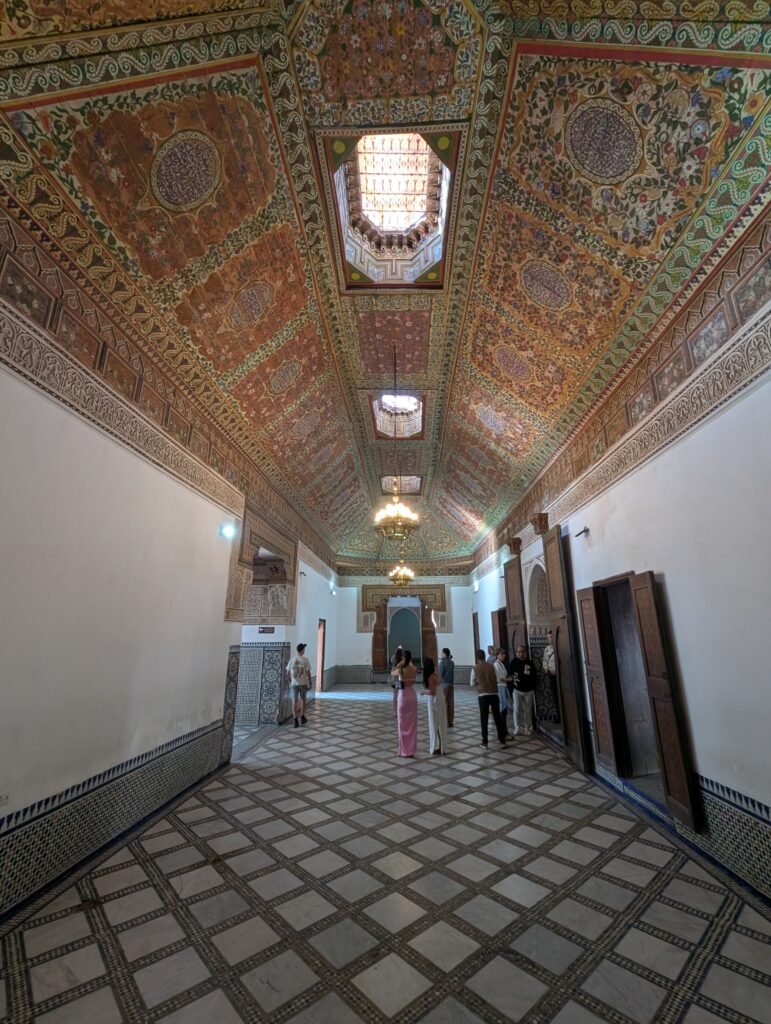
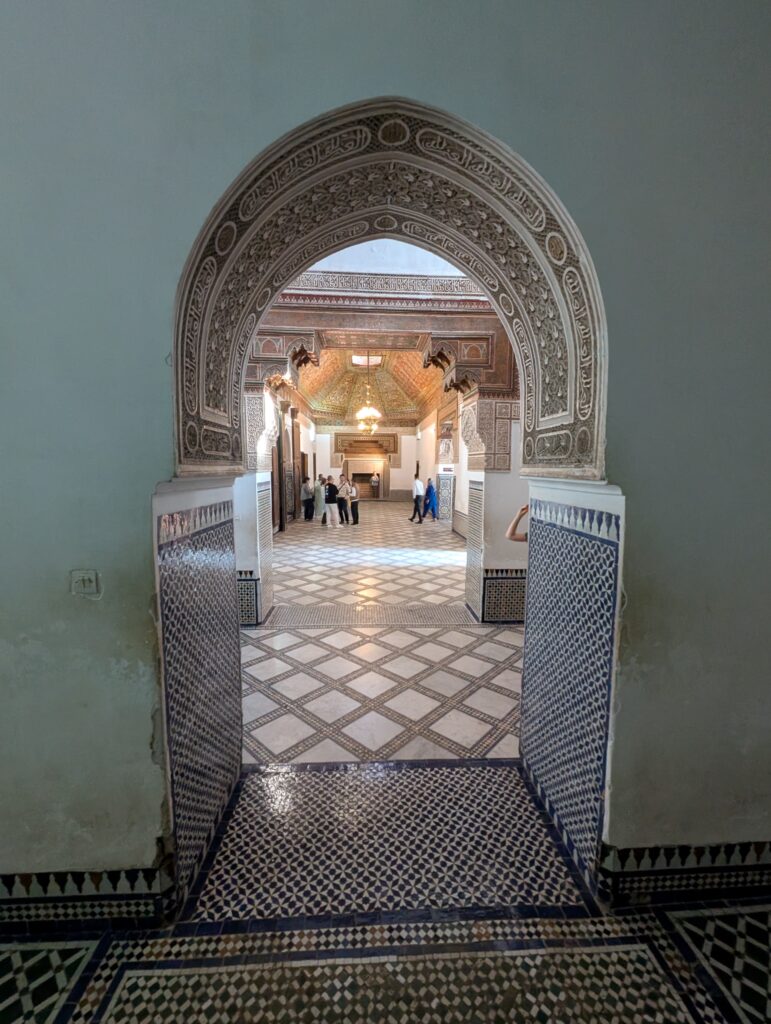
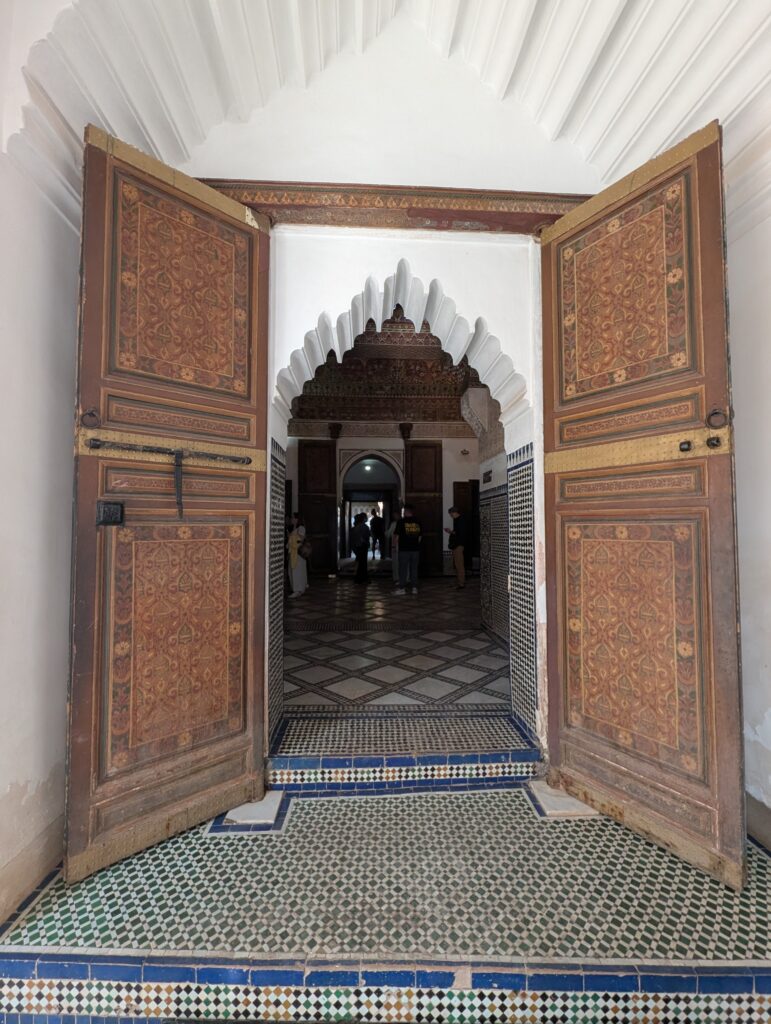
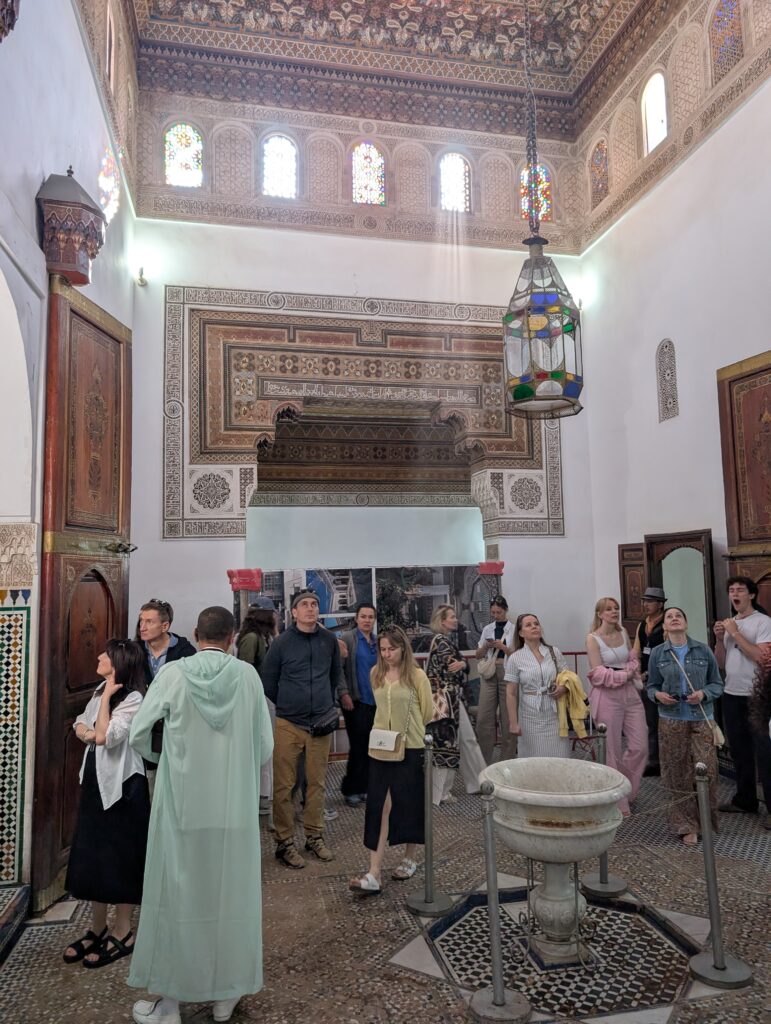
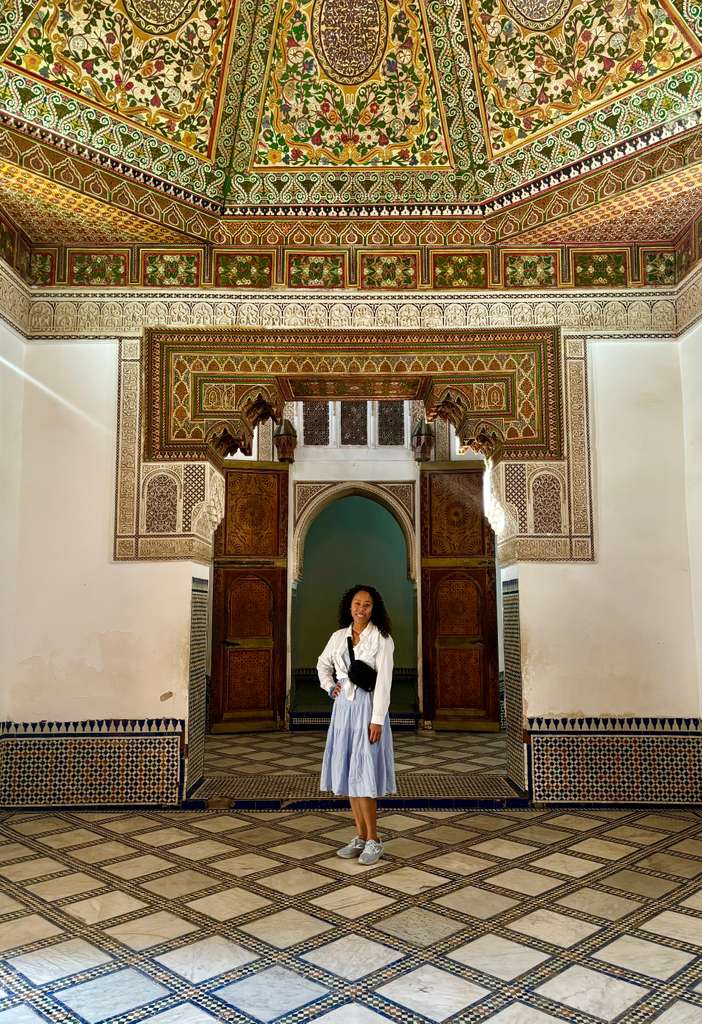
I strolled over to Bahia Palace, only a few hundred meters from my hostel. Bahia Palace was built by the grand vizier to one of the last sultans of Morocco before it became a French protectorate in 1907. It is a beautiful palace, with geometric designs, hand crafted ceilings and architecture reflecting Moroccan heritage, but still quite different from the 16th century Badi Palace I would visit next. Bahia Palace is a sprawling, maze-like structure, likely due to the fact that it was built in phases. Palace construction began in the 1860s. The palace was expanded by subsequent viziers through the 1890s. It is best known for its ornate decoration. The geometric patterns are accompanied by Arabic script, and muqarnas. Muqarnas are interior recessed domes featuring levels of indentations or sort of systematically placed, similarly shaped “pigeon holes” that make a three dimensional pattern inside the dome.
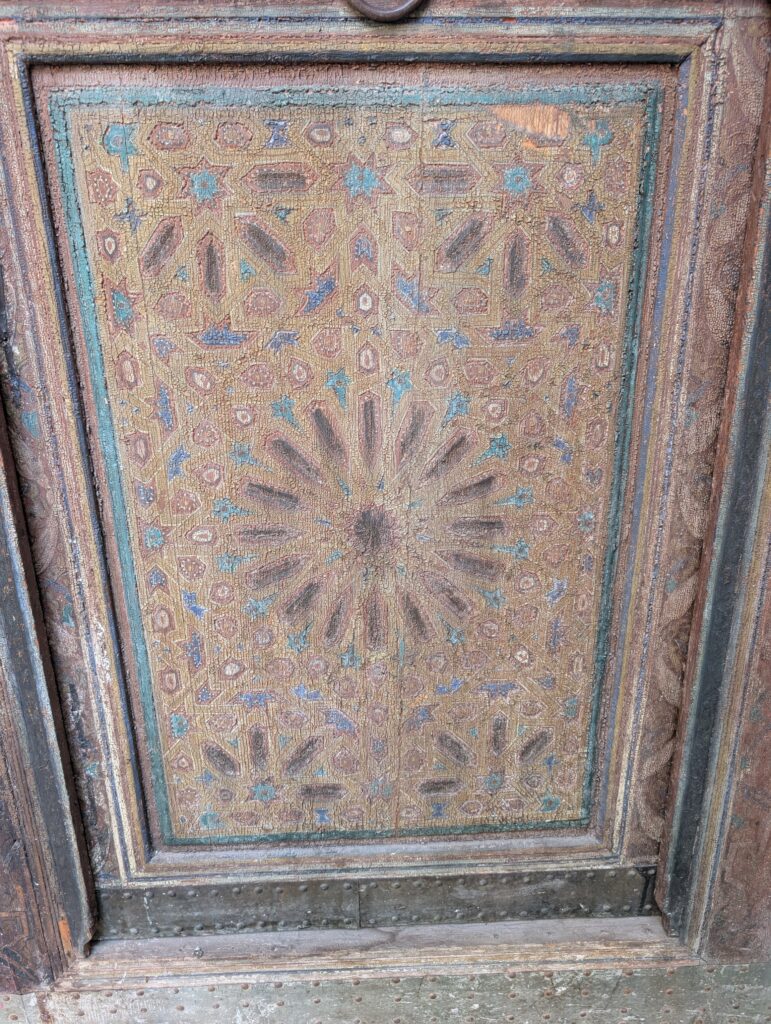
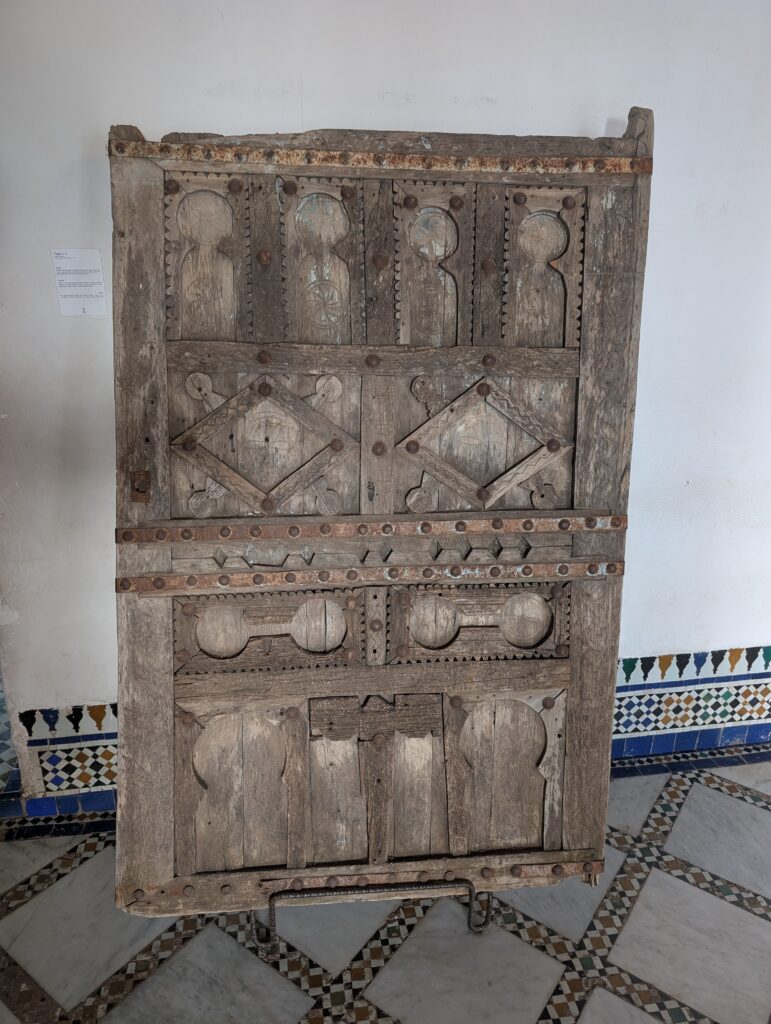
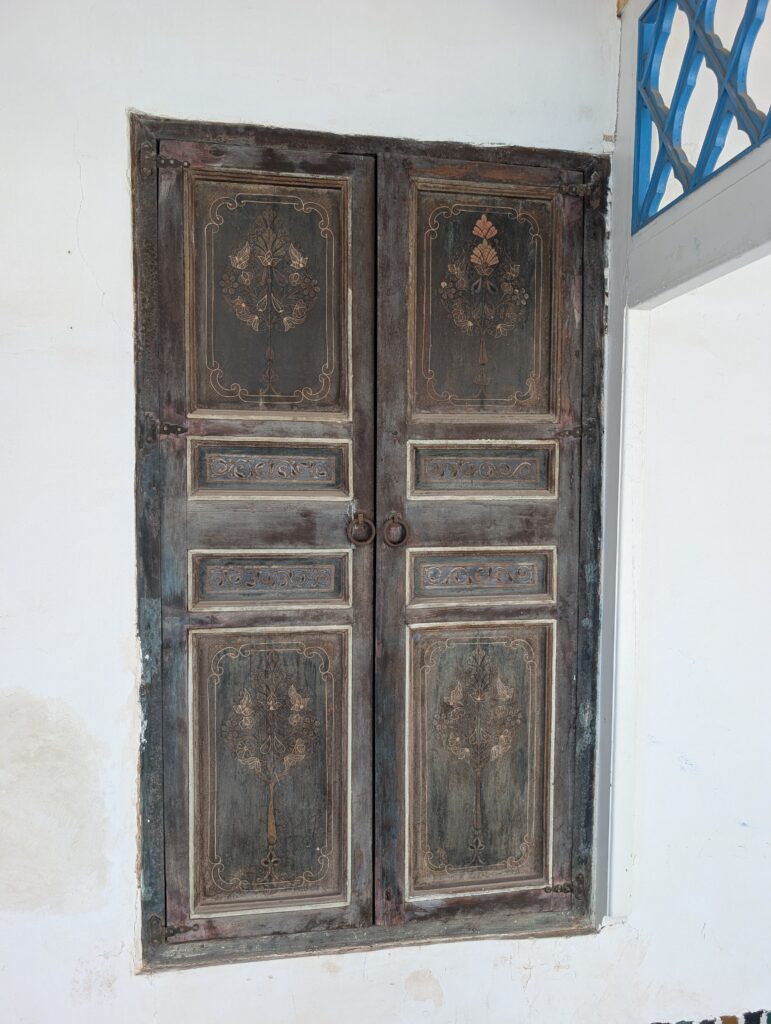
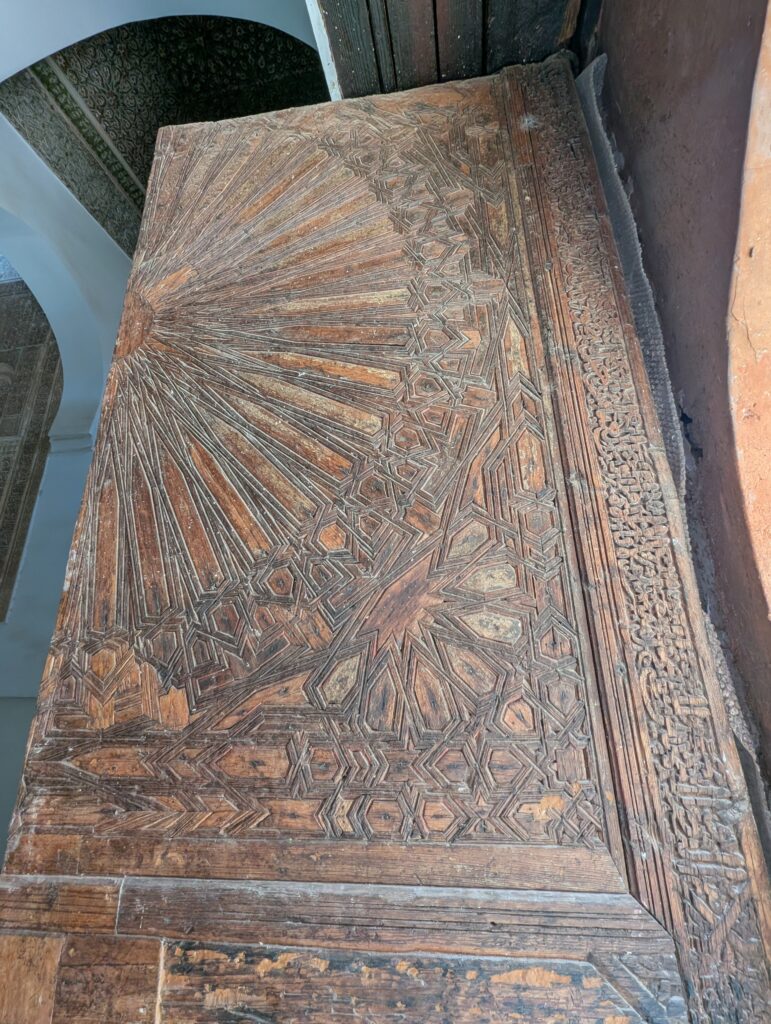
Bahia Palace was damaged by the massive earthquake that struck Morocco in September, 2023. It was closed only briefly, though, and remains one of the most visited tourist attractions in all of Morocco. Bahia Palace operates as a kind of museum as well. In addition to its innate architectural features, it includes a display of wooden doors. Most of them are 19th and early 20th century hand carved granary doors, but there are other doors as well, with some descriptions of their provenance. Nearly all of the doors in the palace are remarkable for their detail, those in the displays, and those of the palace itself.
As with so many international tourist attractions, Bahia Palace costs more for foreigners to visit than for Moroccans. The cost for this, and each of the other palaces and tombs I visited was 100 dirhams (about $10). That’s not terrible, but it added up, and I spent 350 dirhams just in admissions Sunday.
(Continued)

I met another chatty American tourist in Bahia Palace, a 33 year old government biologist originally from Los Angeles, but now working in Washington, D.C. We visited the palaces and tombs and ate lunch together before she headed to a hammam for a massage in the afternoon. Juita had not done quite as much research on what to see as I had, and so was happy to follow me to other nearby attractions. She had been in the Marrakech medina for a bit longer than I had and so knew better where to eat. So we formed a kind of knowledge partnership for the morning.
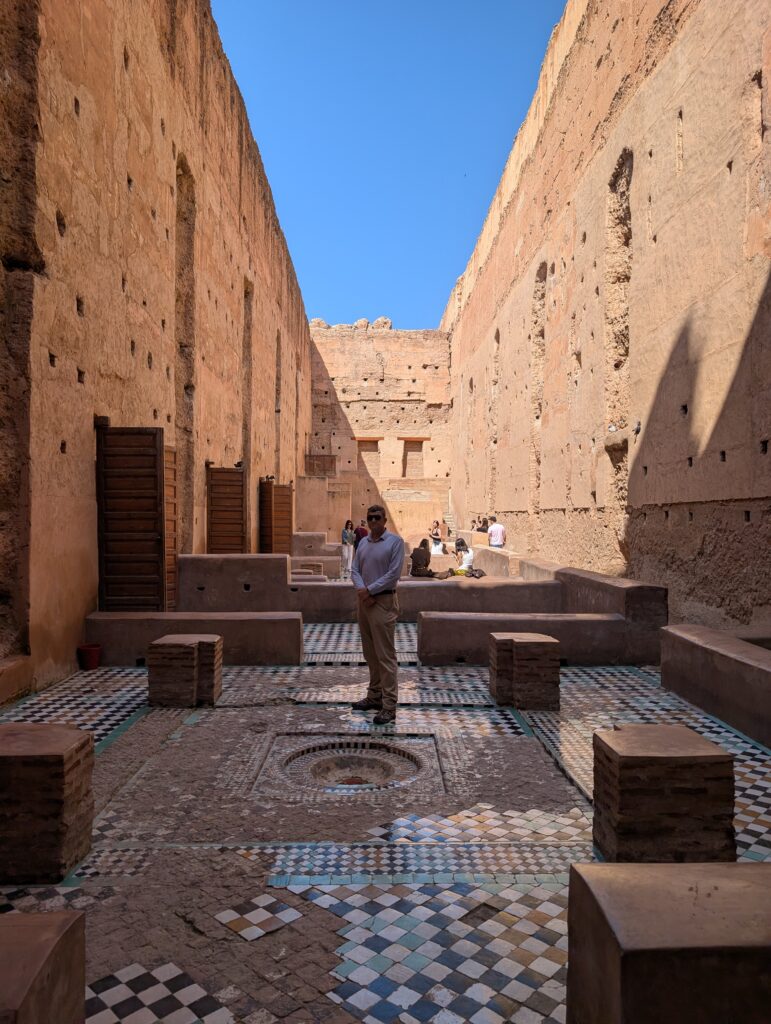
The next logical stop was Badi Palace. Badi Palace was constructed in the mid 1500s by members of the Saad Dyansty. The Saadians ruled Morocco for most of the 16th and 17th centuries. The height of their power was presided over by Ahmad al-Mansur, who ordered construction of the Badi Palace in the 1570s. Members of the ruling family quarreled among each other at times, and some leaders were assassinated by the Ottoman Empire. Morocco was the only part of North Africa the Ottomans were never able to completely establish suzerainty over – a fact Moroccans are quite proud of. As with so many places along the African coast, the Portuguese had captured cities on Morocco’s Atlantic shore, and exerted pressure where they could. Forces under Ahmad al-Mansur decisively defeated a Portuguese military incursion in support of his brother’s rival claim to the throne. Through this victory, he consolidated power and ruled from Marrakech.
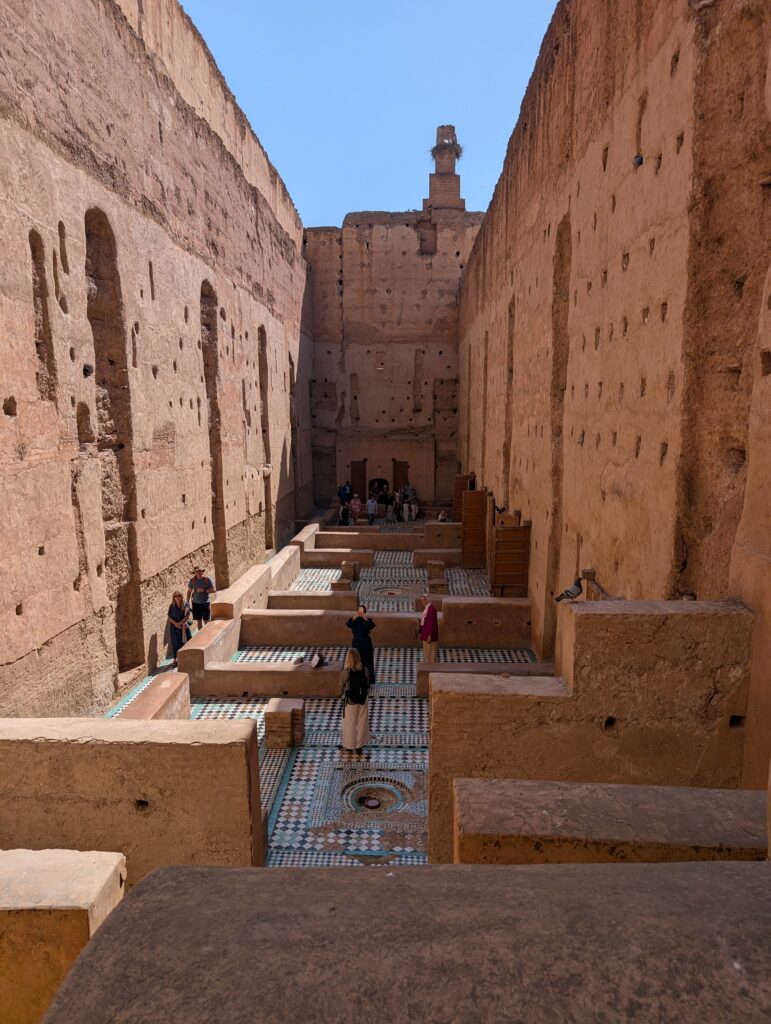
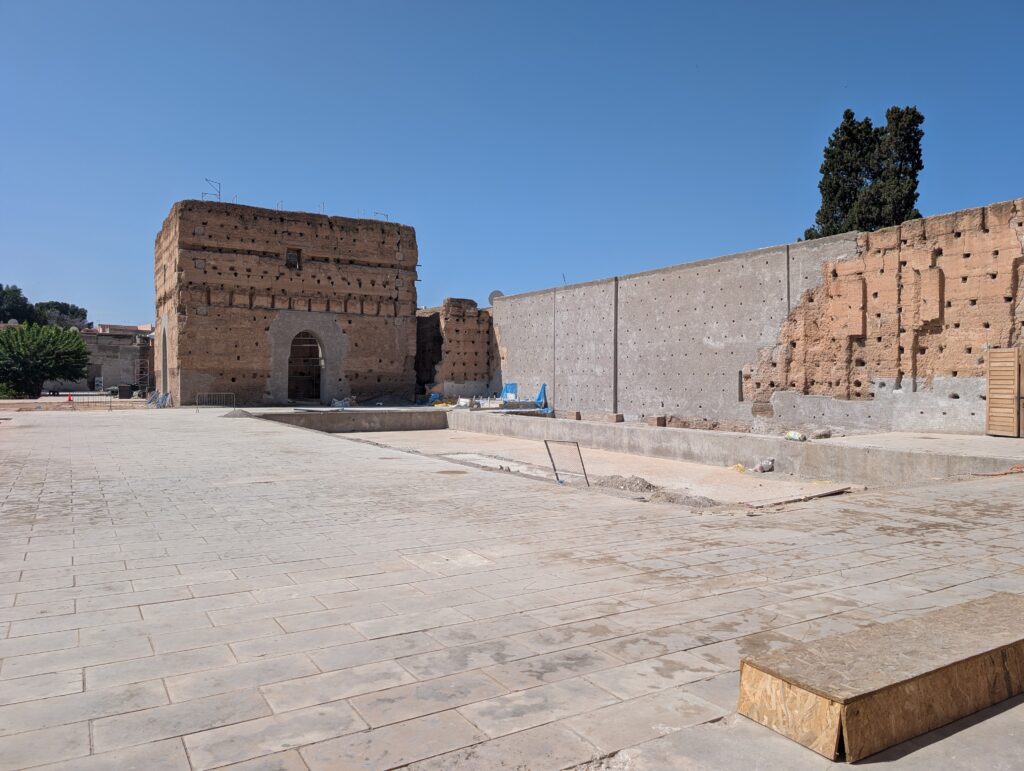
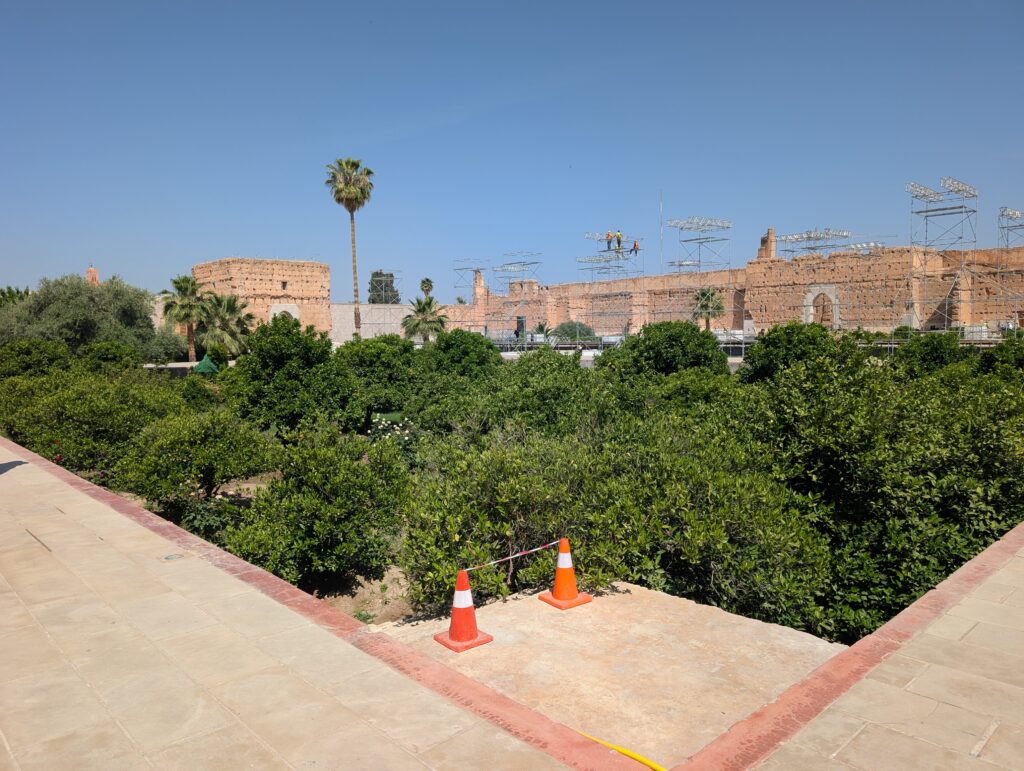
The Badi Palace fell into neglect and disrepair shortly after al-Mansur’s reign. It remains largely in ruins. But the grounds are impressive, and significant parts of the original art and architecture remain intact so that visitors can imagine what the rest looked like. It was certainly laid out a lot more purposefully than Bahia Palace. It, too, was damaged by the earthquake in 2023, and there is a lot of construction going on. There remains a large observation tower, a large citrus garden, some pools, and many smaller rooms meant for hosting foreign dignitaries, etc. By the early part of the next dynasty, the palace was in such disrepair that the sultan refused to host guests there anymore. He ordered much of the adornment to be removed to his palace in Meknes, another one of Morocco’s four imperial cities. The other two are Fes and Rabat.
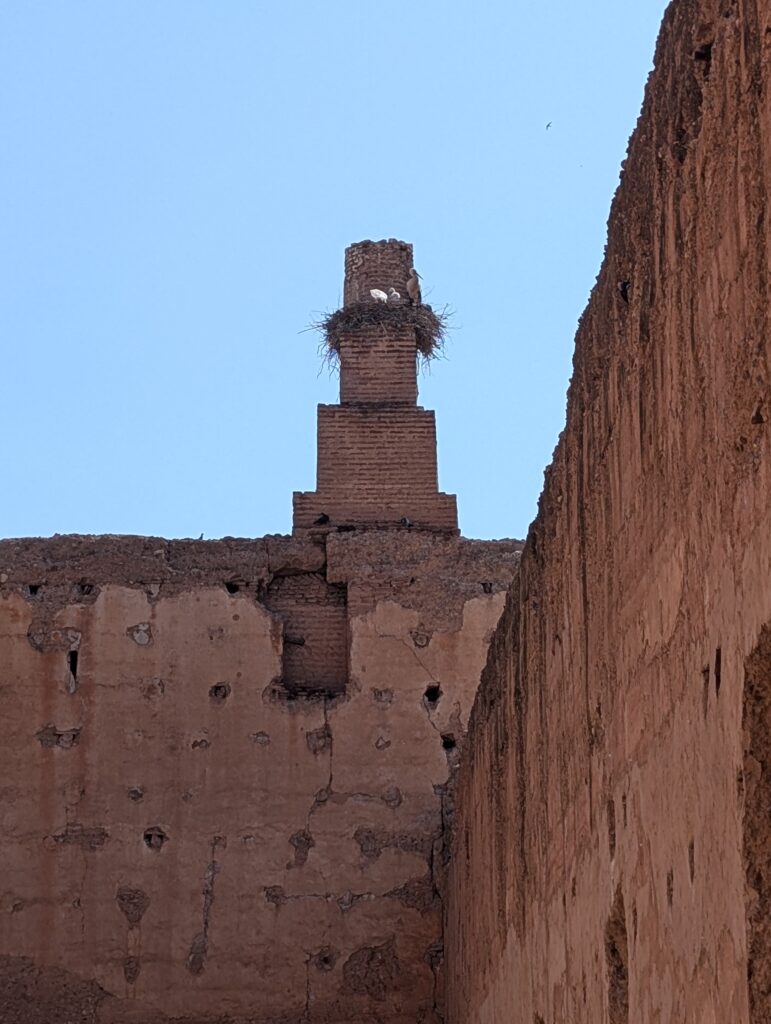
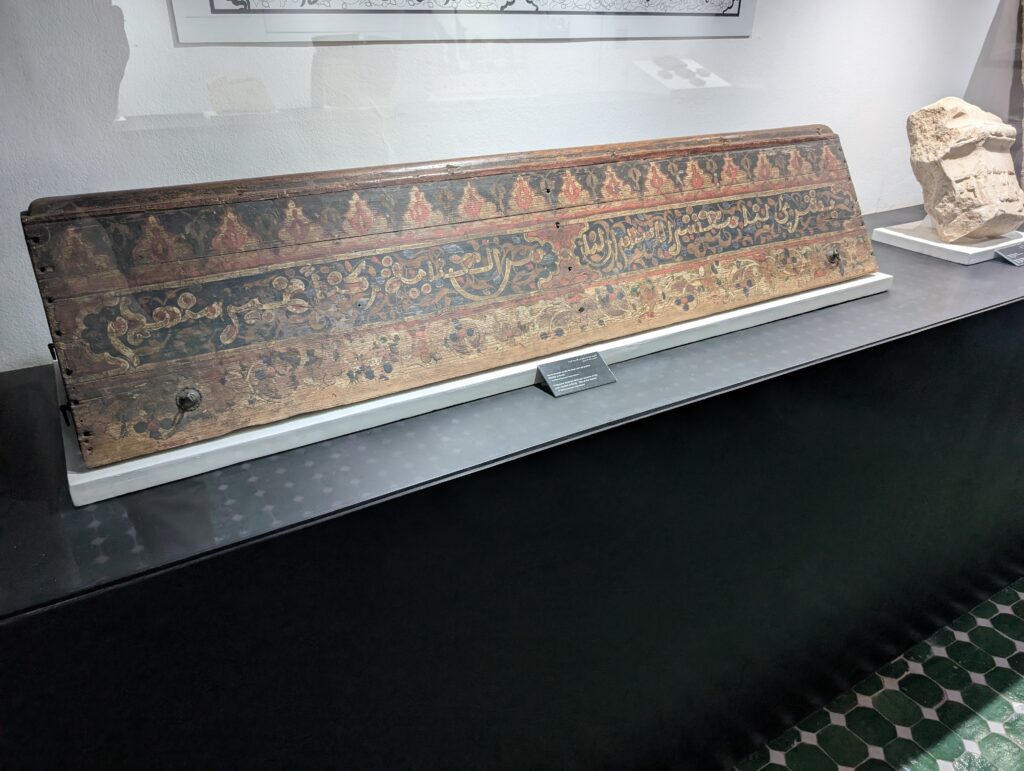
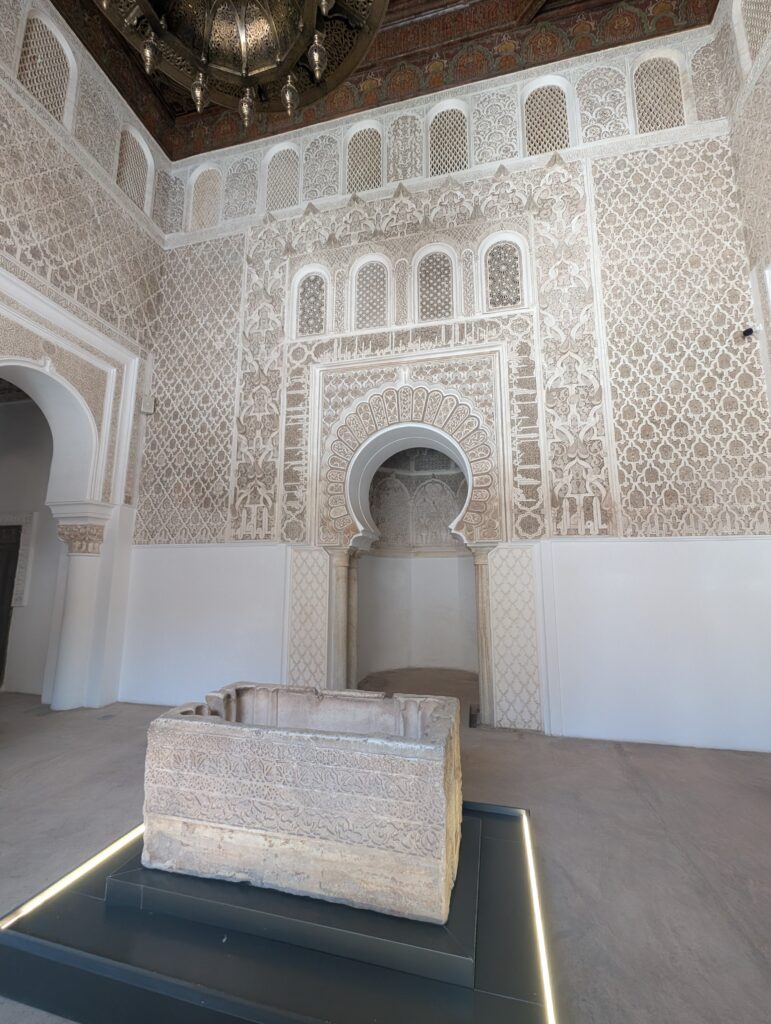
There is also a famous 12th century Muslim pulpit on display there, normally, though it had apparently been moved elsewhere the day I visited. Another peculiarity about the Badi Palace was its resident storks. My biologist friend asserted that they were actually ibises. Online information all supports them being white storks. I did not have enough knowledge to dispute either. Whatever they were, they had constructed gigantic nests into the observation tower, and any other high points they could find – light poles or whatever. We saw several of the storks. One nest even had a very prominent baby resting in it.
(Continued)
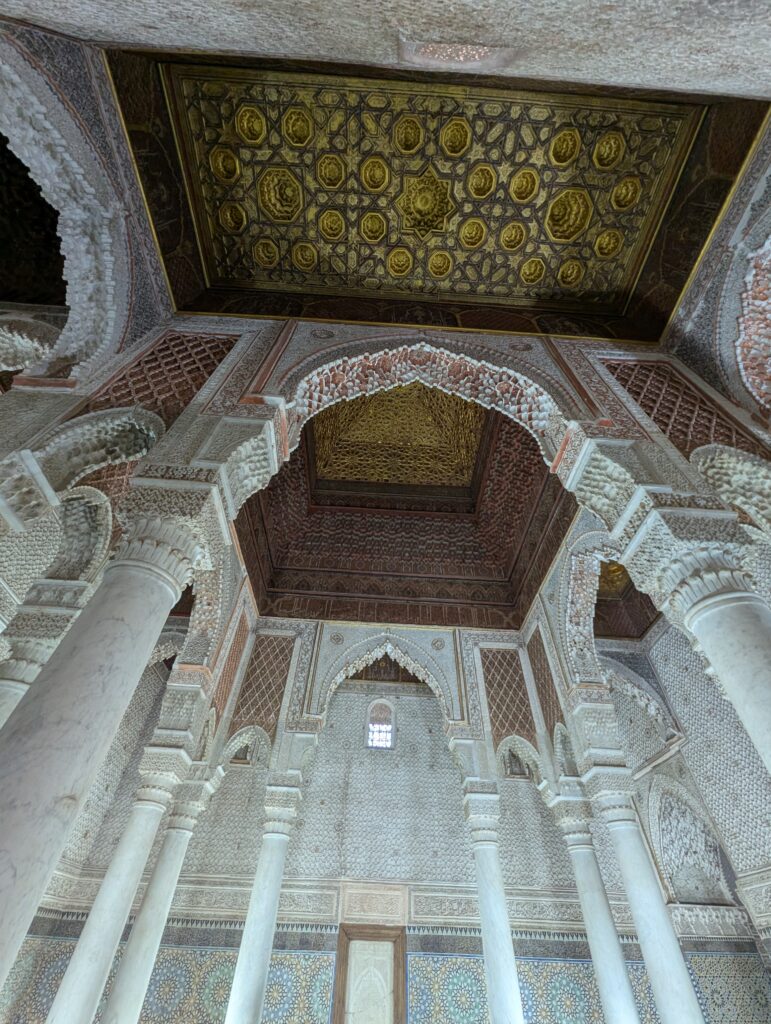
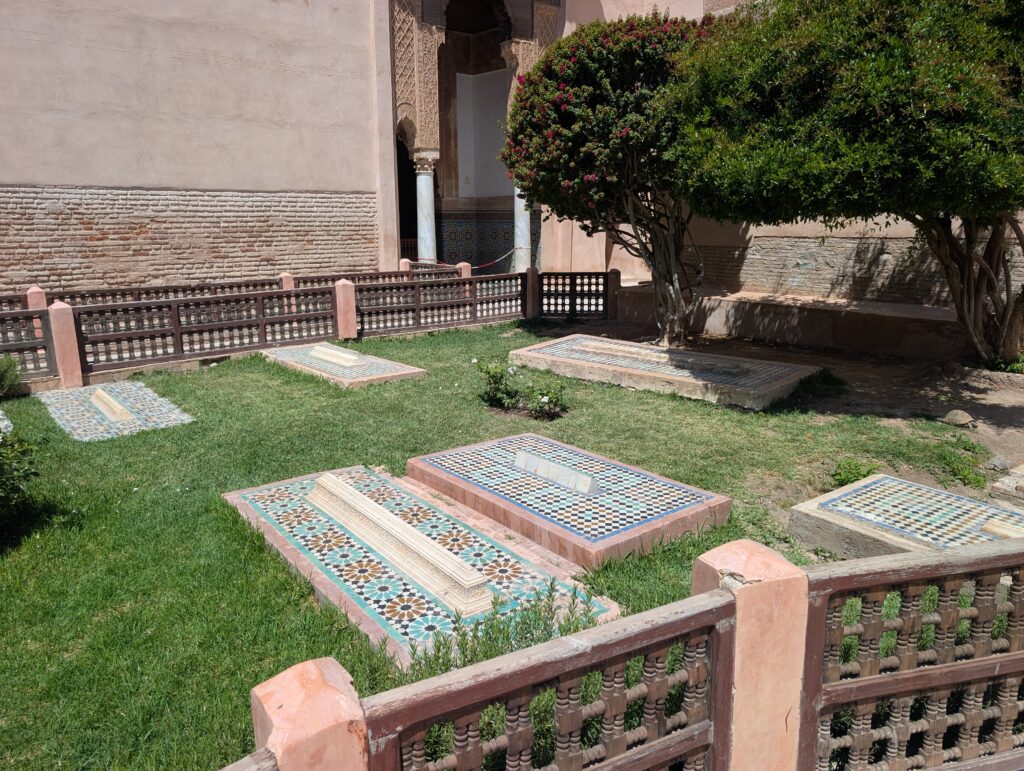
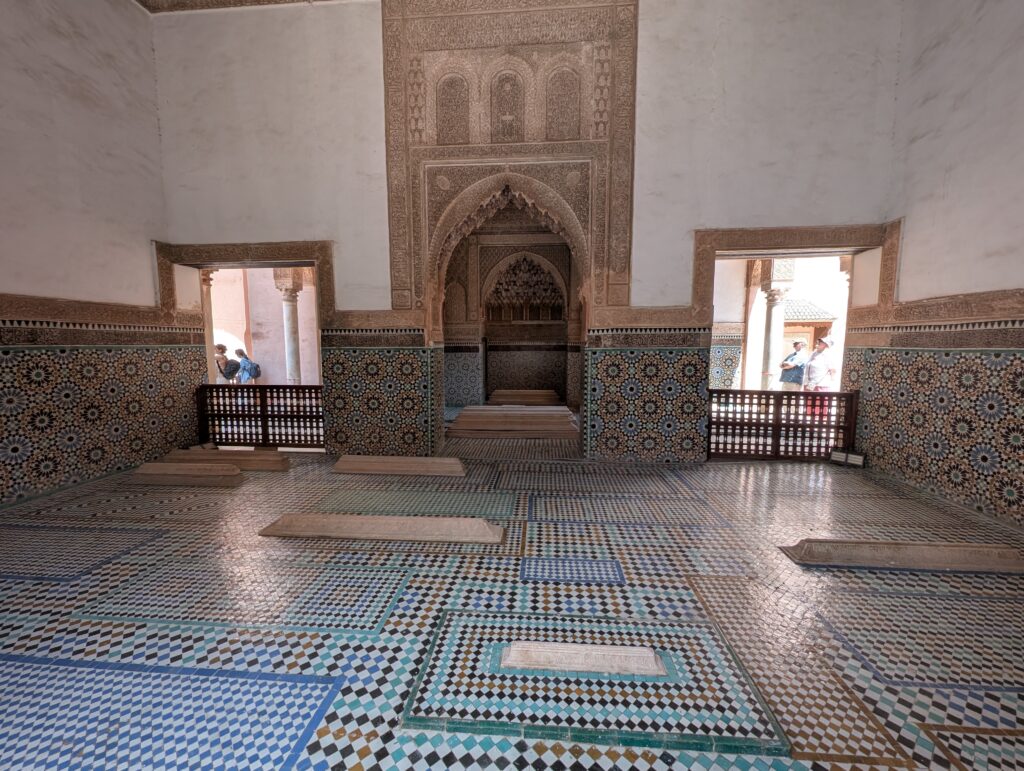
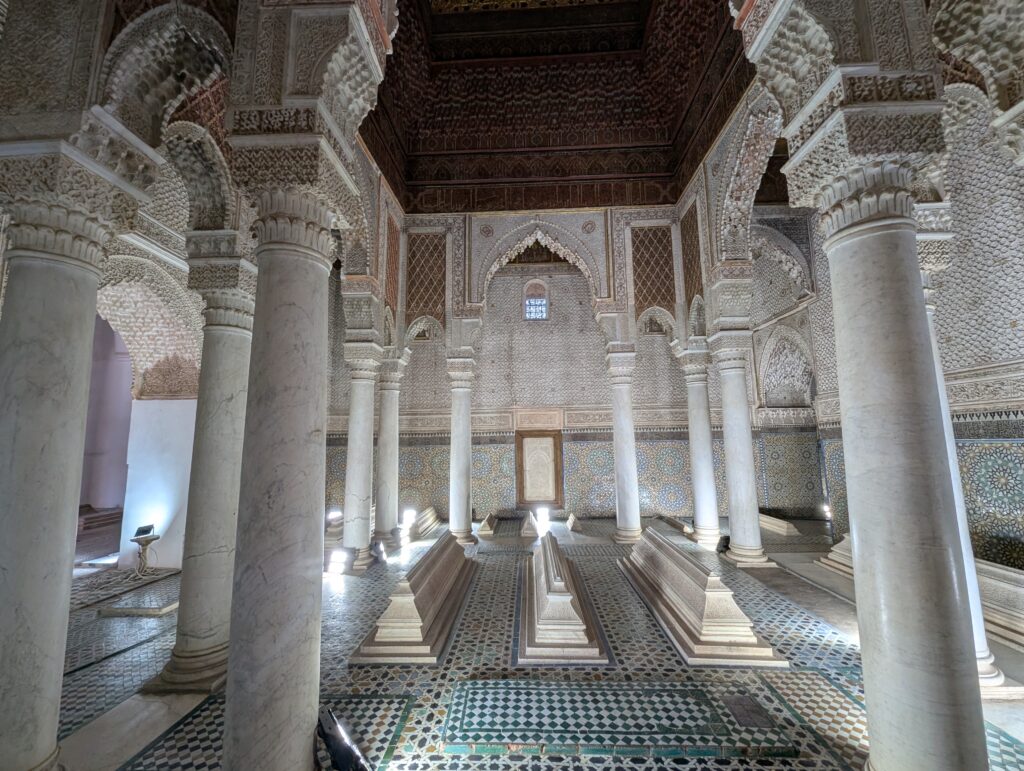
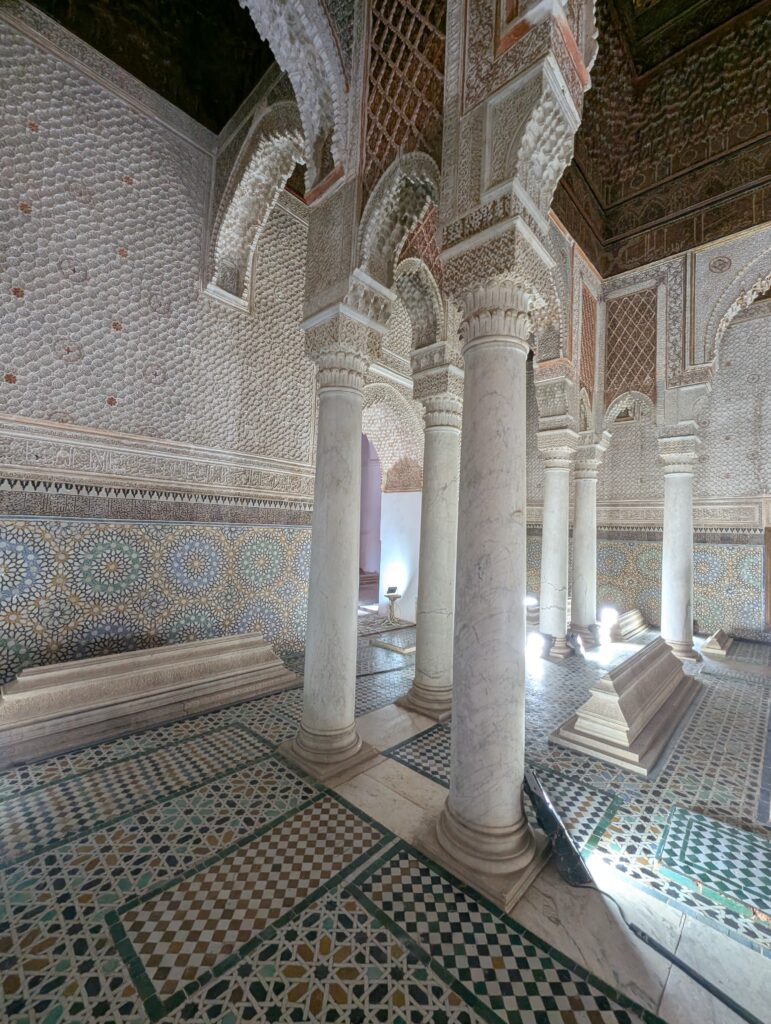
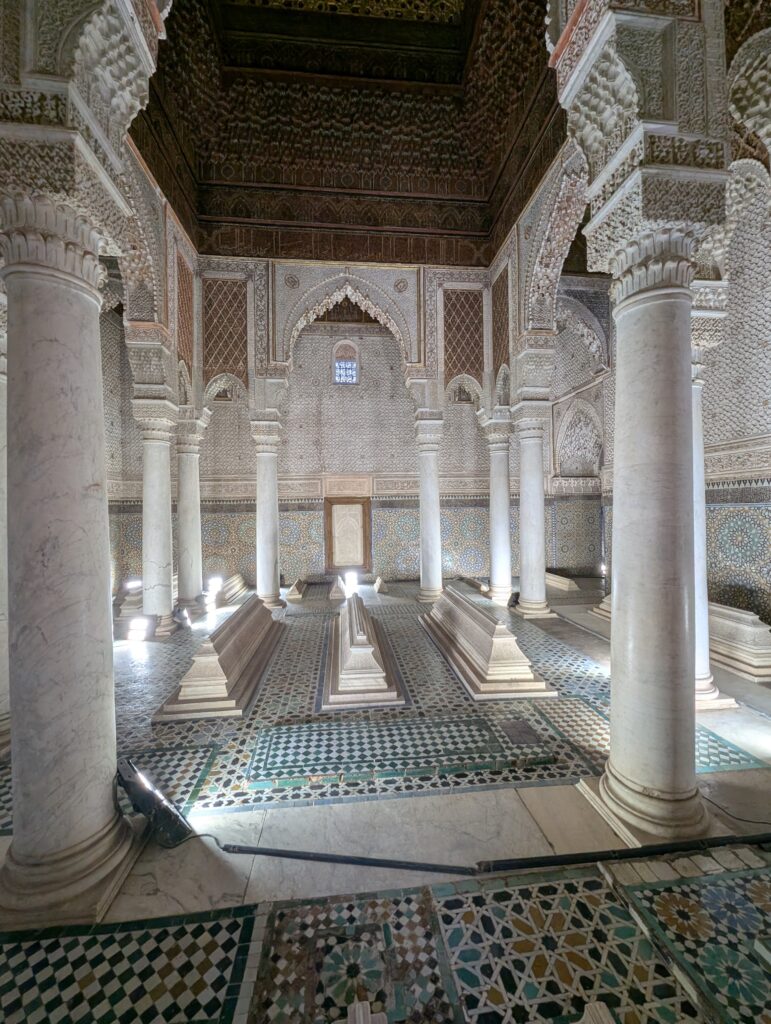
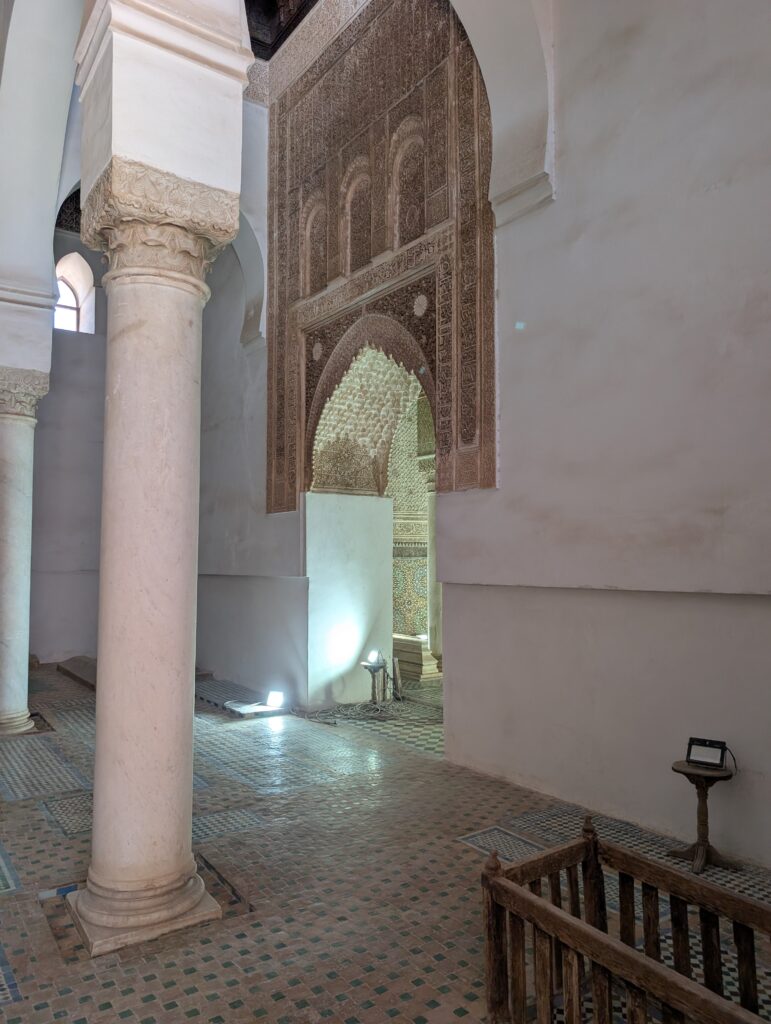
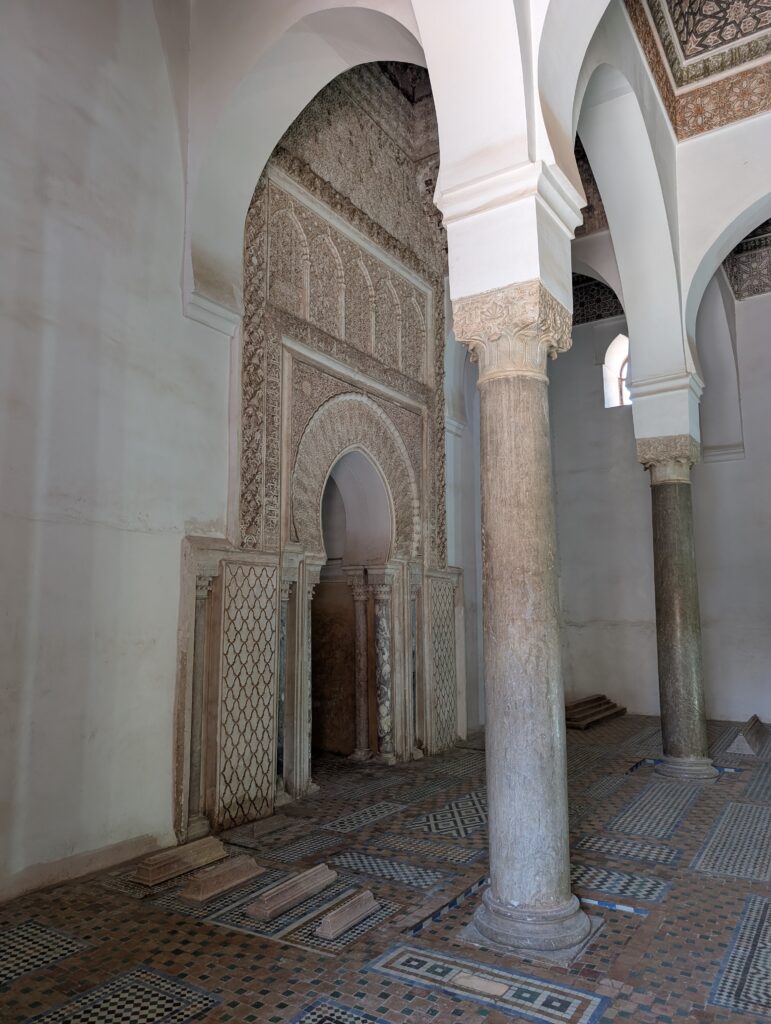
After briefly considering grabbing lunch, Juita and I decided to stroll to the nearby Saadian tombs. It was a longer hike over to her favored food stalls, and Moroccans don’t eat until 1:30 or 2:00, anyway. So we shelled out another 100 dirhams each and headed into the tombs. These tombs also date to the 16th century. Some of those of the “lesser important” people are outside, but the royal tombs are enclosed in ornate buildings. As is often the case with Islamic funerary monuments, the graves themselves are marked with something that looks like a fancy, colorful parking blocks – the cement things that dictate how far you pull into a parking stall.
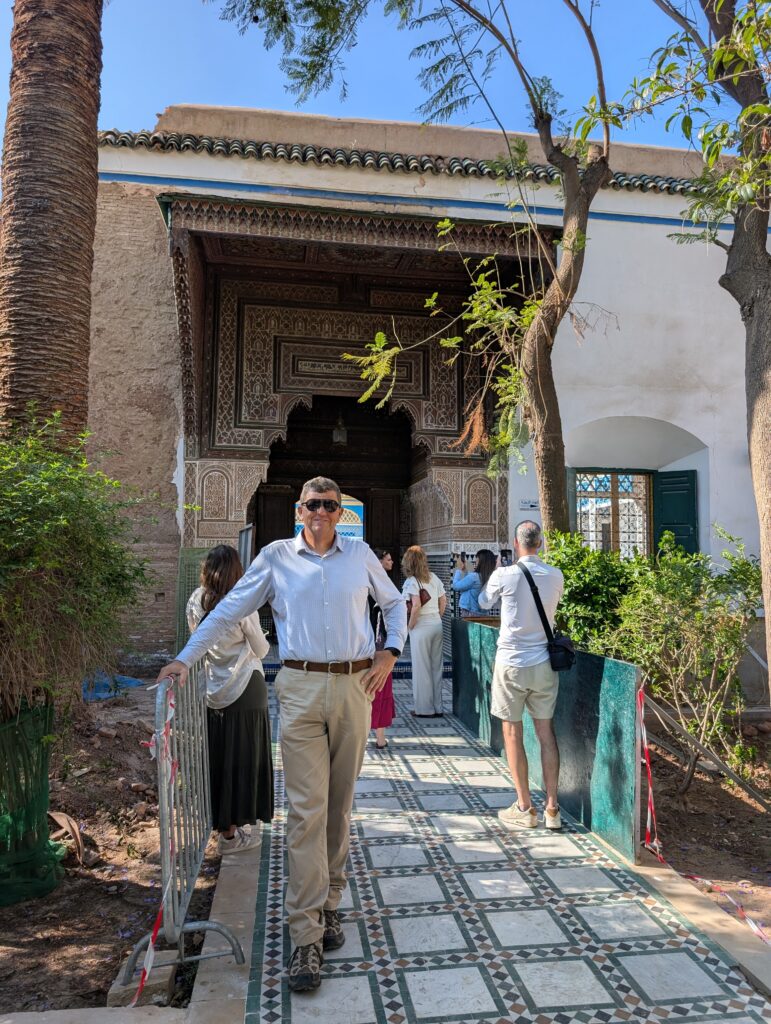
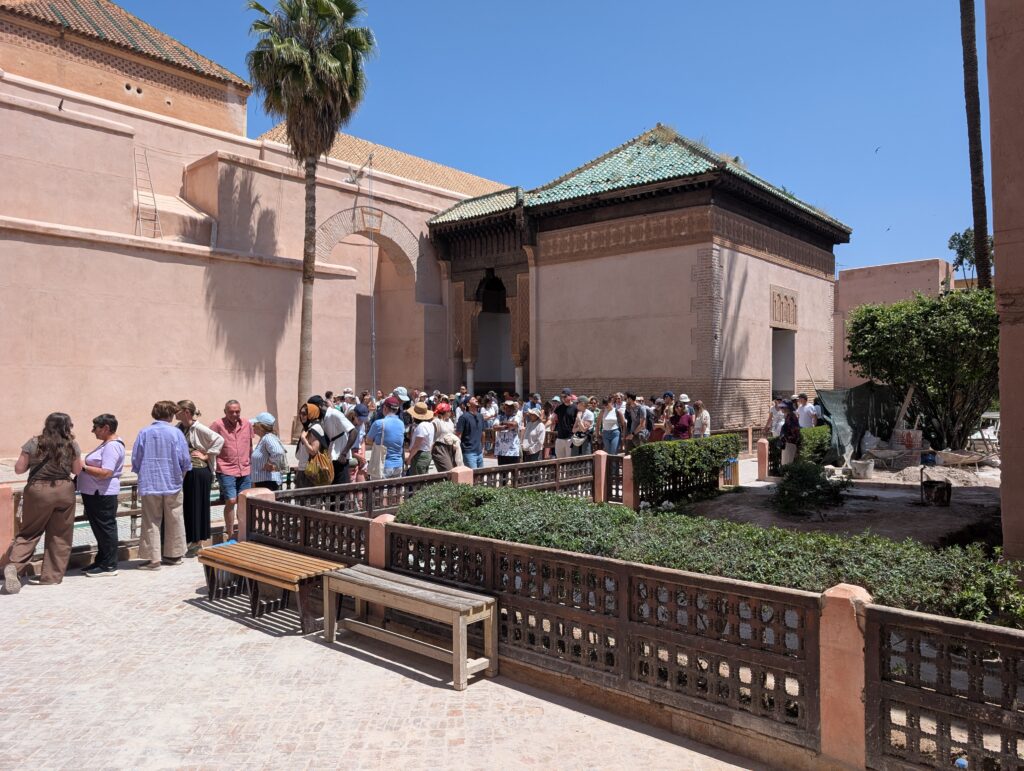
The markers themselves are decorated with colorful tile and inscriptions. Those outside and in had these, and the low bump tended to be surrounded by a rectangular shaped tile covered flat area, about the size of the hole where a coffin would be lowered. There was a smaller structure in the garden with some markers in it, and a larger, more elaborate one for the royal tombs. Most of the pictures here are of the royal tombs, though I have included some of those outside and also of the other building for reference. In the photos, you will also see that the line to enter the royal tombs was quite long. If visiting on a busy, hot day, you may be stuck standing out in the sun for upwards of an hour.
Only two people at a time can stand at the entrance point where you can see the main royal tomb. No one regulates how long you stay, so the speed of the line is dependent upon the mood of the visitors in front of you. We made it to the front in about half an hour, though my companion that day was less than enthusiastic about spending that amount of time in the sun. For me, it was great – an arid, 80 degree day, out seeing the world. I was getting pretty hungry though.
Juita had some favorite meat stands. This was a bit peculiar, as she is otherwise largely vegetarian. We headed anyway to a part of the souq in the casbah where the meat vendors and restaurants operate. Souqs seem to often be divided into areas where all of the shops sell the same thing. The most famous meat shack had a “line” so thick we had to push our way through it just to get by to the next one. They were taking numbers. I grabbed one for insurance as we pushed by. I got 75. They were on 35. We decided to find a different spot. We were led to the roof of a rustic restaurant building where the host spoke only a few words of English. It was enough for us to understand the menu. Their menu only had about five items anyway. I decided to try the tangia, since there was a picture of it, and it looked good.
The tangia came in a portion for two, anyhow, so that was perfect. Tangia is usually lamb, though it can be ordered with beef. It is comprised primarily of meat stewed all night in a clay pot, sitting in ashes. The meat is very soft by then, and is served with other spices, oil and citrus flavoring. It is served without utensils in most restaurants (including the one we were in). Some places catering to tourists bring forks. We just watched the Moroccans, though, and determined that the bread served with it was the only utensil you got. It is kind of oily. The bread soaks up the oil and spices. You grab a chunk of stew meat with it, and eat them together. Tangia is a specialty of Marrakech. I wasn’t sure if I’d see it other places. Tagine is ubiquitous in Morocco, so when I had the chance to order tangia in that city, I did. Tangia costs a bit more than tagine, but the portions are big, and it’s quite filling.
(Continued)
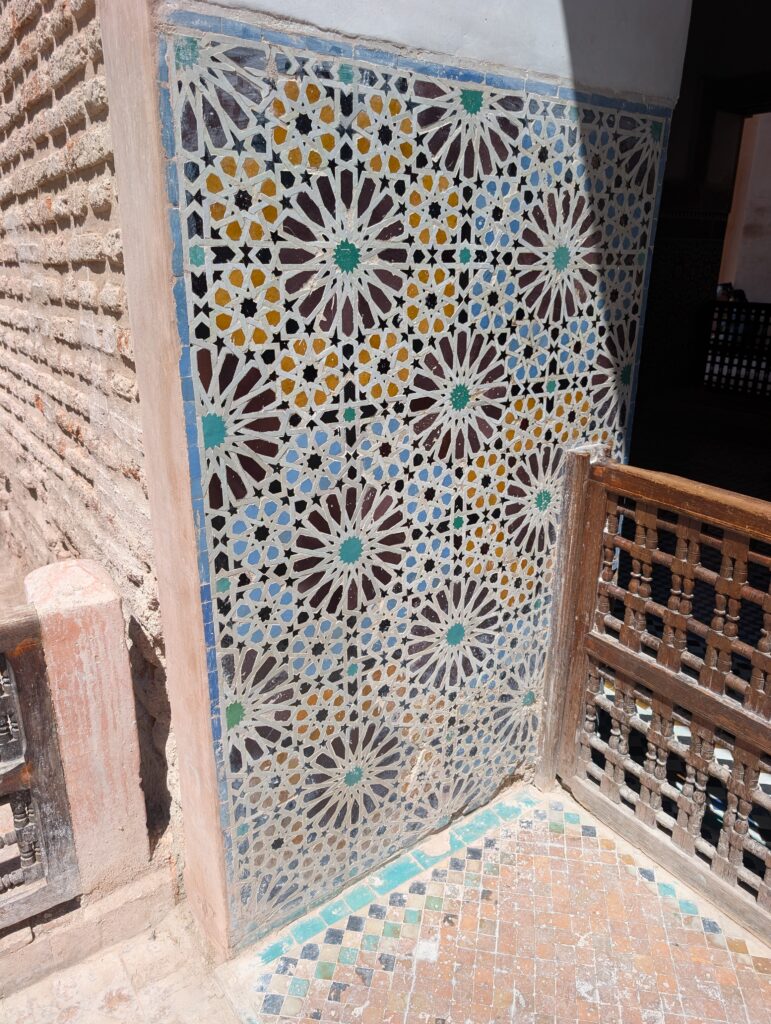
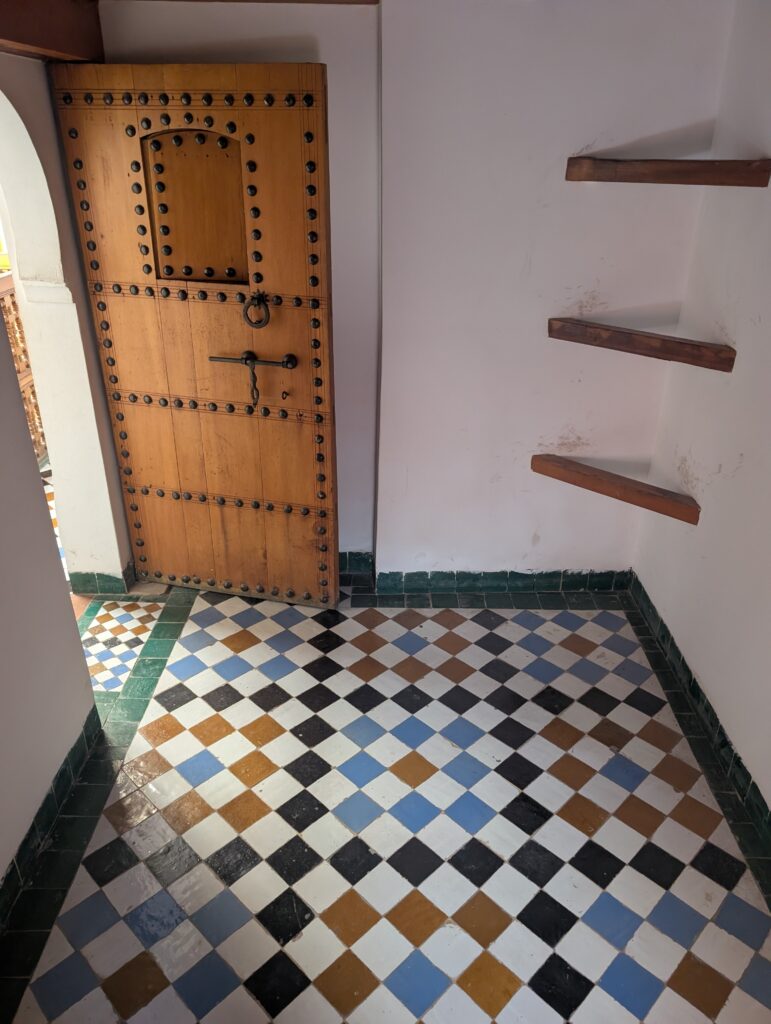
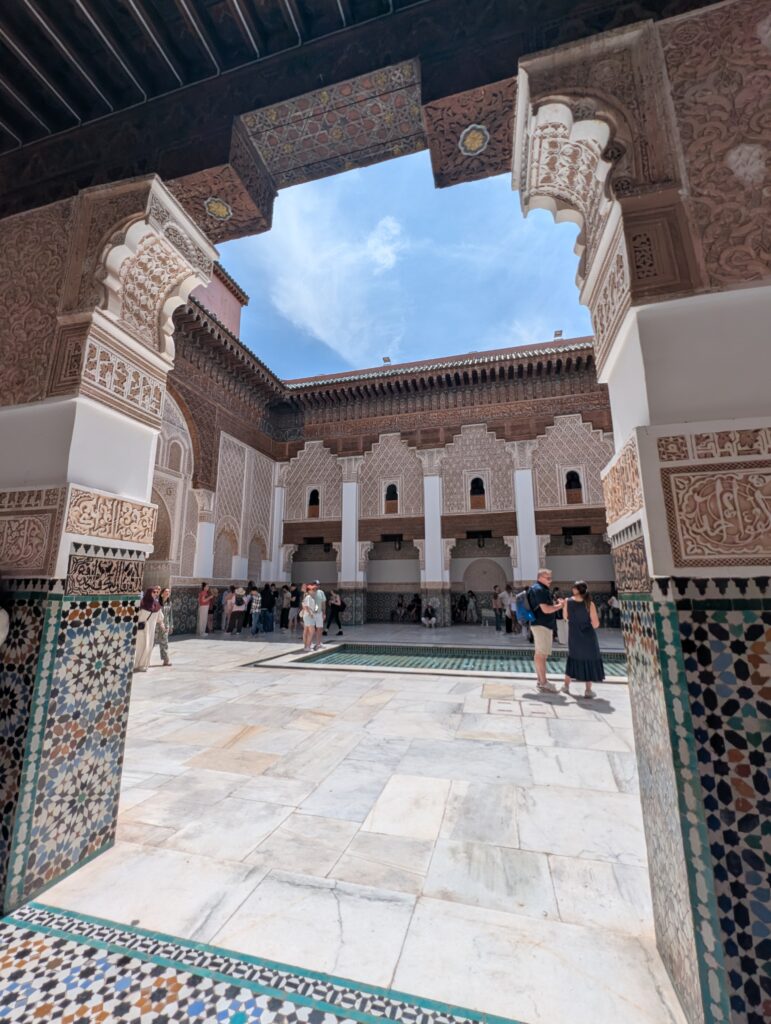
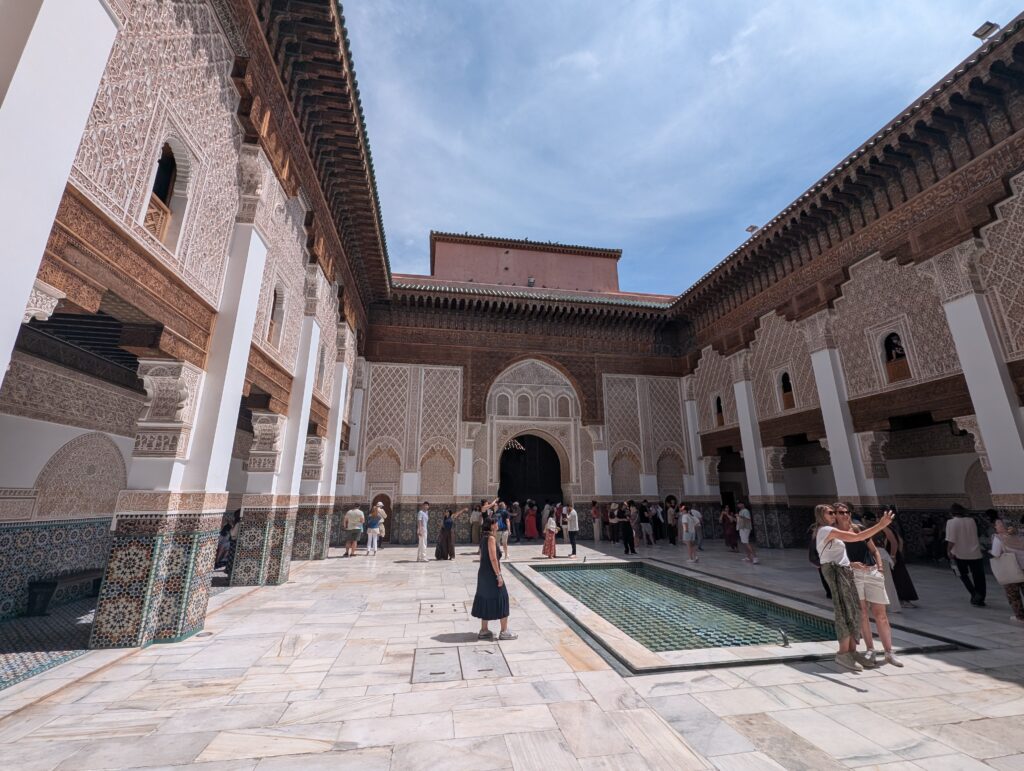
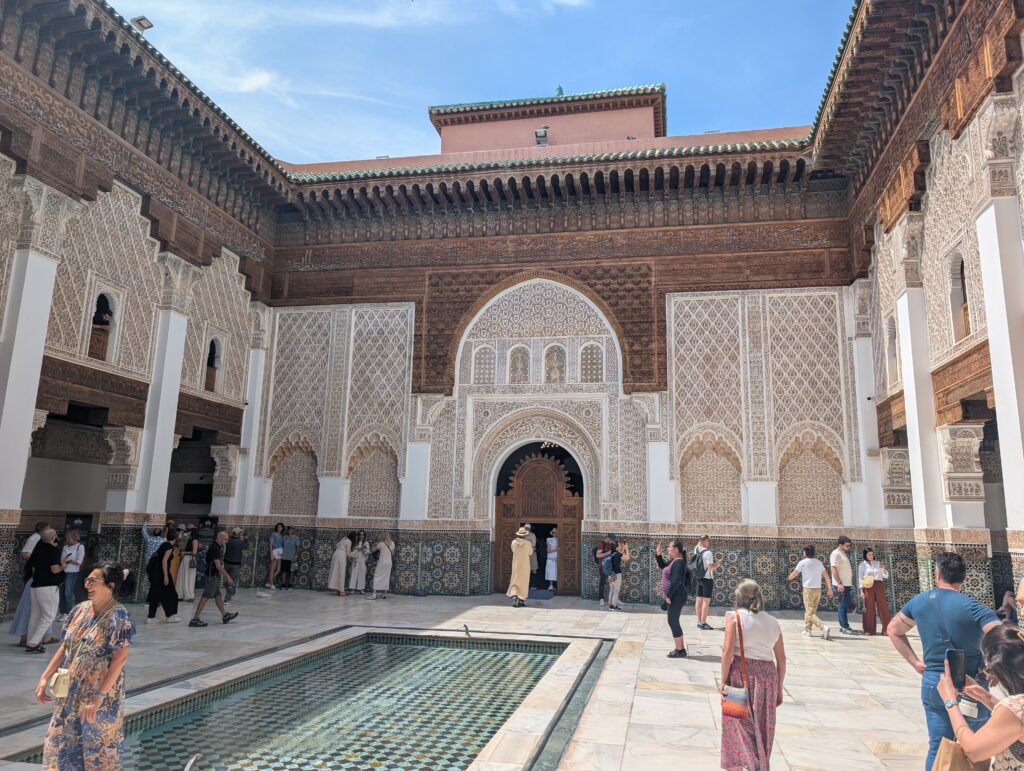
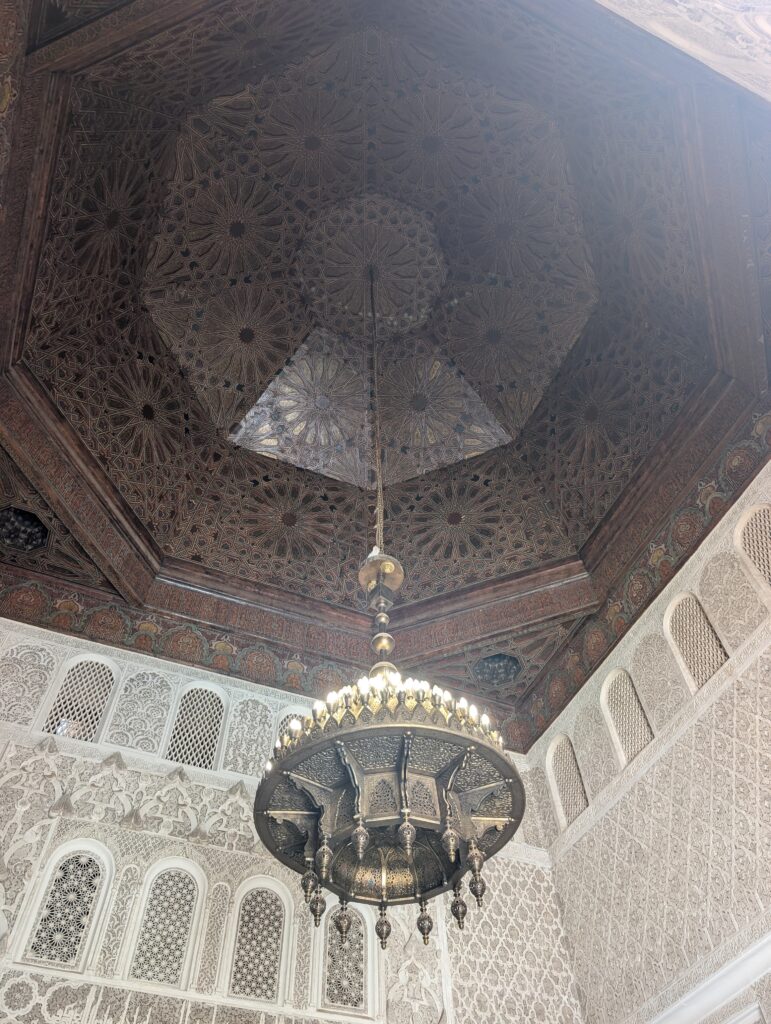
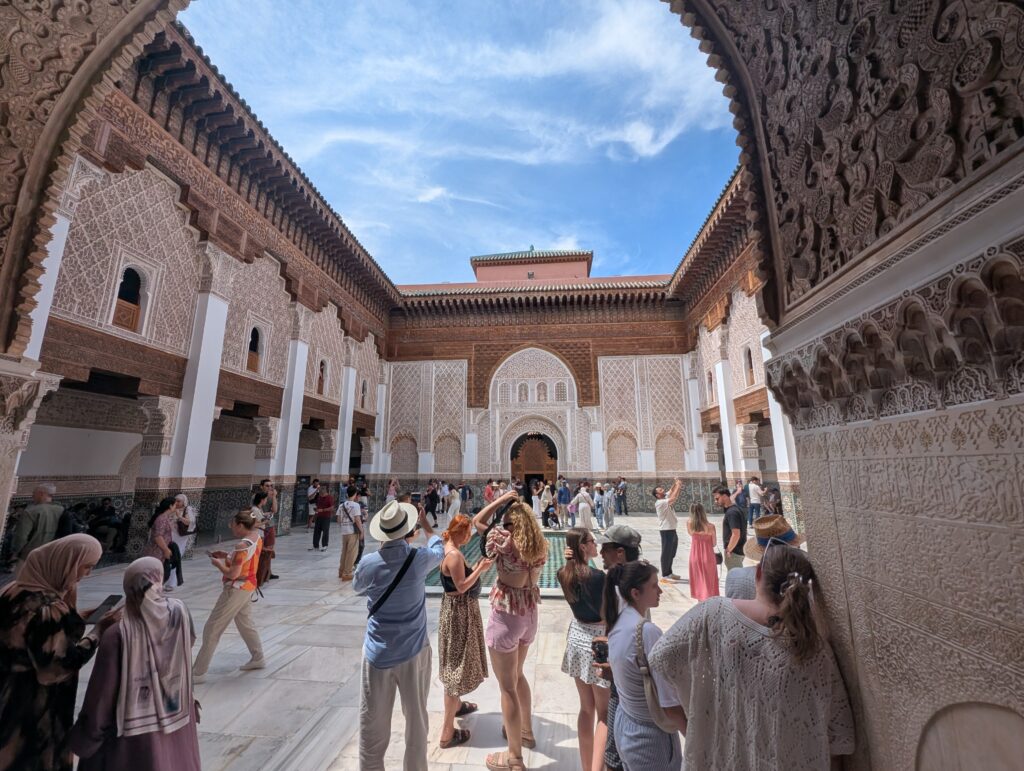
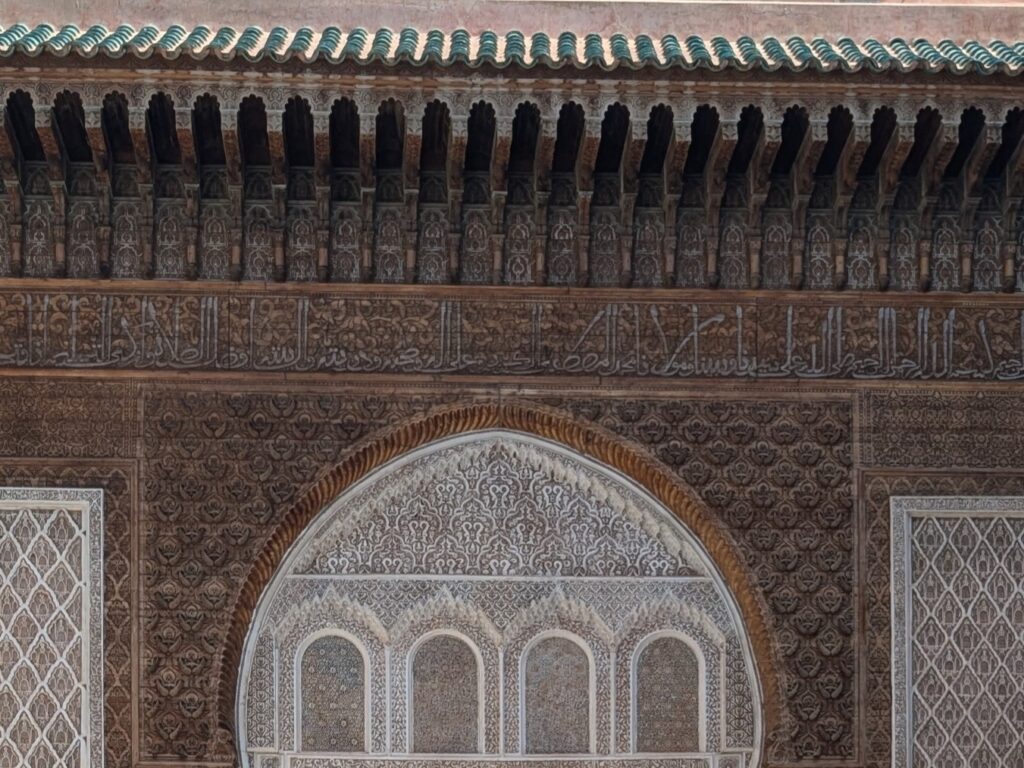
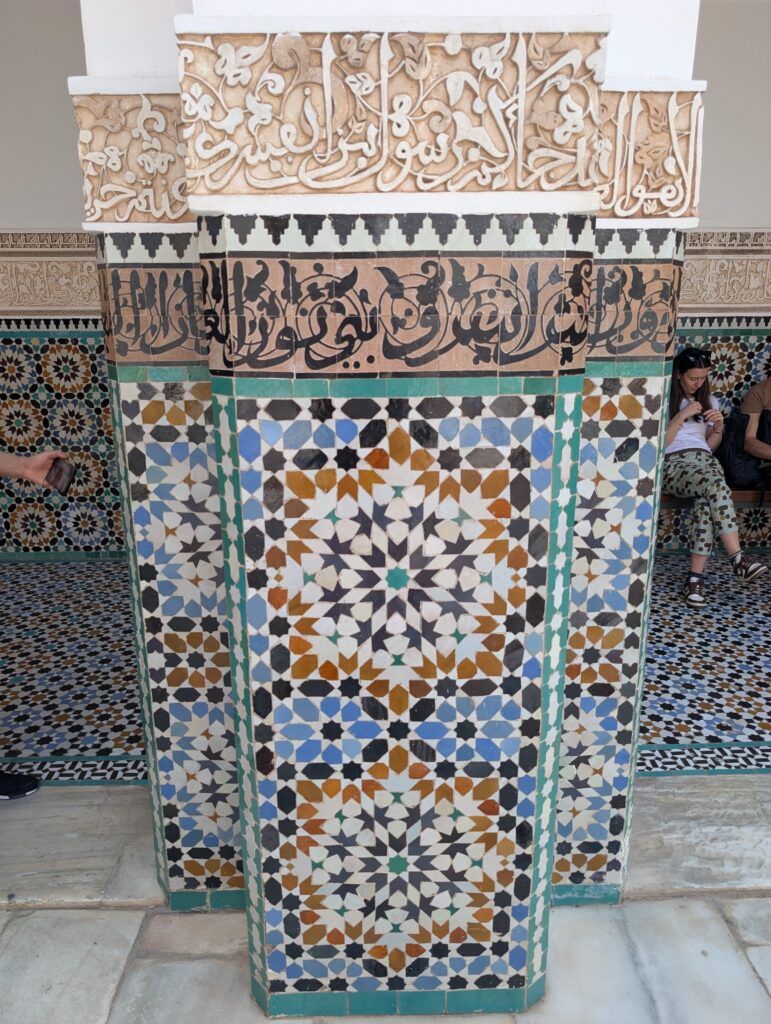
After lunch, Juita went off to her hammam, and I headed to the Ben Youssef Madrasa. A madrasa is an Islamic religious training school. They teach other subjects there as well, but that’s the primary purpose of a madrasa. This one was built during the 14th century, and remained in service on and off, when it was supported by current ruling dynasties. Once again, the highlight of the madrasa was the architectural design. There were many geometric designs. The existing structure seems to mostly have been constructed in periods after the 14th century, though I could be wrong about that. As you might expect, there is a mosque. There are many student rooms. The madrasa was built with the standard riad layout. There is a large inner courtyard decorated with a pool and amazingly detailed wood carvings, and the typical Moorish archways. The surrounding rooms on the bottom floor that were too large to be reserved for students were decorated with interior domes, as is common in Islamic architecture. One of the rooms had an ablution pool. One of the aspects of this building that particularly represents Moroccan design is the use of ceramic tile. The thick, geometrically arranged ceramic tiles are quite attractive and give older Moroccan buildings the character so many people come to the country to see.
I rested a bit in the room before heading to church. For more on the church situation in Morocco, check out this page on churches in North Africa. Once church was over, I headed immediately to look for something to eat. I was tempted to grab something outside the medina, since I expected the food stands geared toward tourists in the old city to be over priced, and under-flavored. I didn’t see anything that looked affordable, so I jumped back on the bus and headed to Jemaa el Fnaa.
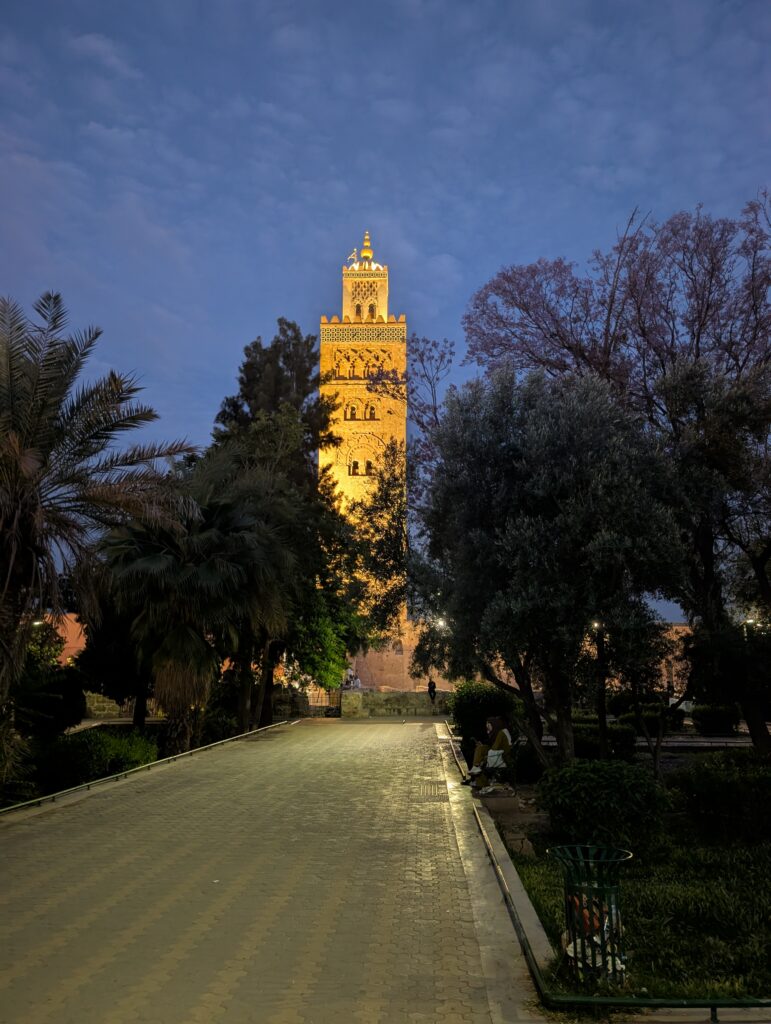
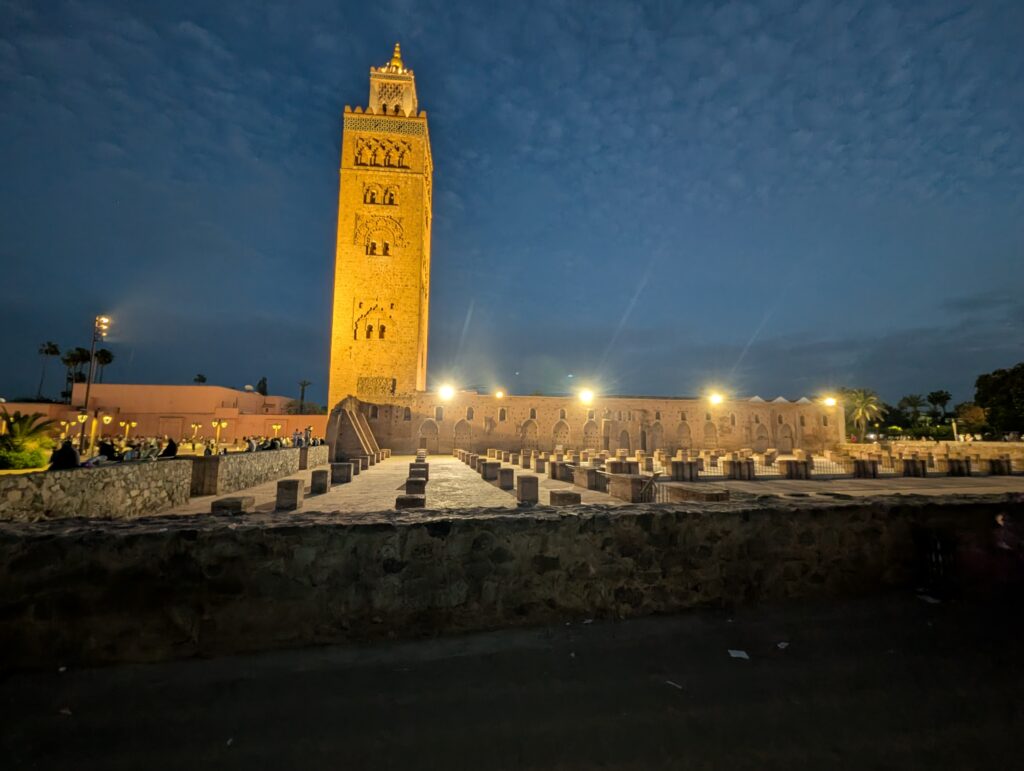
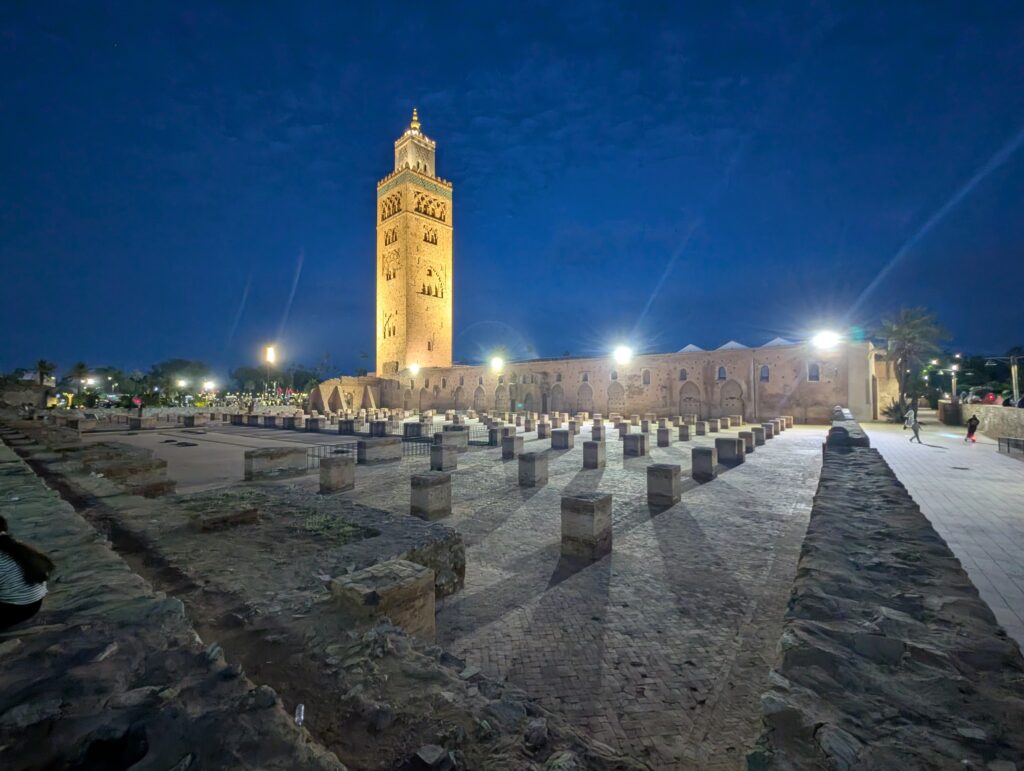
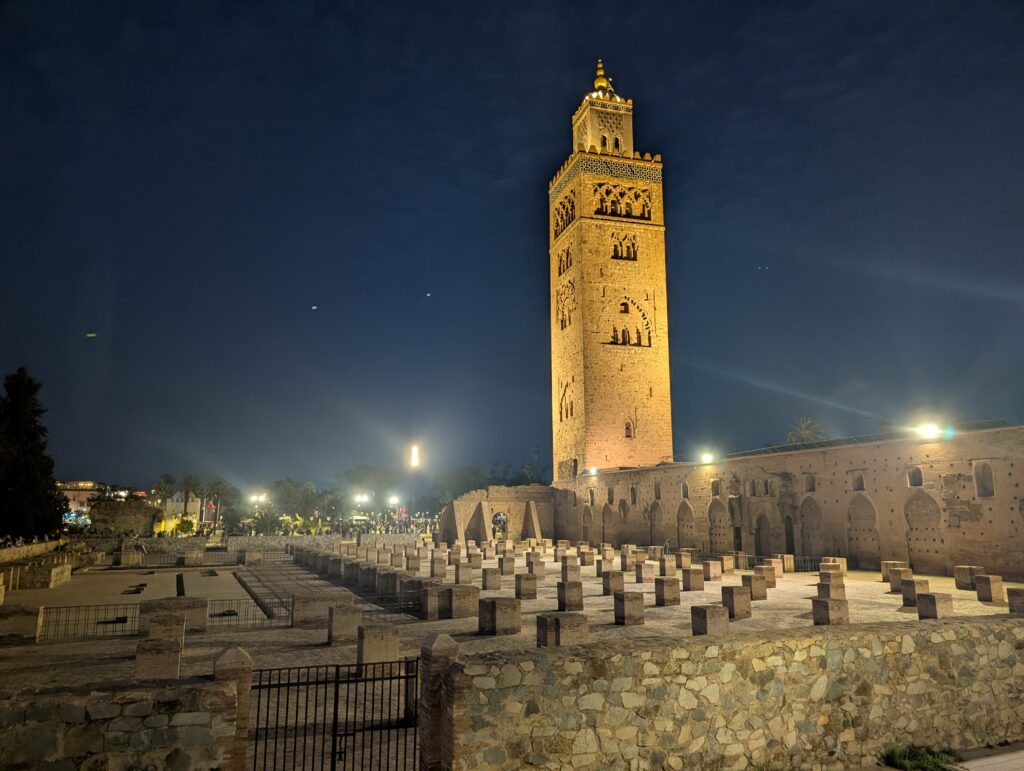
On the way back to the medina, I stopped to walk around the Koutaubia Mosque. It is located just outside the square. This mosque was originally constructed in the mid 12th century. Some of the original foundations are visible in the area around the existing structure. Most historians believe the “new” mosque was built toward the end of the same century. The first mosque was destroyed under the pretense that it’s qibla (prayer orientation) was incorrect. There was in any case a squabble between the new and old dynasties. The rulers who took power toward the end of the century believed the first mosque’s original commissioners heretics, and were determined for one reason or another to destroy and rebuild what they had made.
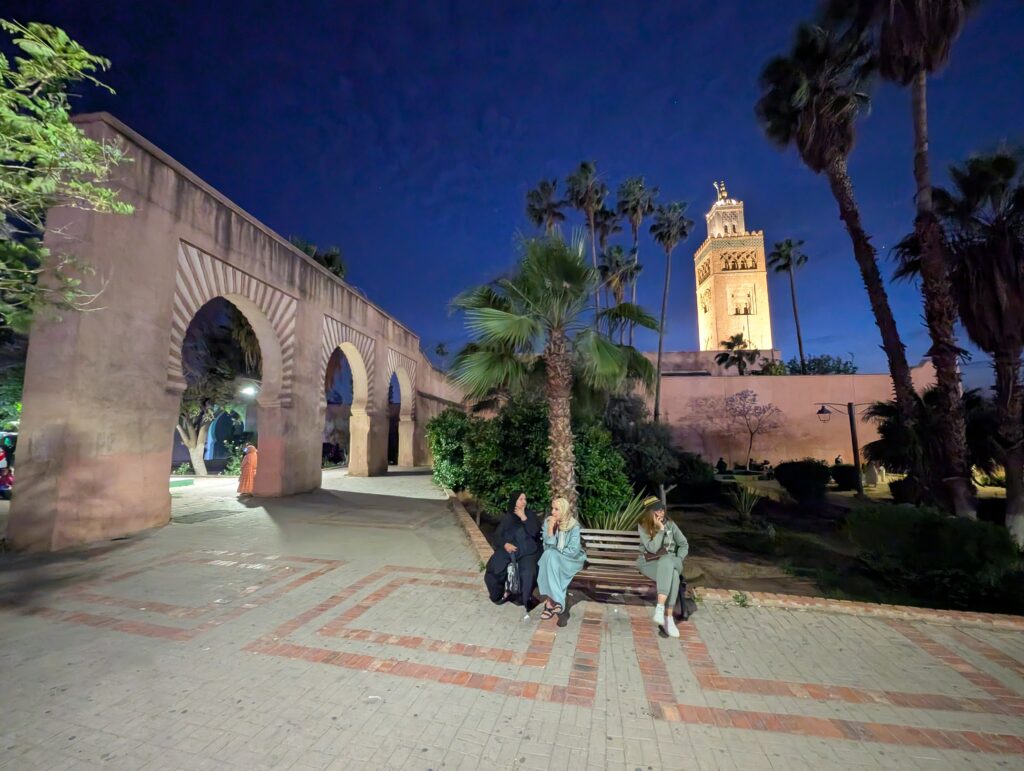
There is quite a bit of recorded evidence for the layout of the original building. The only question seems to be whether or not it had a minaret. The minaret is the most prominent and noteworthy component of the second mosque, and even this one is very old, and historically significant. Tasteful lighting makes the building really stand out at night, and the lower areas have been kept clear of trash and obstructions so the minaret can be seen clearly from just about any direction. It is iconic enough to appear on many postcards, magnets and other mementos meant to convey the spirit or sense of the city. The mosque is right next to the Jemaa el Fnaa entry, so I walked there next.
(Continued)
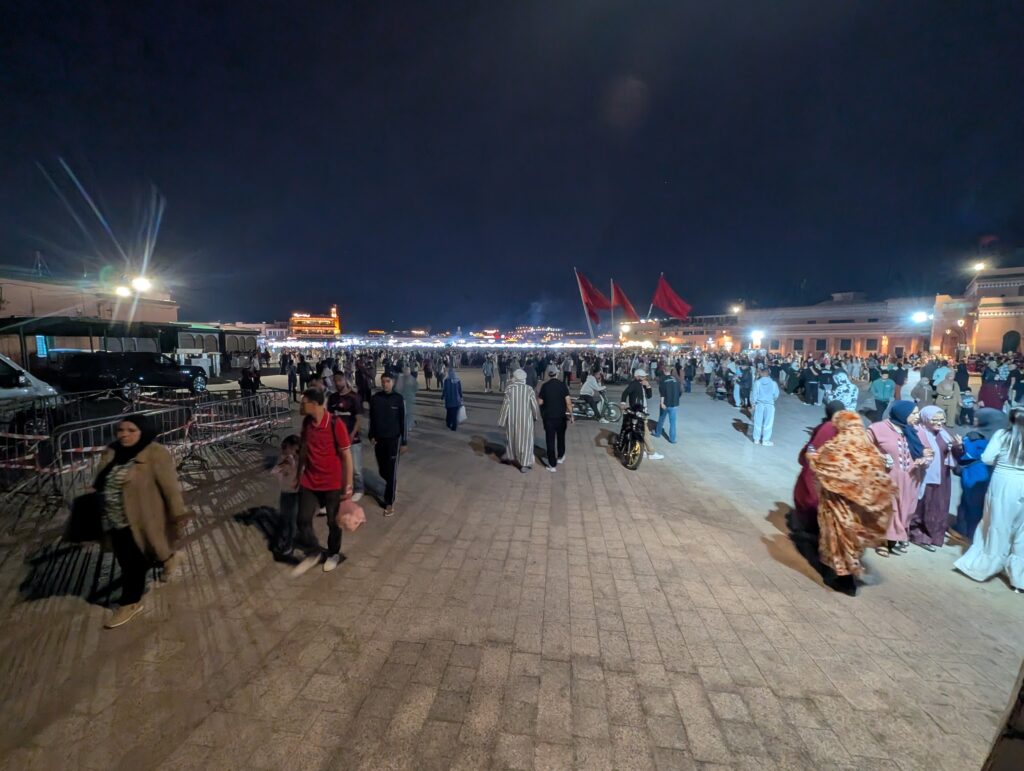
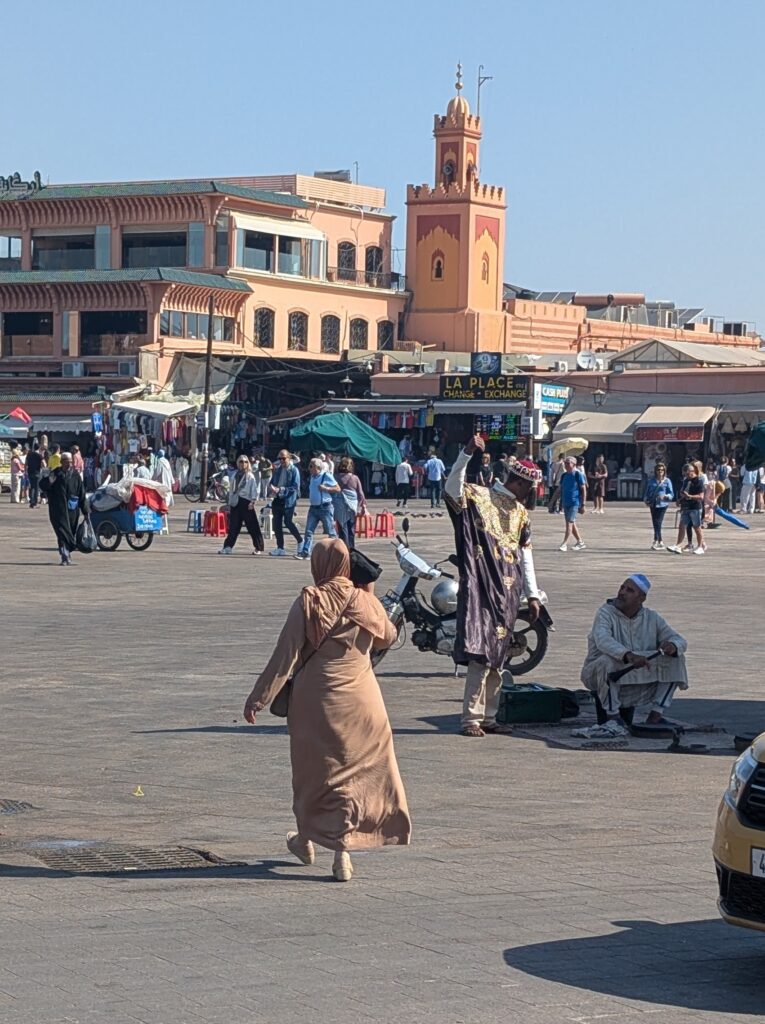
Jemaa el Fnaa is the main square of the Marrakech casbah. The giant, open area stands out clearly from the narrow winding alleys where foreigners are likely to quickly get lost among the souqs. Clearly, this was a medieval street pattern, but it seems to serve the same purpose as the labyrinthine design of Las Vegas casinos. Guests wander around looking for exits until they just give up, sit down, and start spending more money. Only you can’t sit down in the casbah unless you are at a restaurant stall, and some of those don’t even have seating.
Jemaa el Fnaa, on the other hand, is a wide open, stone-paved area where some vendors set up stands, but the majority of the space is reserved for performers of one type or another. There are dancers, musicians, people with glow in the dark flying toys, fortune tellers, and most famously snake charmers. I strolled through the area trying not to make direct eye contact with any of the performers, as that was a tacit offer to pay for whatever service or performance they were undertaking. The one group I didn’t see the first couple of times I passed through were the snake charmers. I finally passed some laying out their equipment – which included snakes – on the way to the bus the morning I left town for El Jadida.
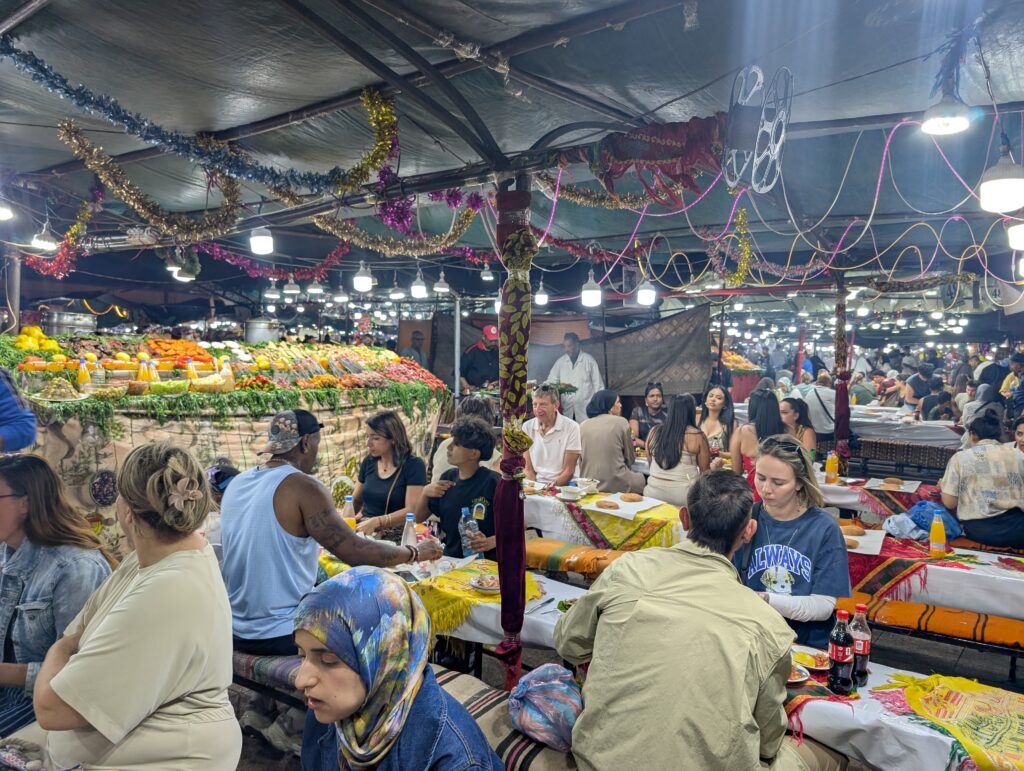
I had not set out to eat my supper at 9:00 p.m., but it worked out that way many of the evenings I spent in Morocco. This is not uncommon in the country. Most people seem to stay up late and get started late. I was still on U.S. time, so although I was tired from a short night and a long day, my body wasn’t shutting down just yet. I plopped down in a plastic chair in an open-air restaurant in the middle of the square at the behest of one of the many touts.
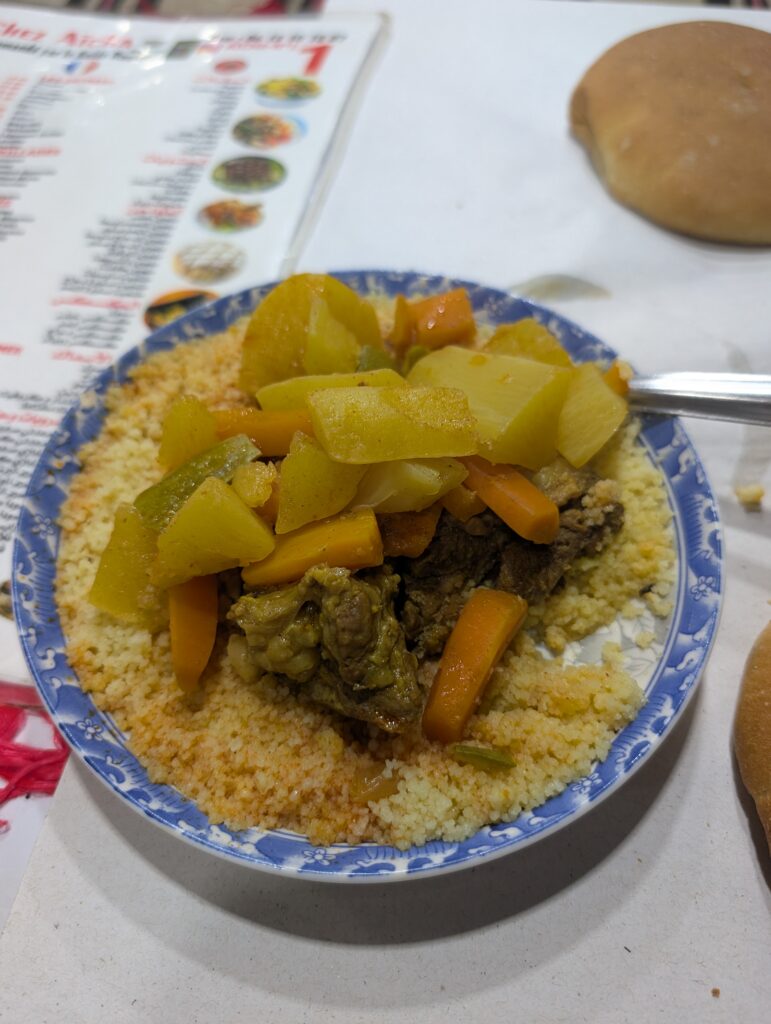
My beckoner worked hard to convince me that I needed a few meat skewers to go with my couscous, but I had a solid idea of how much I intended to eat. I ordered a meat-based couscous and a large water. My couscous was good, and it was all I needed to eat that late. Couscous is a dish based on small, marble-like pasta made from durum wheat. The pasta is filling, and when combined with some vegetables and especially a bit of meat, you don’t really need much unless you have worked up a monstrous appetite.
I suppose I should have worked up a large appetite, as I walked well over 10 miles to see all of those things. It had been a good day, and I had seen all of the major historic points in and around the casbah of Marrakech. I skipped over a couple of gardens. I decided to bypass these due to their greater distance from my home base, and the fact that their entries were even more expensive than the palaces I visited in the morning.
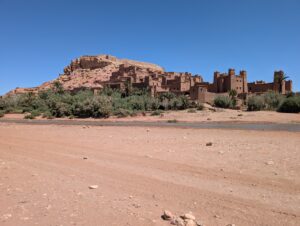
I headed back to the hostel with a full belly and a plan to hop on a day tour to see Ait Ben Haddou and the nearby movie studios the following day. Check out that write-up here.