Sarajevo
WWI, Olympics, and a Modern Siege
Afternoon of July 30 to Morning of August 3
My bus from Jajce arrived in Sarajevo during mid afternoon. I was pretty tired from non-stop power touring the last few weeks. I was happy to just go to the hostel and check in, then sit and write for a while, do farm stuff, and talk to the other hostel dwellers. I did head out to eat supper during the evening. I also visited one major tourist site.
I suppose there are three main tidbits of knowledge Americans might remember about Sarajevo. We were all taught at some point that the First World War kicked off when Gavrilo Princip, one of a handful of young men acting on behalf of the Serbian terrorist group Black Hand murdered the heir to the Austro-Hungarian crown in Sarajevo on June 28th, 1914. Those of us born before the mid ‘70s might remember that the same year the summer Olympics were held in Los Angeles (1984), the winter games were held in Sarajevo. On a more somber note, again those aware of world events in the 1990s will probably remember something about a war that happened there in that era.
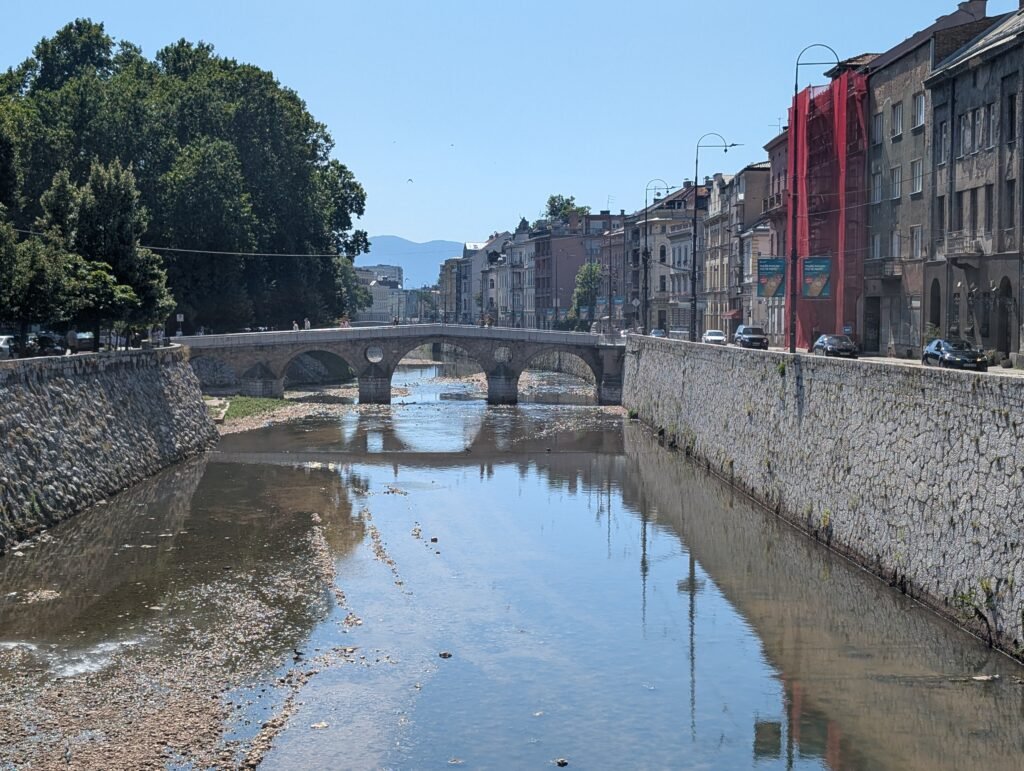
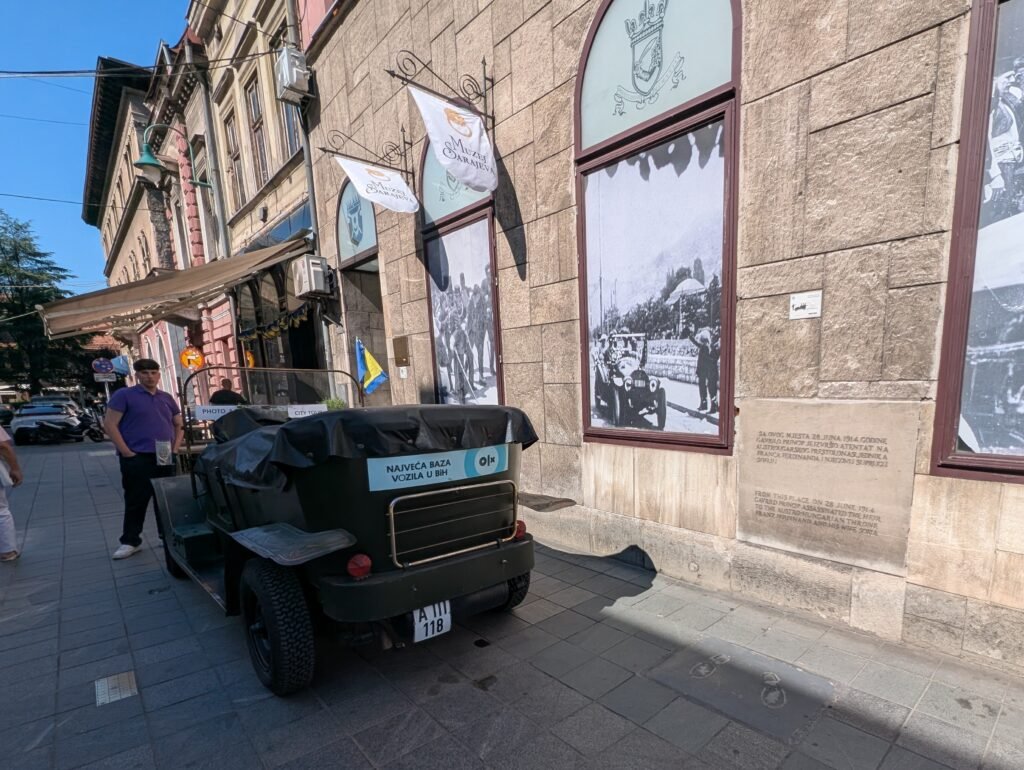
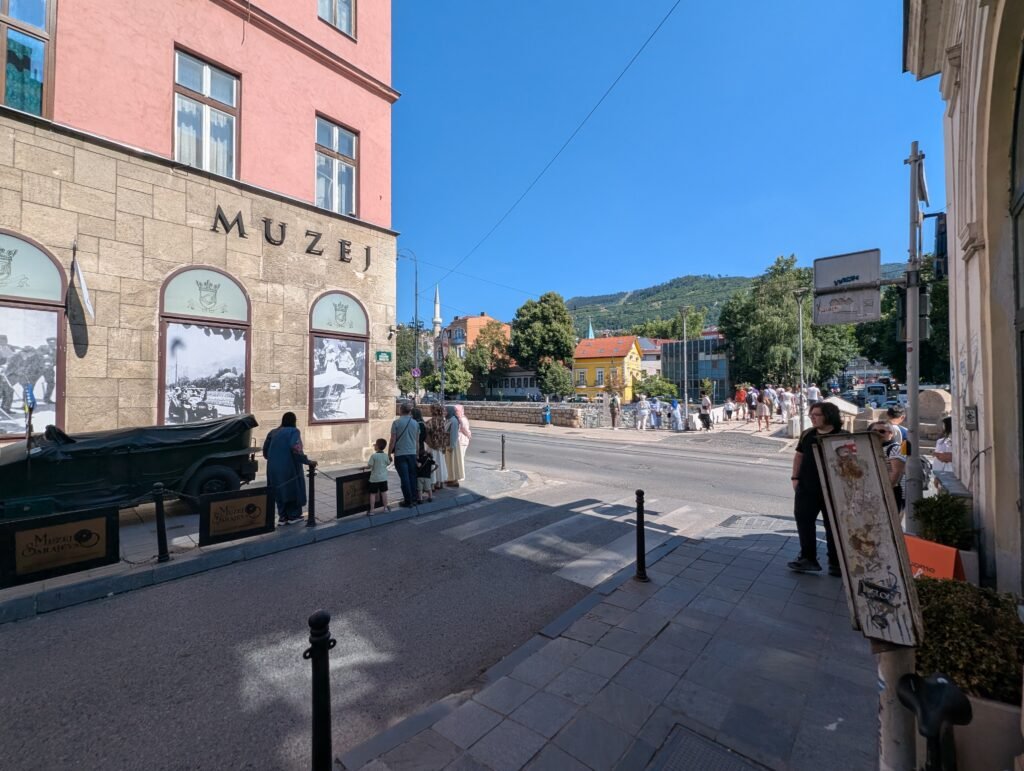
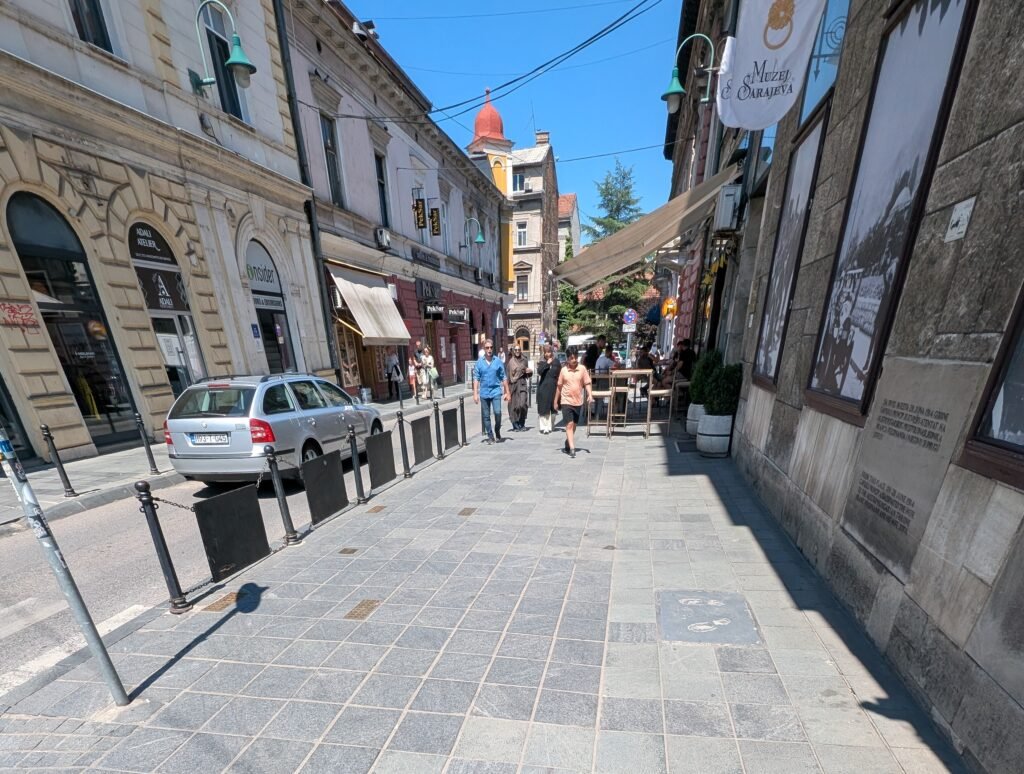
When walking from the tram stop to my to my hostel, I noticed that I was staying just a couple hundred yards from the site where Archduke Franz Ferdinand, his wife Sophie, and their unborn child were assassinated in 1914. After getting settled, I made my way back down there. The assassination point is where the Latin Bridge crosses the Miljacka River. The Archduke’s family had attended a wedding. They planned to visit city hall and attend a luncheon the same day. There were actually a few different assassination attempts that day. The Archduke decided to cut his meeting short and skip the luncheon as a safety measure. The driver was a bit confused by this, and made a wrong turn up a street next to the Latin Bridge. Princip was nearby in a coffee shop. Having lost his nerve on a previous opportunity, he decided this was his chance to set things straight. He saw the car stopped in the driver’s moment of confusion, emerged from the cafe, pulled out his Belgian pistol, and fired the fatal shots into the royal couple. He then turned the pistol on himself in a suicide attempt. This time, the pistol misfired. Princip was captured, tried, and convicted. His sentence was prison, not death, as he was a minor.
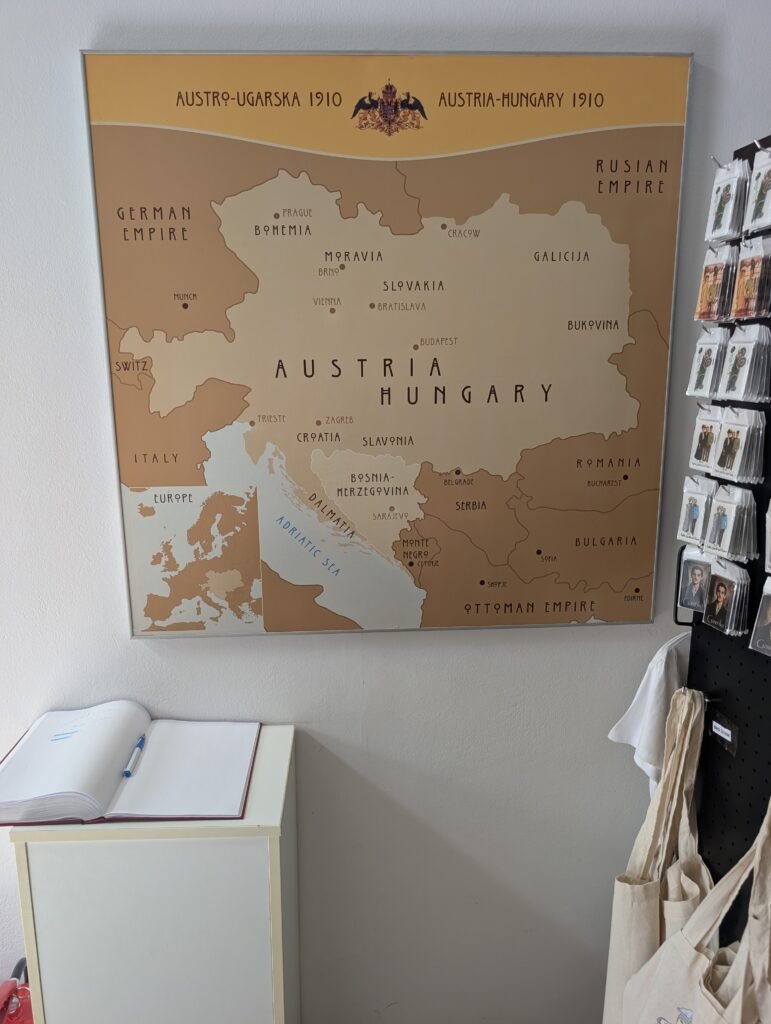
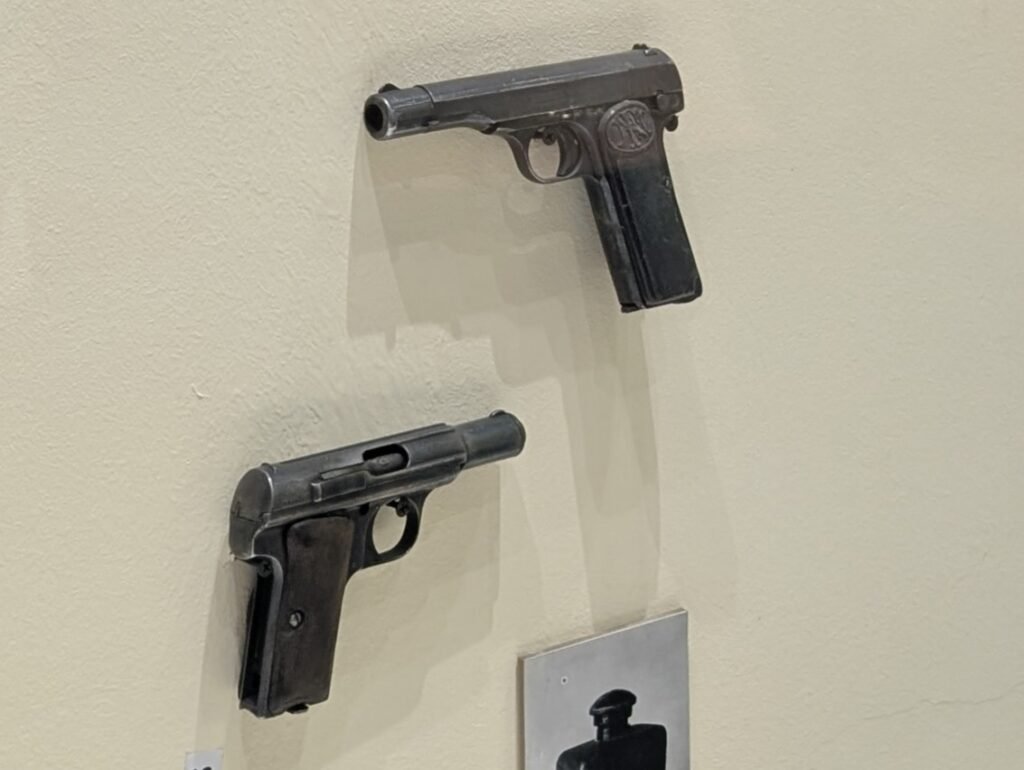
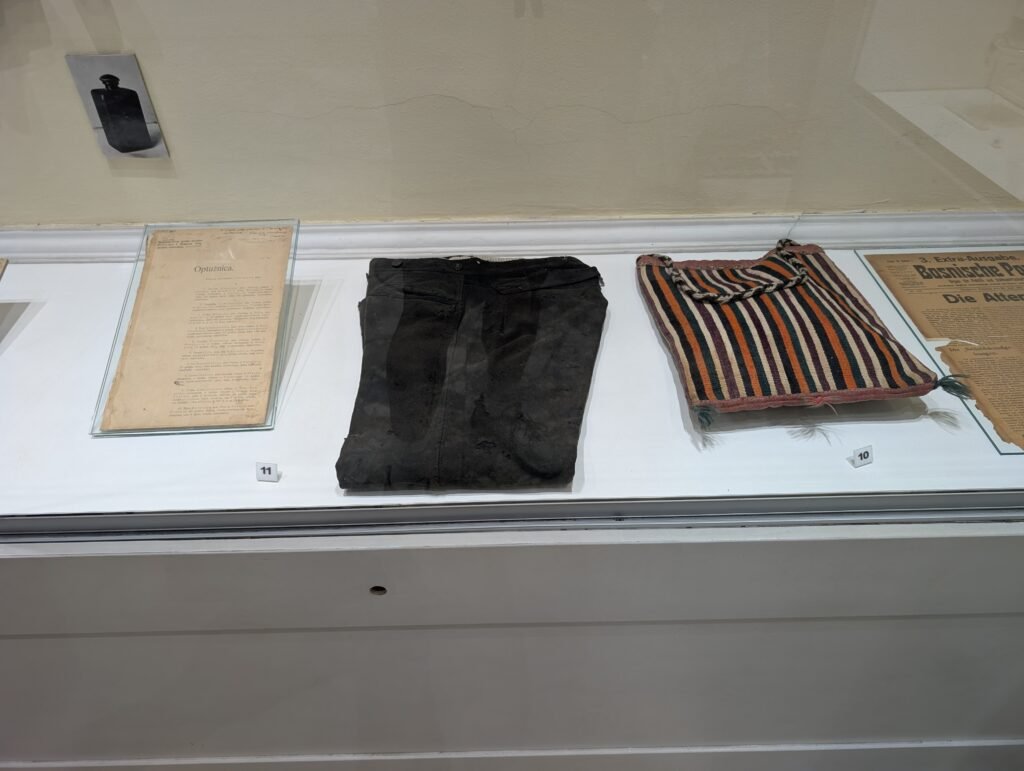
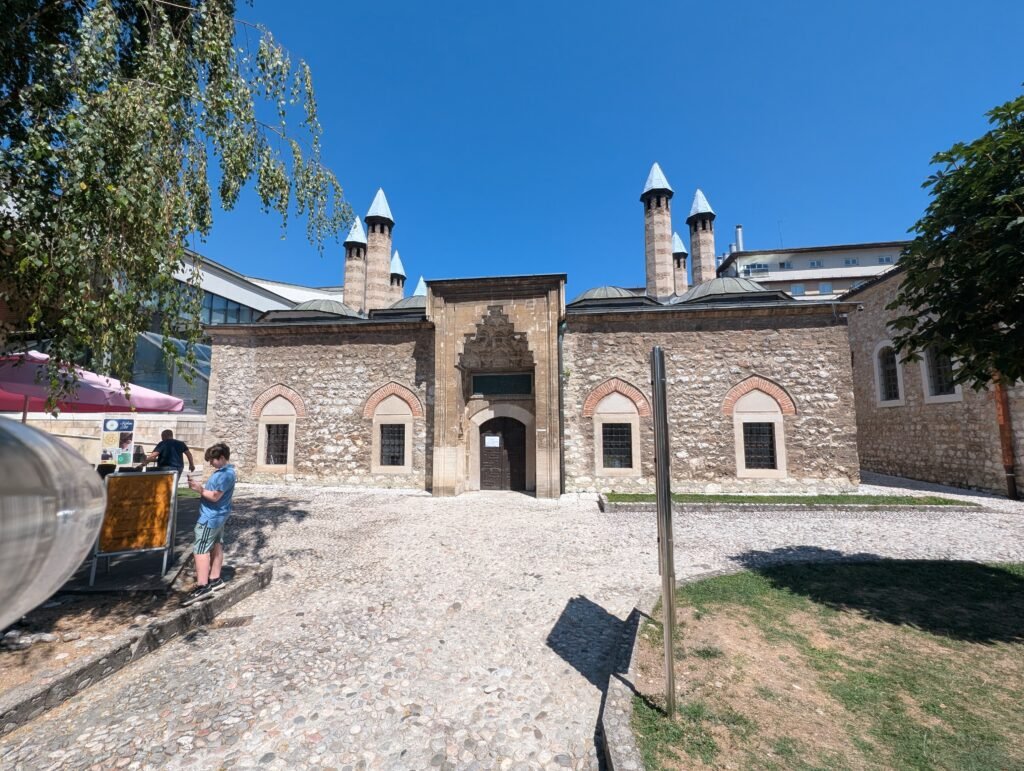
There is very little in the museum next to the assassination site. Most of what is there is convoluted enough to imply that Princip was acting as a sort of liberator of Bosnia, when he was, in fact, a Serb. Serbia wanted to annex Sarajevo, not liberate it from Austria. There is a pistol of the type that was used in the assassination, though I believe the actual weapon used is in Vienna. Same goes for the car. There is a replica car parked outside, but the car Franz Ferdinand was riding in is on display in Vienna, not Sarajevo.
I thought the stop and the Sarajevo Museum 1878-1918 were worth visiting, though I would recommend doing your own research on the history of Sarajevo, Serbia, Black Hand and the First World War before arriving, as you won’t get a clear picture from the museum’s presentation. On the whole, there is a lot more evidence and presentation in Sarajevo about the 1990s war than the outset of World War I.
The 31st was Friday. I had gotten into the kind of lazy habit of just taking city walking tours as the bulk of my sight seeing in towns I just had a couple of days in. As time wore on, and my energy level waned a bit, I relied on these even more. There were two complementary walking tours in Ljubljana that I was able to take on the same day. One dealt more with the city in general, while the second was a historical tour culminating in a hike up to the castle. I thought I would do something similar in Sarajevo. Both tours offered here were historical. The morning tour covered mostly the Ottoman and Austrian periods, with some explanation of what happened up through the world wars as well. The afternoon tour concentrated more on the Bosnian war and the genocide committed against them by the Serbs in the aftermath of the breakup of the former Yugoslavia. Unfortunately, these tours were not both available the same day. I ended up taking the Ottoman & Austrian tour on Friday, and the Yugoslav War tour on Saturday the 1st.
(Continued)
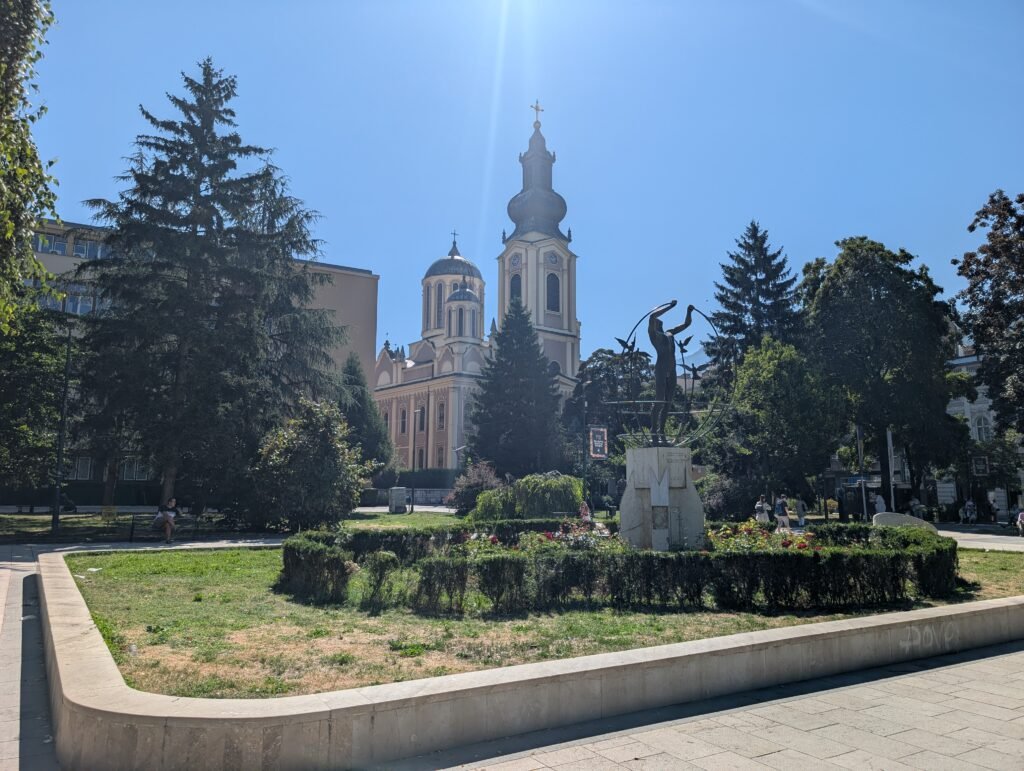
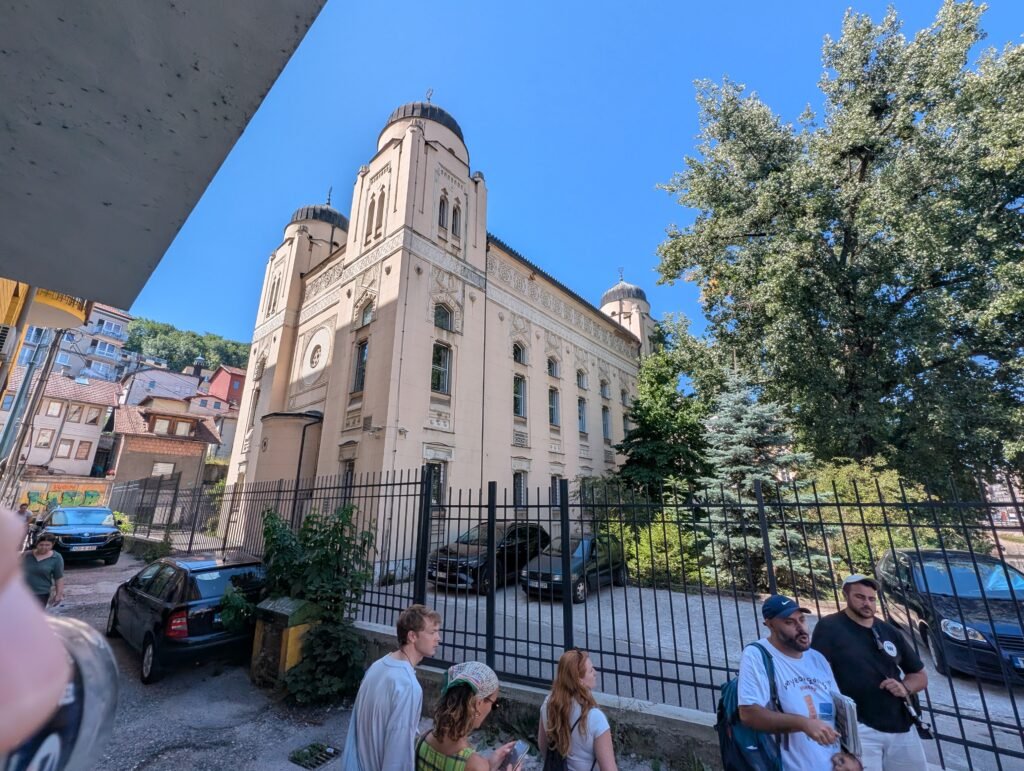
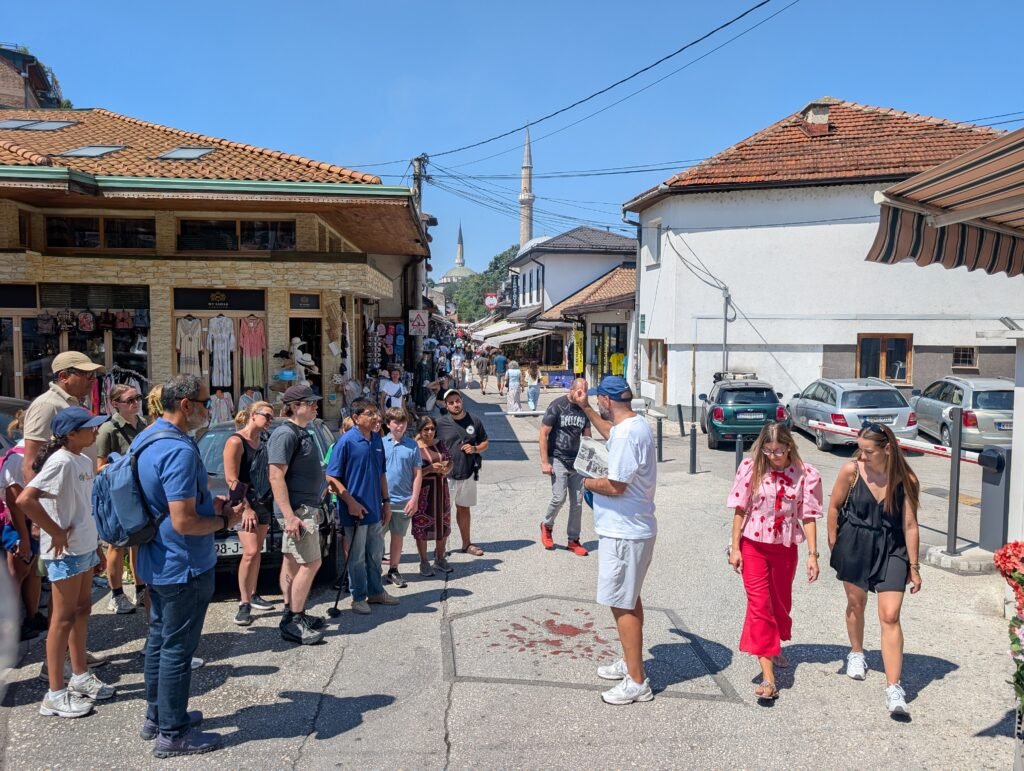
We began the original walking tour at Susan Sontag Square, in old town Sarajevo. We visited several interesting sites on this tour. We of course passed the site of the assassination of Franz Ferdinand. We saw a Serbian Orthodox Church, one of the more plain Orthodox buildings I have seen. We saw the Latin Bridge, of course. We passed a synagogue. We also stopped at the Hotel Europe. This five star hotel was built during the brief Austro-Hungarian dominion in Sarajevo. As the Austrians sought to bring their empire into the modern world, they encouraged the development of upscale facilities like this one. It was nationalized during communist rule, and re-privatized after the wars of the 1990s.
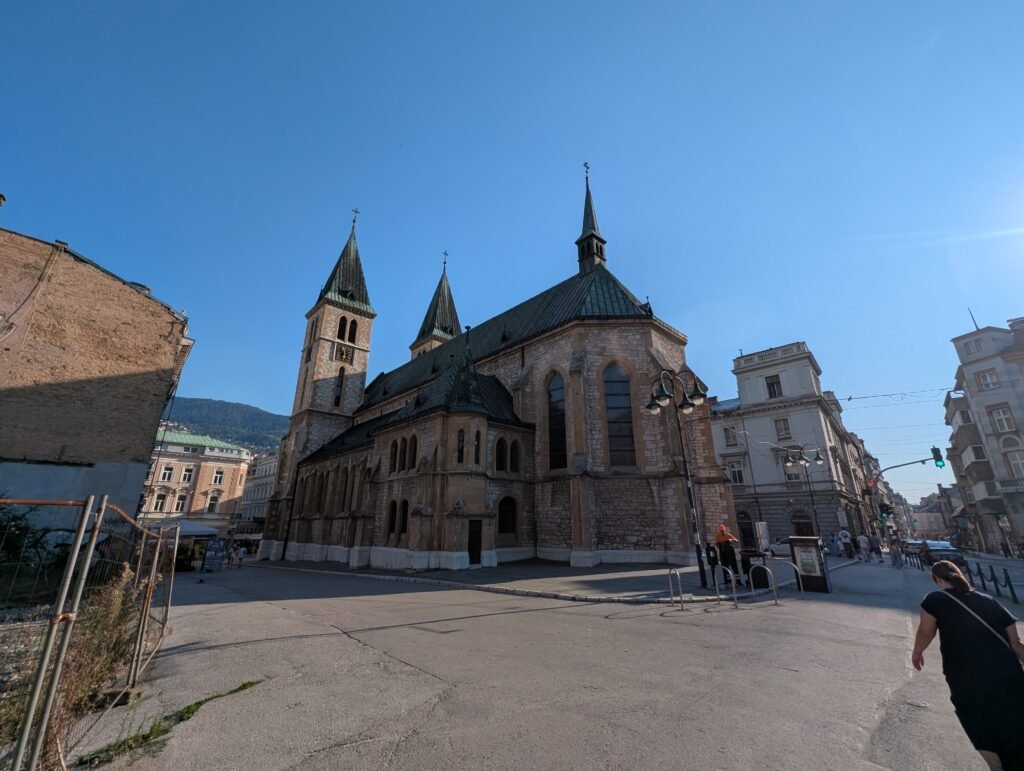
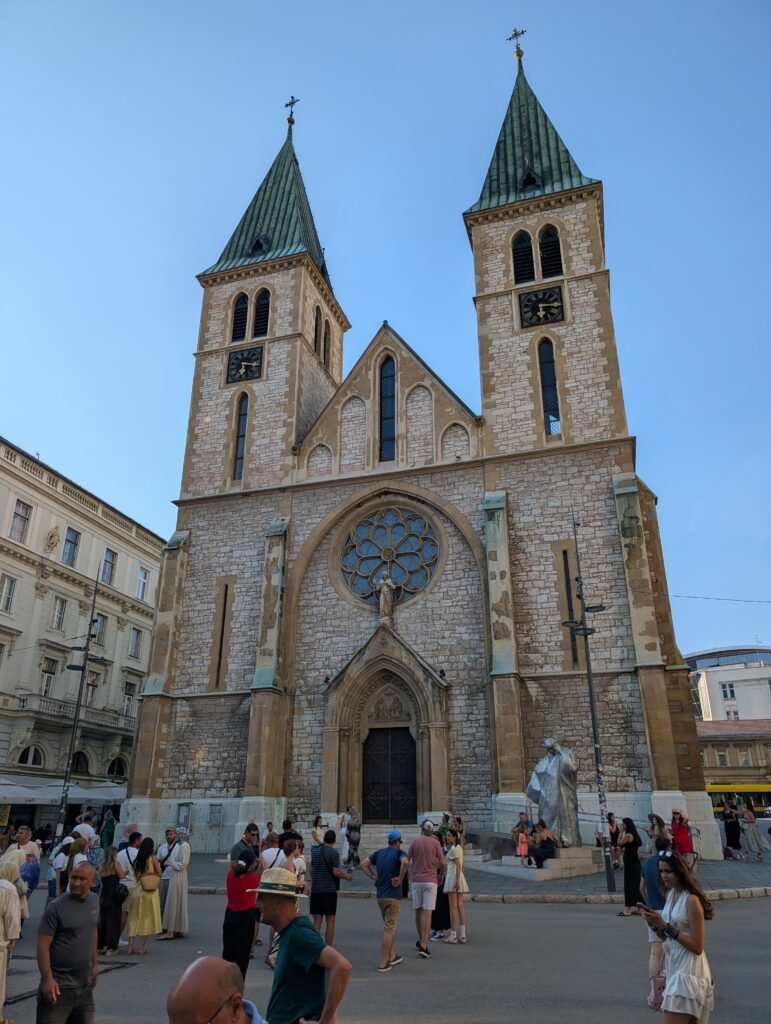
One of the most prominent buildings in old town Sarajevo is the Sacred Heart Cathedral. It, too, was built during the Austrian period. The Austrians were Catholic, so it stands to reason that more Catholic churches would be constructed once they had dominion. Prior to that, there were only a few Croatian Catholics in the area. Our tour brought us by this picturesque building, though you couldn’t have missed it. I noticed it the night before.
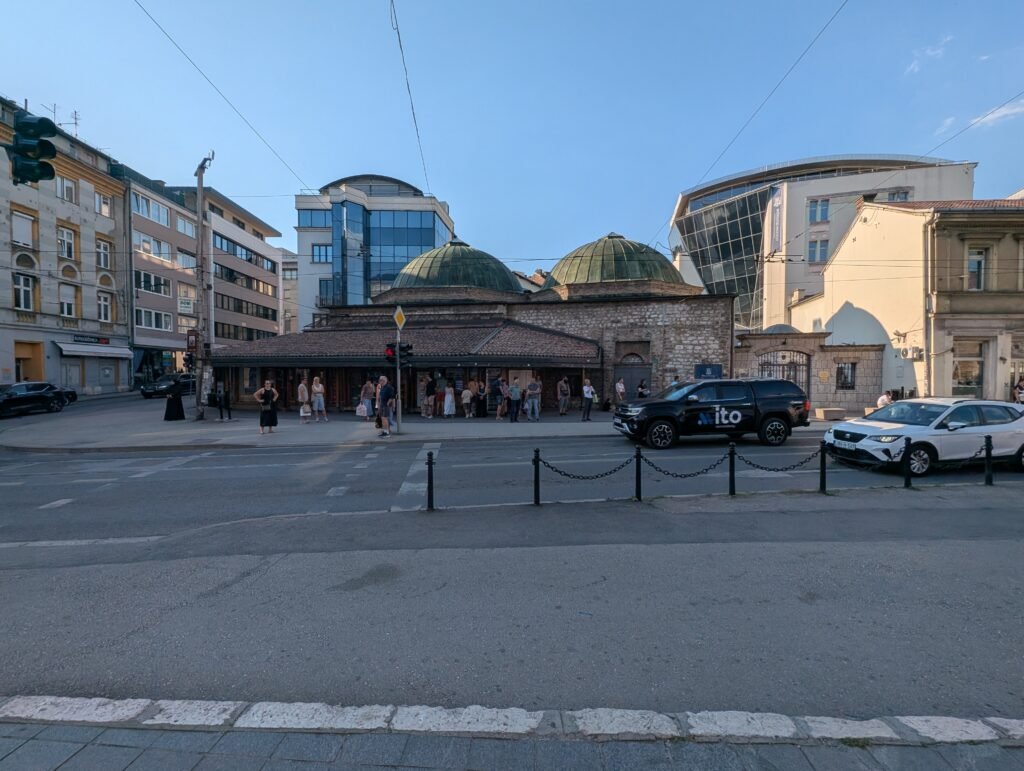
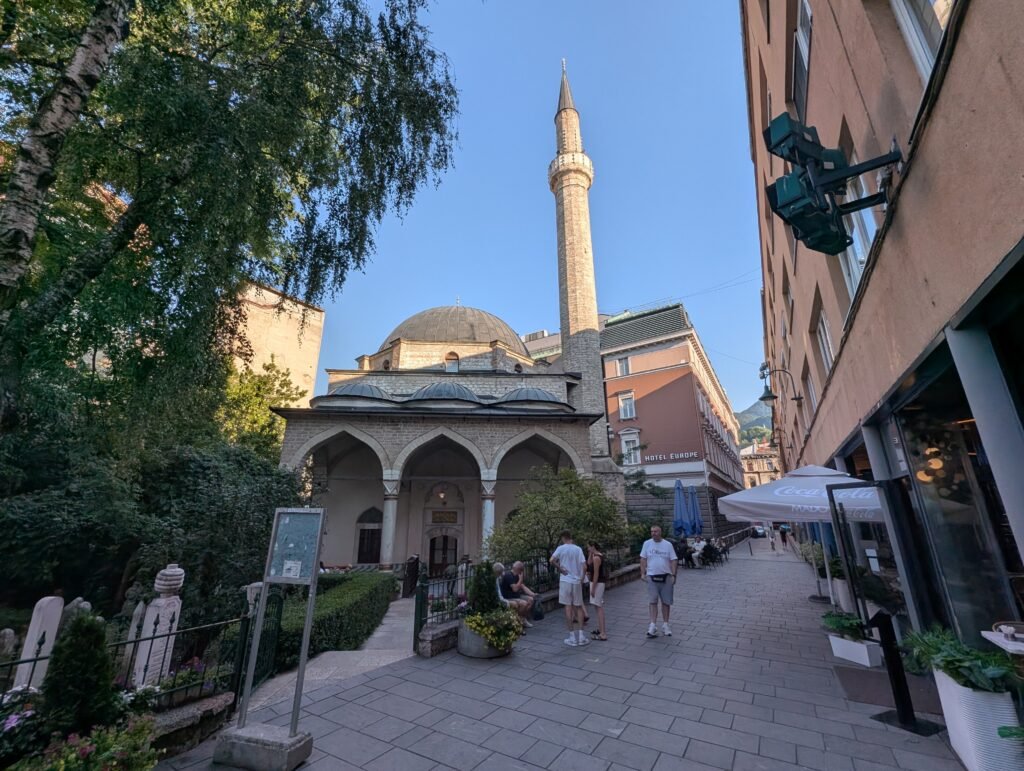
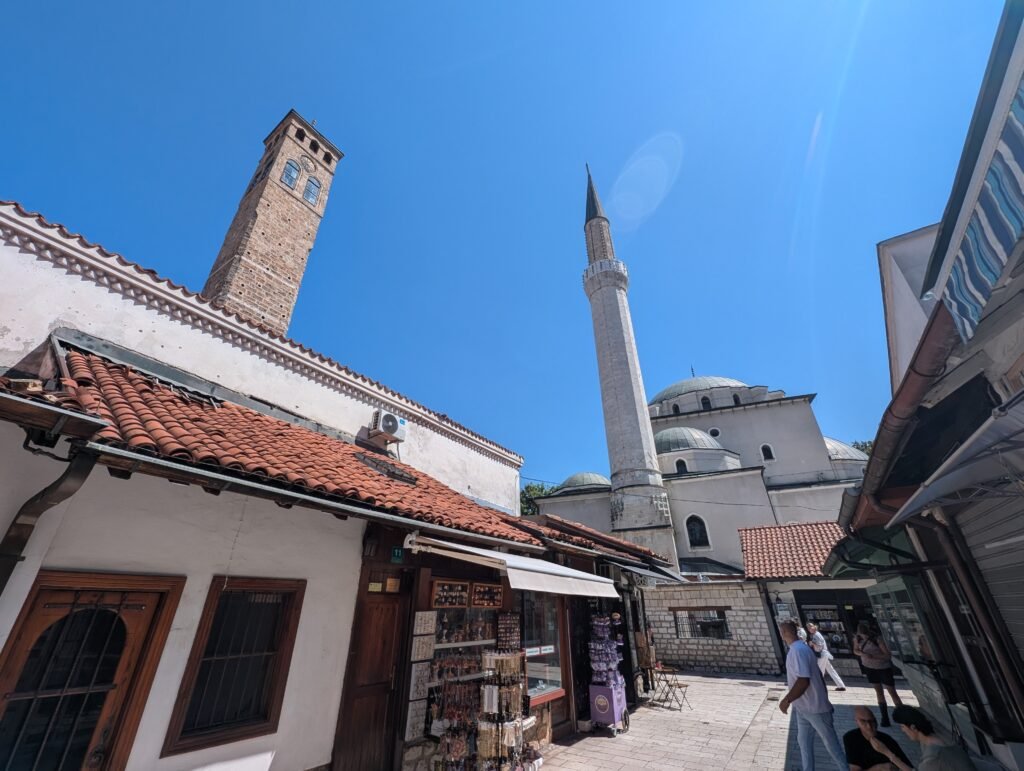
We walked by the exteriors of two mosques as well, though many others were within sight. We passed the Emperor’s Mosque, the oldest mosque in Sarajevo and one of the oldest in Bosnia, having been constructed in the late 1450s, not long after the Ottoman conquest of Bosnia. The Gazi Husrev-beg Mosque was home to an interesting clock tower. The clock at this mosque is set to strike twelve not at noon or midnight, but at sunset to mark the end of Muslim fasting.
One of the more interesting stops on the tour was Morica Han. This is the last surviving old style inn in Sarajevo. Built in 1551 during Ottoman rule, it was effectively a caravanserai. In many ways like the ones I had seen on the silk road routes, this inn was a place for traveling traders. Their livestock could be housed below, or even traded off for fresher or healthier animals. The upper floor rooms were reserved for the people themselves. Traveling traders could stay here for a few days and turn the area into a de facto market as they took advantage of another opportunity to profit from the goods they had brought from far away lands.
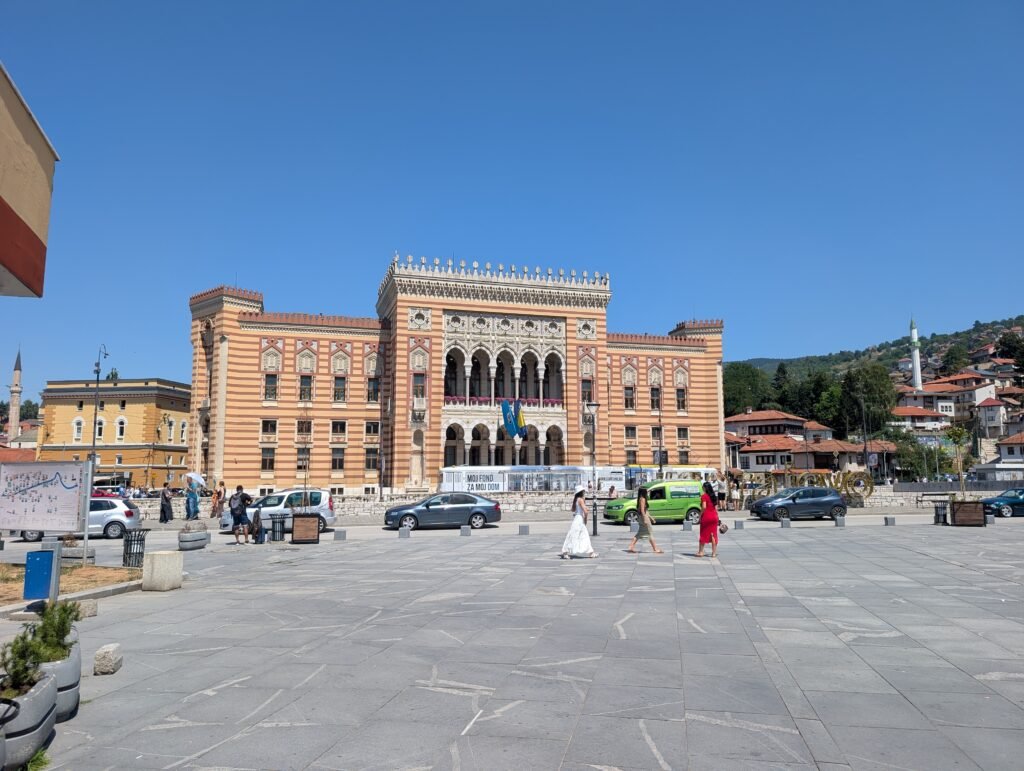
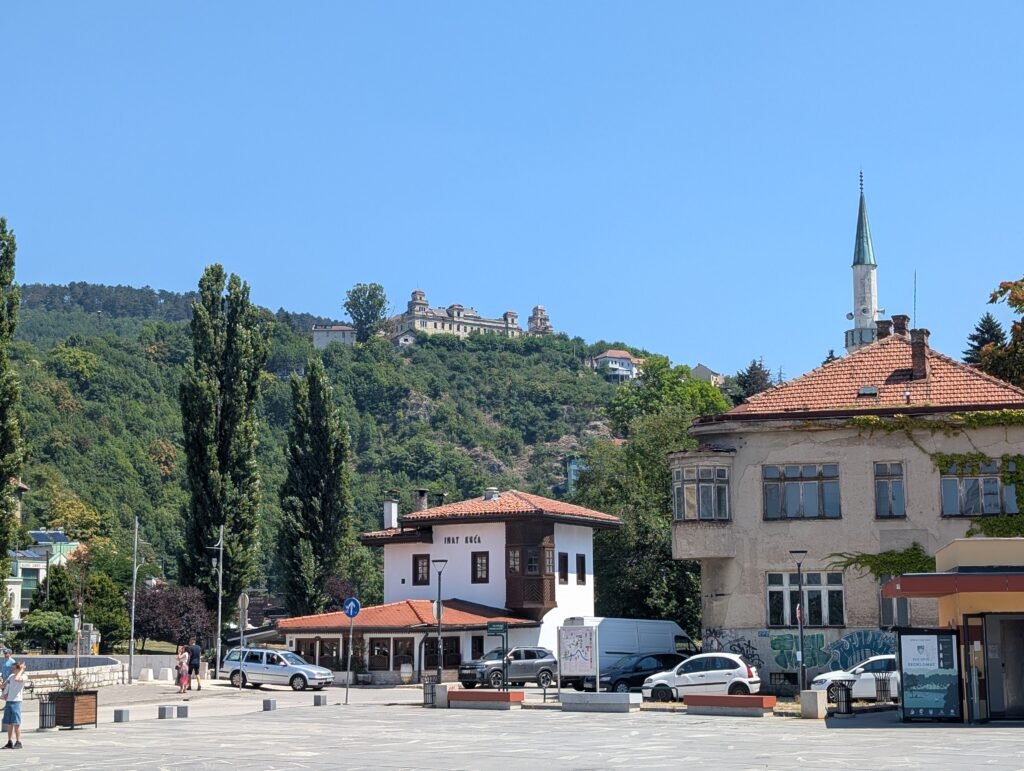
At the upper end of the river, we saw two more notable buildings. We visited the exterior of the unique city hall building. The Austrians had this building constructed with a Moorish design, as was en vogue at the time. It was a 19th century building of course, and there had never been any Moors anywhere near Sarajevo. This was the style in the late 1800s, though, so the building was made in this fashion. The Austrians didn’t just destroy the entire area to build their city hall. They sought to buy out all of the neighbors with generous offers to clear land for this piece of construction. One hold out threatened to upend the entire project. Eventually, the old man insisted the Austrians pay him a bag of gold for his house and still move it in its entirety to the other bank of the Miljacka River. They did this in order to build their city hall without running over anyone. The house is named Inat Kuca, or “House of Spite,” and has become a sort of monument to Bosnian resistance to foreign governments. In a way, I think it could also be seen as a testimony to Austrian benevolence. They certainly didn’t have to comply with the stubborn old man’s wishes, but they did to be diplomatic.
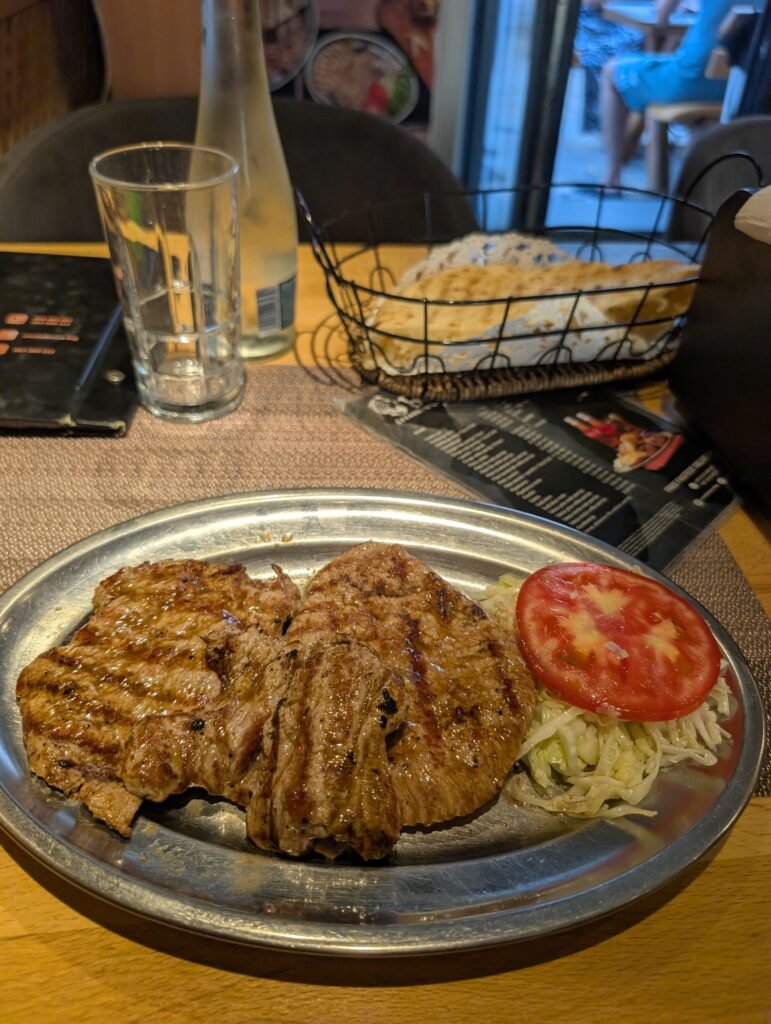
I spent a good part of the afternoon on the phone with Stephanie. On both Friday and Saturday, I spoke with Andrew quite a bit, and spent a good amount of time visiting with other travelers in the hostel. I practiced my Spanish with Elizabeth, who was acting as sort of hostel foreman, and her Argentine helpers. I did some shopping and eventually headed out to try some more Bosnian food. This time I had punjene paprike, thin skinned peppers stuffed with minced meats. These were tasty, and about as close as I could get to a vegetable dish anywhere in the Balkans. I did some other shopping as well to restock my non restaurant food supply.
(Continued)
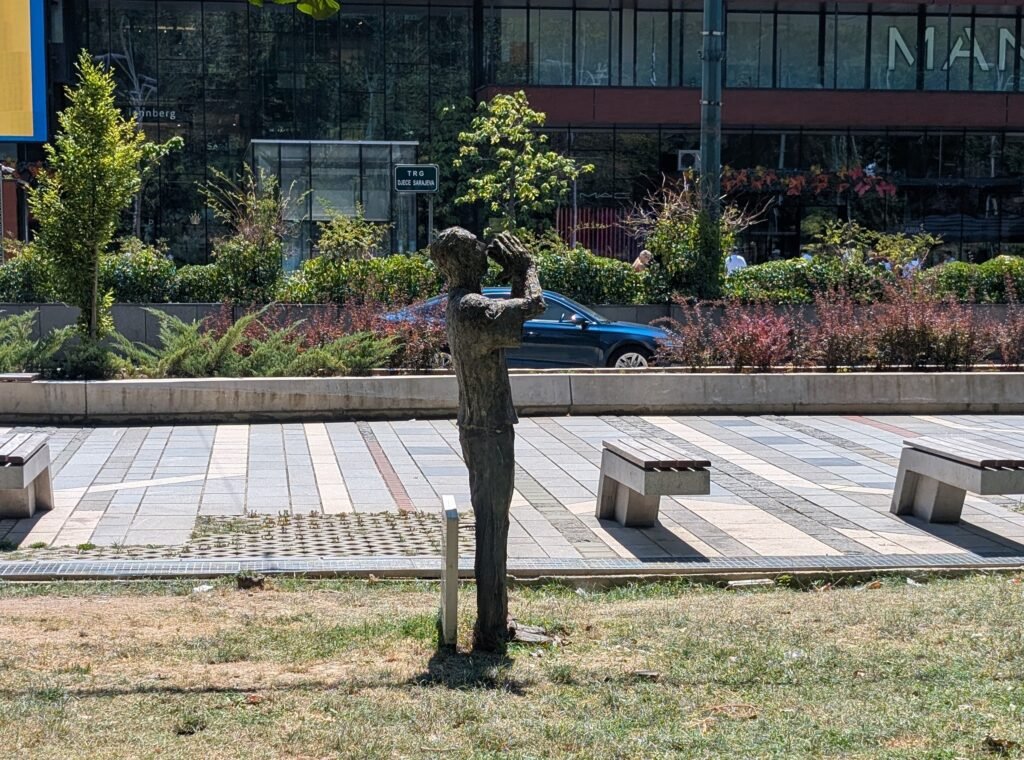
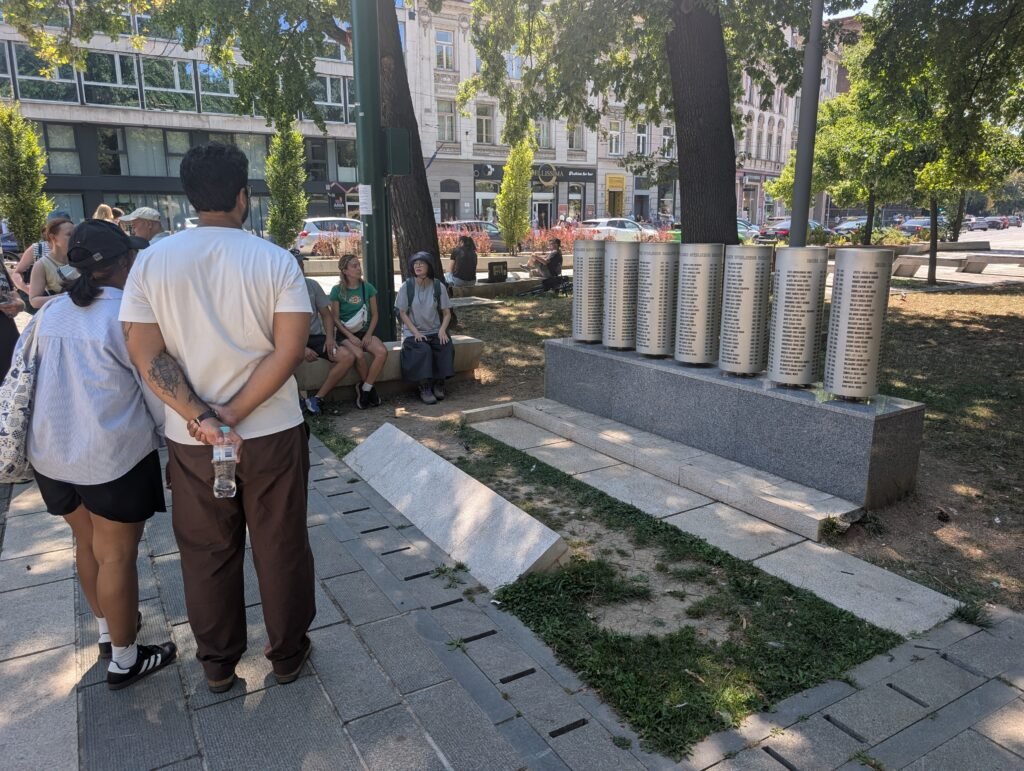
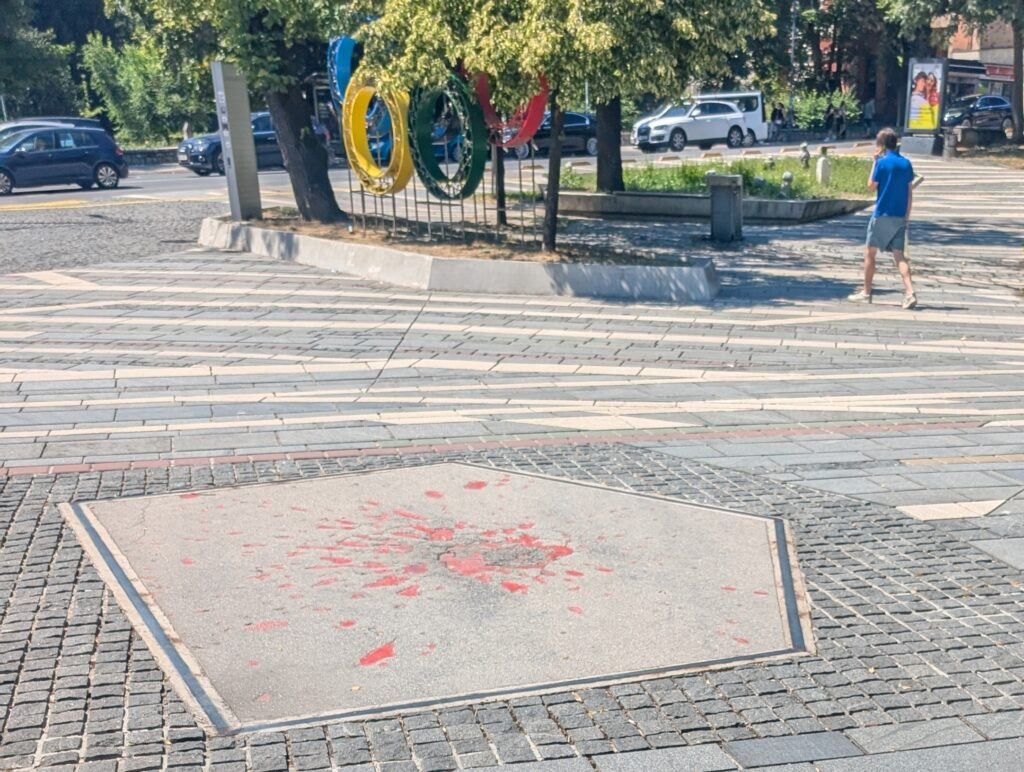
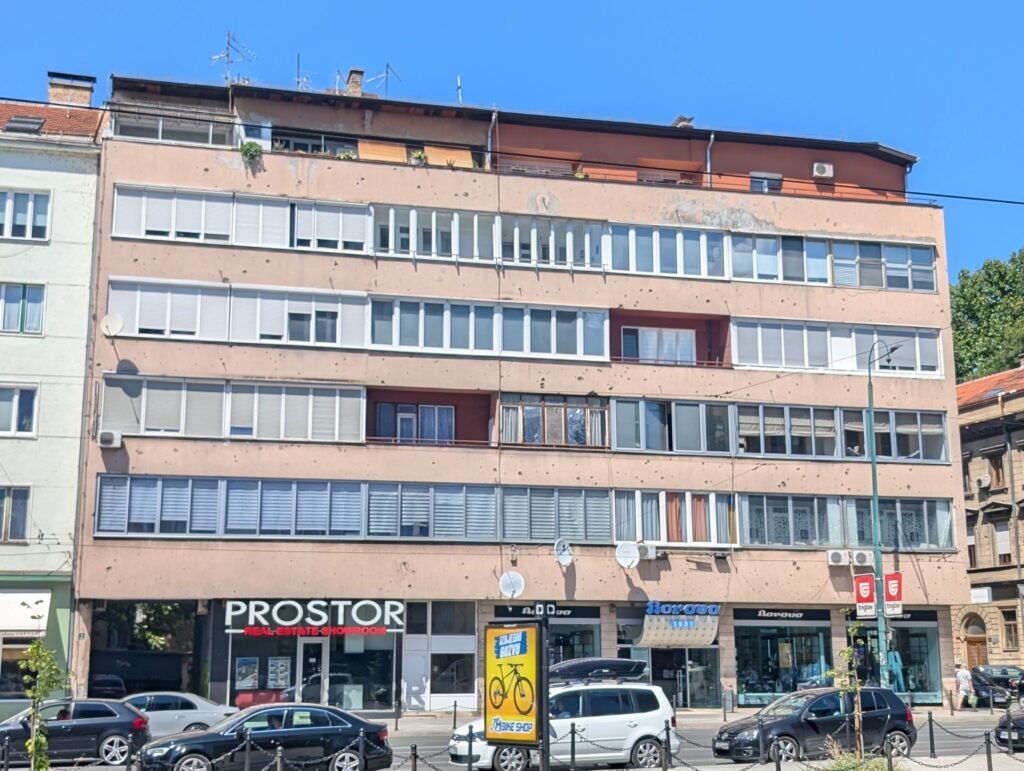
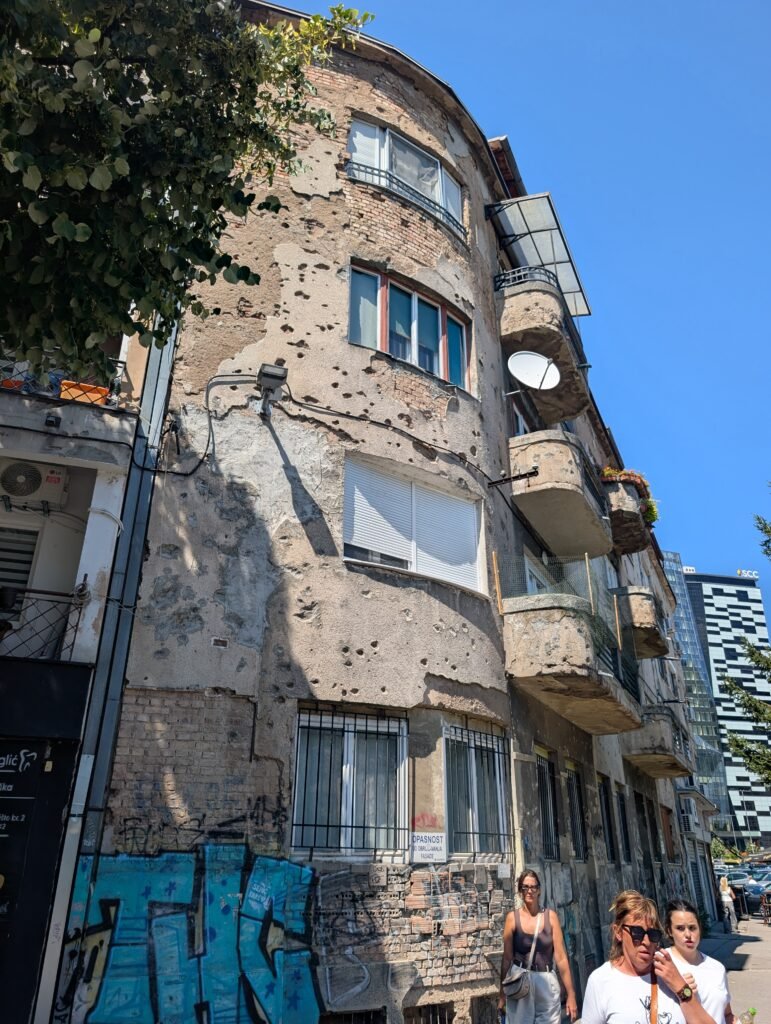
The “War-Torn Bosnia” tour was completely booked for Friday afternoon. Due to the possibility of enforcement of some Bosnian limit on the number of folks in each tour, I was forbidden from joining that day. I had to try again the following afternoon. This cost me a day of touring other sites. I was a bit tired though, and the War Scars tour was worth taking for sure. Our tour guide had been a girl during the 1990s war and had her own stories to tell. She took us past the children’s memorial, with names of so many children who died during the siege. We visited a tongue in cheek monument to canned beef donated by the United Nations. We heard about sniper alley, learned about the complicated government system in Bosnia, and felt the cost of unresolved war crimes. We saw buildings still bearing damage taken during the siege, and found some of the Sarajevo roses. In several places where Serb mortars did physical as well as human damage, the scars in the pavement have been filled with red resin forming a permanent reminder of the shelling that took place, and the fact that someone or some people were killed in that spot as they went about their daily business. We learned of the lovers who tried to pay their way to escape Sarajevo only to be shot down together when they tried to leave. We learned of the father who, at Srebrenica was tricked into calling his own 21 year old son back to be executed with him by the Serb army. It was a heavy, but far more personal tour than any other of these free walking tours I have been on. It was worthwhile and I think I left the largest tip I ever have for one of these. It was very good.
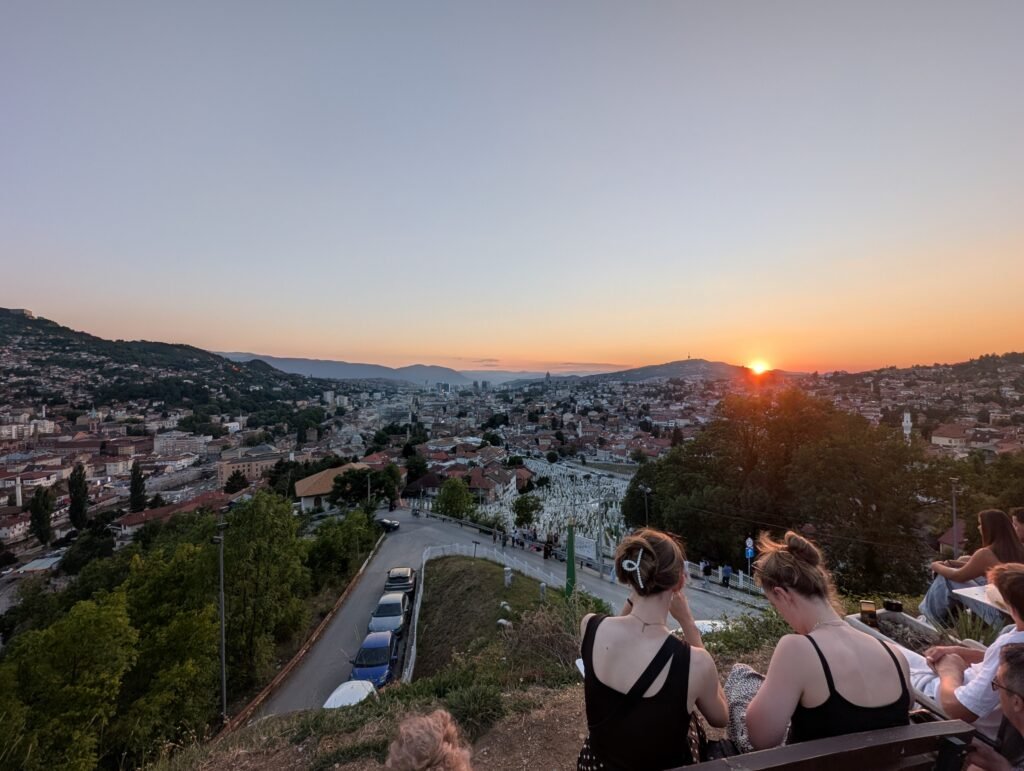
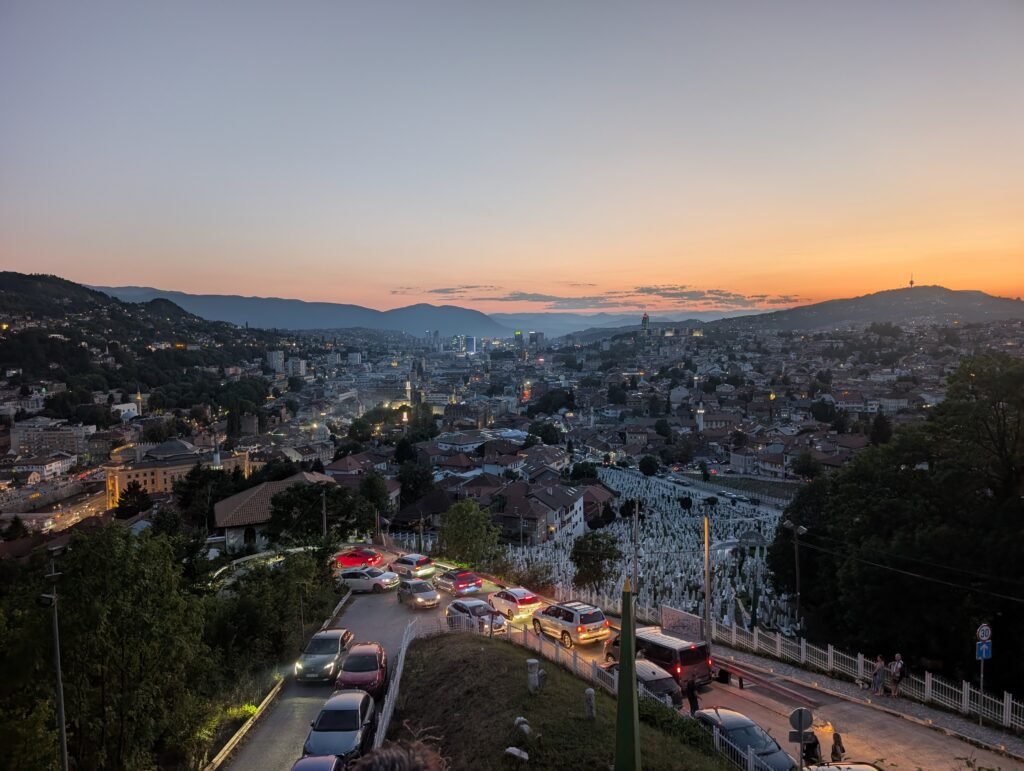
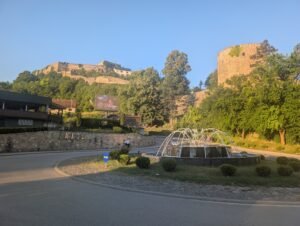
Saturday evening, I joined Elizabeth and two of my hostel-mates for pizza and a hike up to watch the sunset from the Yellow Fortress. This fortress was constructed in the 1720s to help defend part of the city from the Austrians. Today, hundreds of visitors climb the small hill through a cemetery to reach it an hour or so before the sun goes down. We ordered pizzas for 10CM and carried them on up to enjoy as we waited for the shadows to grow long and finally disappear. We visited together, people watched and enjoyed the company. We watched the city lights come on. There were so many people around that no one had a completely panoramic view, but we saw plenty of pretty city views and more importantly enjoyed the good company. It was a nice way to finish the evening.
There are no Churches of Christ in Bosnia. As such, I decided to join Elizabeth to attend an Evangelical service she knew of Sunday morning. It was a pretty ad hoc affair. Interestingly, one family at church recognized me from the bus I took from Zagreb to Jajce. They thought it was pretty brave of some foreigner to hop off the bus at Jajce. Little did they know there was a hostel full of foreign tourists there. People were friendly, if the service was quite a bit different than I was used to. I walked with Elizabeth and her Mexican friend for a bit, then they parted ways and I walked Elizabeth to the train station where she learned some information about tickets for a trip to the waterfalls with one of her Argentine friends the following day.
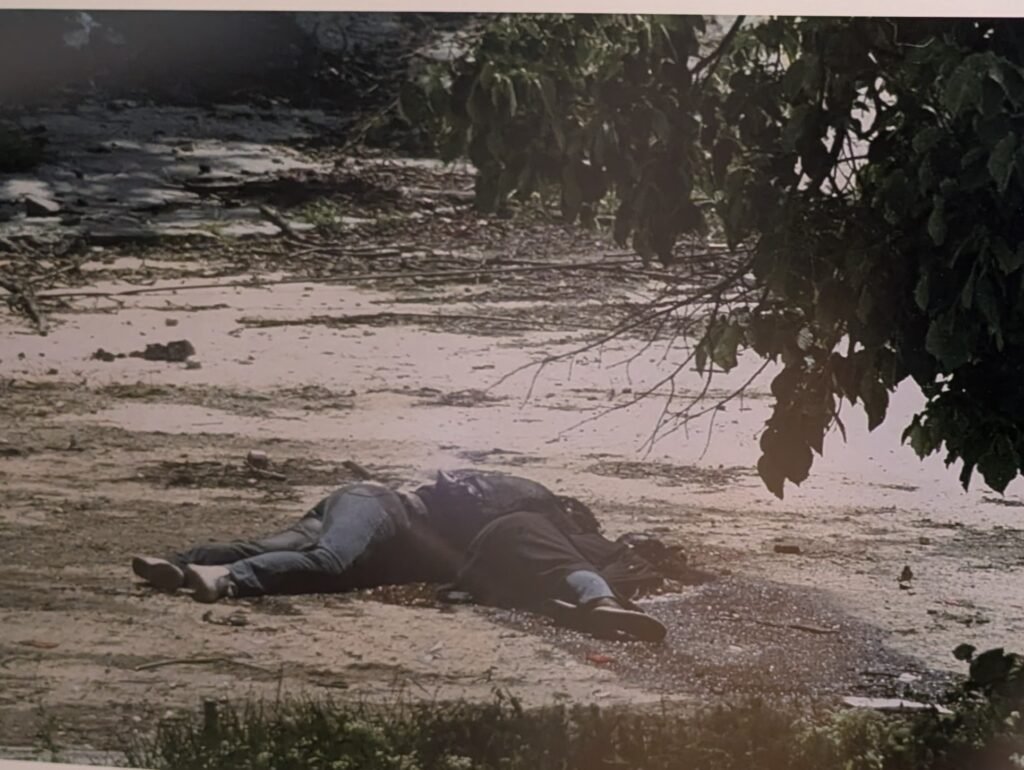
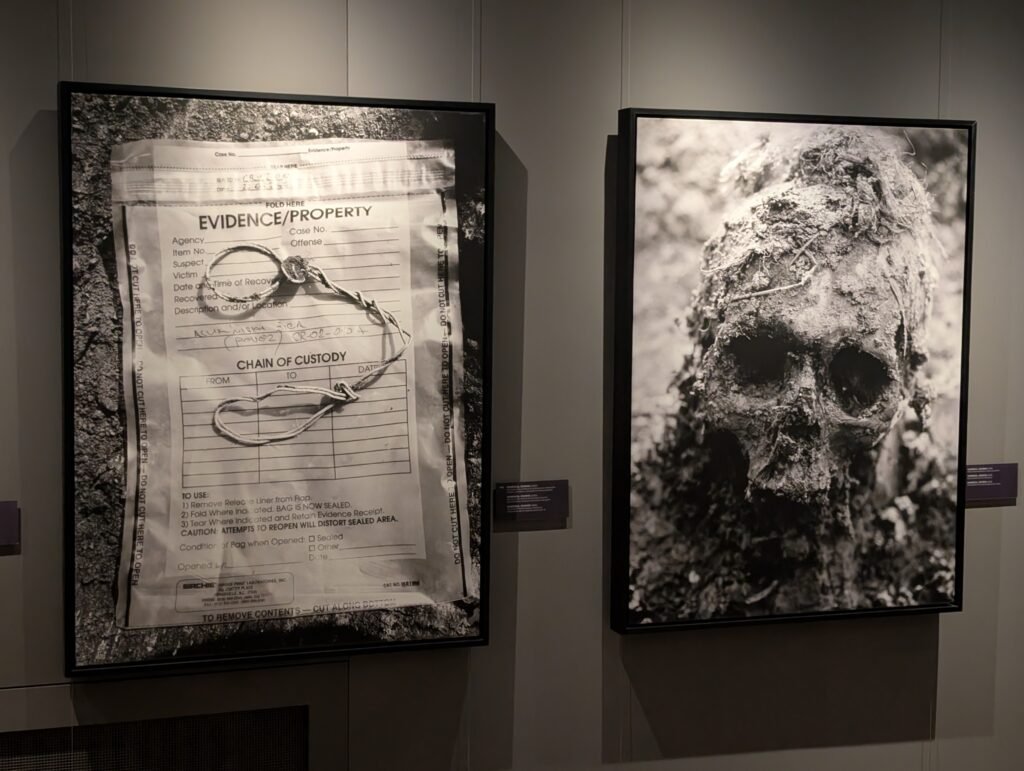
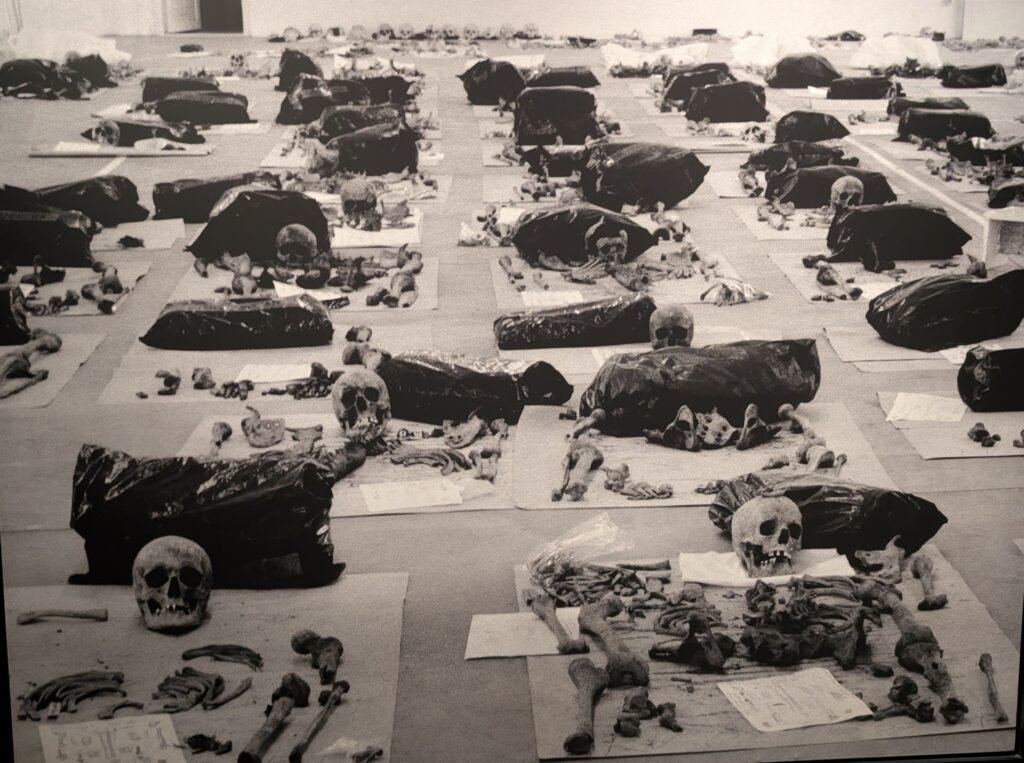
That afternoon, I went to visit the Galleria July 25, 1995. This was an art display designed to commemorate the Srebrenica massacre. There was plenty of interpretive information inside as well. It was quite well done, with accompanying videos and an audio guide. Afterward I had a nice supper in old town. Thus concluded my first stint in Sarajevo. I would set off for Bucharest to join Andrew the next morning.
August 8-9
Andrew and I arrived back in Sarajevo after a long bus ride from Belgrade on Saturday, August 8th. We took the early bus, and so arrived in Sarajevo in the early afternoon. We would only be there one night as I had already spent a few days in Sarajevo. I had been tired when I arrived the first time, however, and did not see everything I wanted to in town. I had also wanted to take a day trip or see Srebrenica on the way to my next destination. I still was not able to visit Srebrenica, because it is closed on Saturdays and Sundays, but Andrew and I were able to pack in some other experiences before we caught the afternoon train on Sunday to Mostar.
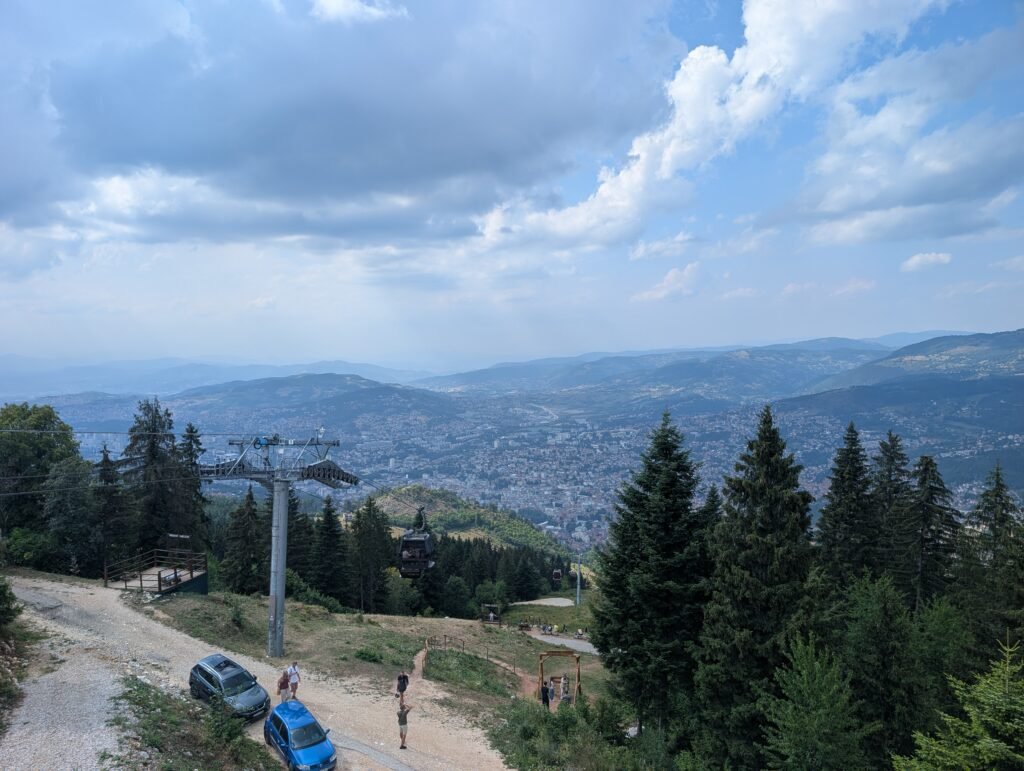
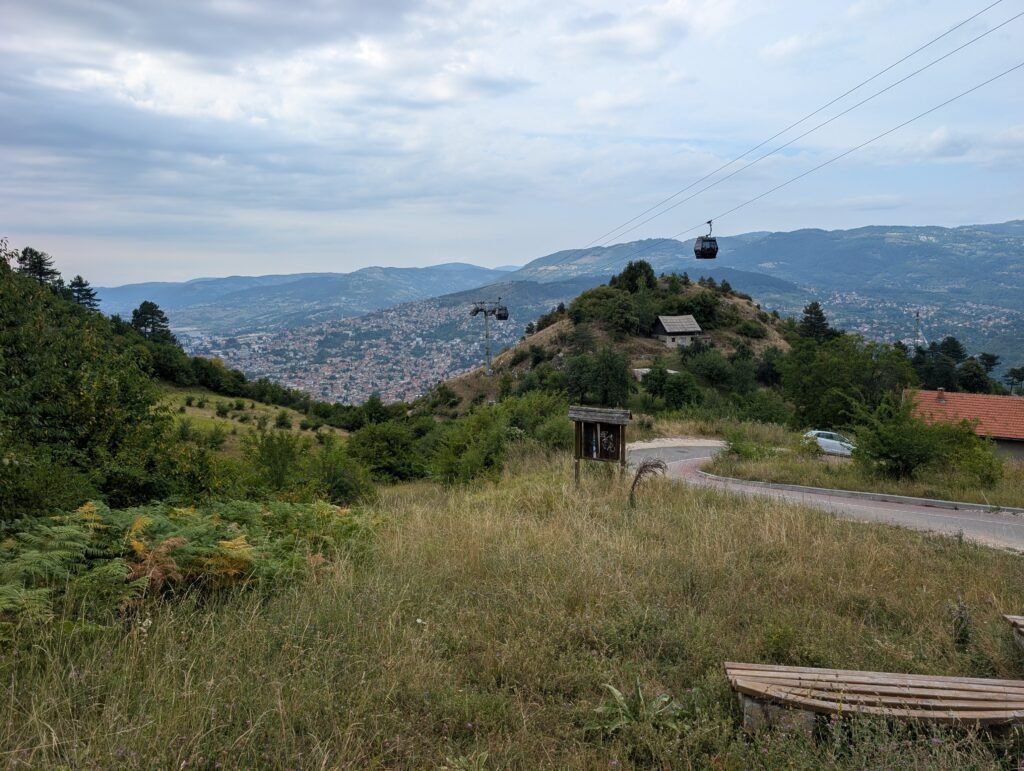
We dropped our bags off at the Exotic Nature Hostel, the same place I had stayed on my first stint in Sarajevo. This time, we had a private room. Oddly, the private had no air conditioner. I hadn’t even checked for one, assuming since the dorms had them all of the rooms would. After dropping the bags, we walked to the cable car that lifts you up Trebevic Mountain to some of Sarajevo’s winter sports venues. We enjoyed wonderful views of the city from the top of the mountain of course, but these weren’t the highlight of the day’s adventure. Sarajevo is kind of in a bowl. There are many places from which you can get great city views.
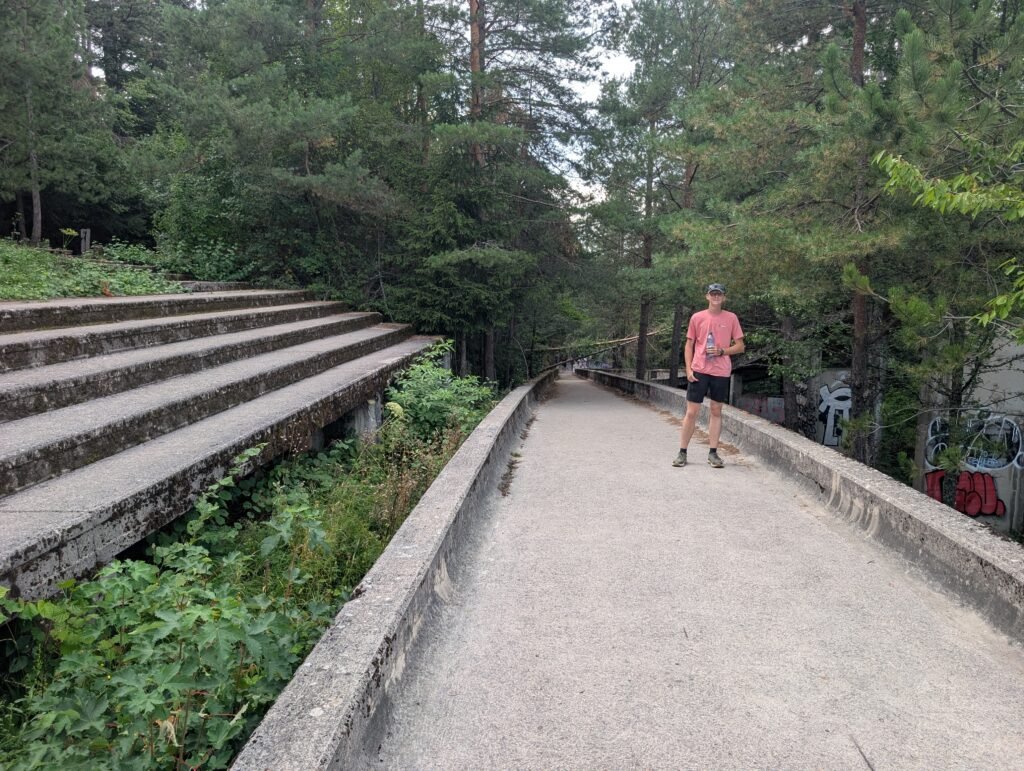
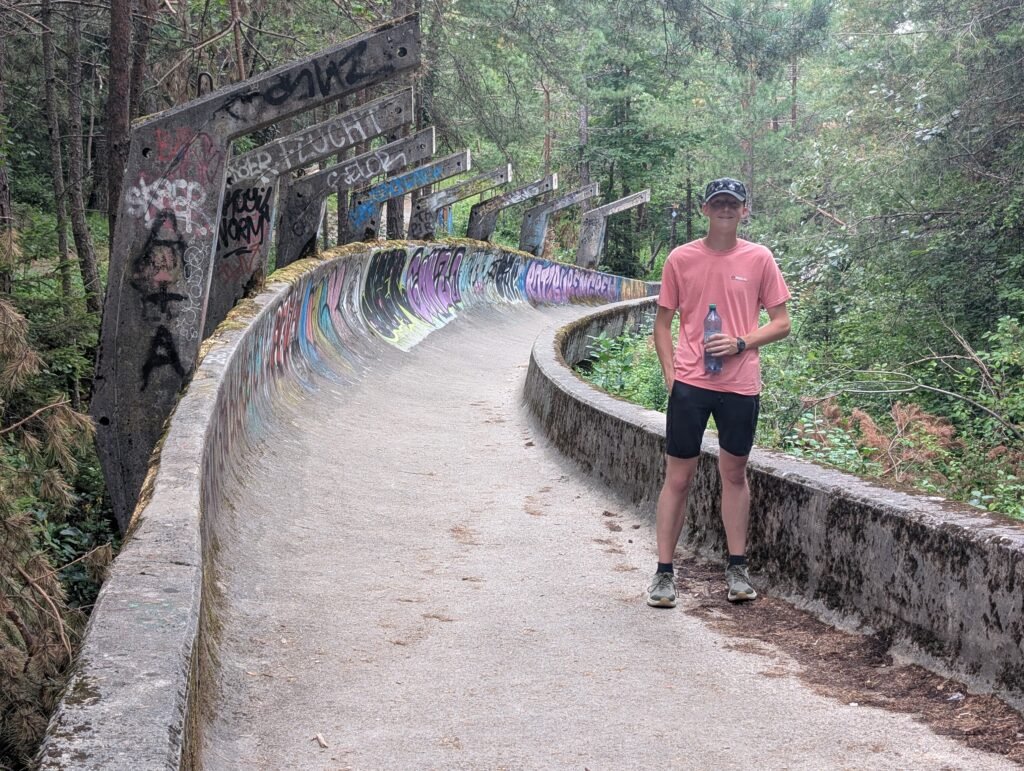
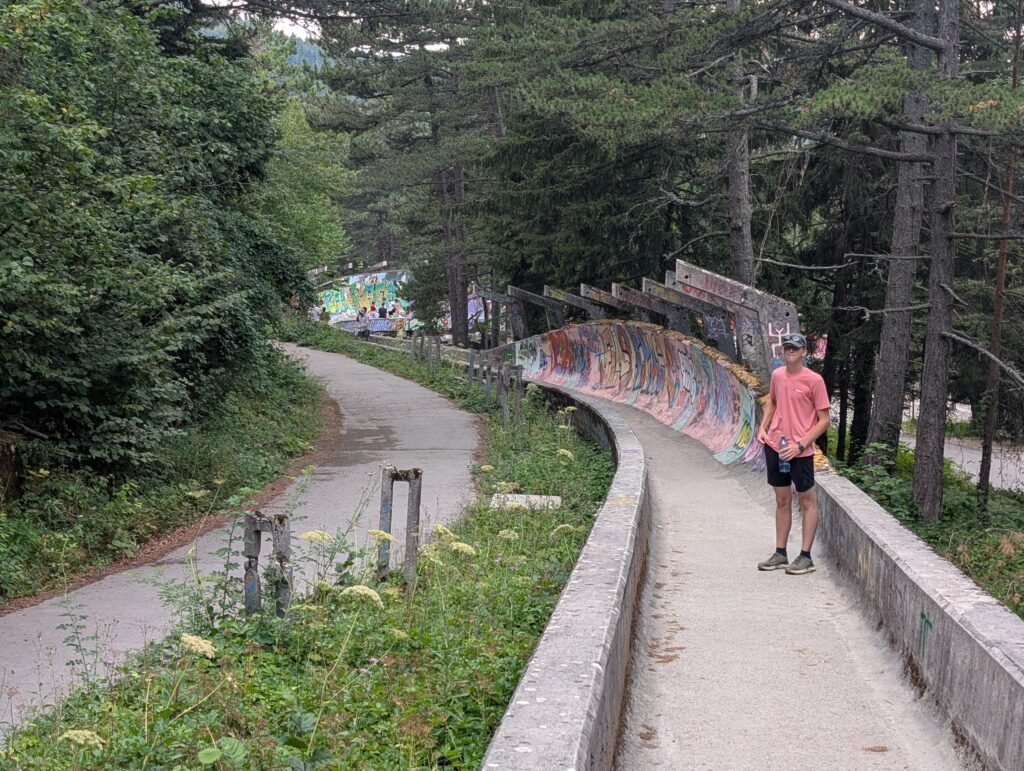
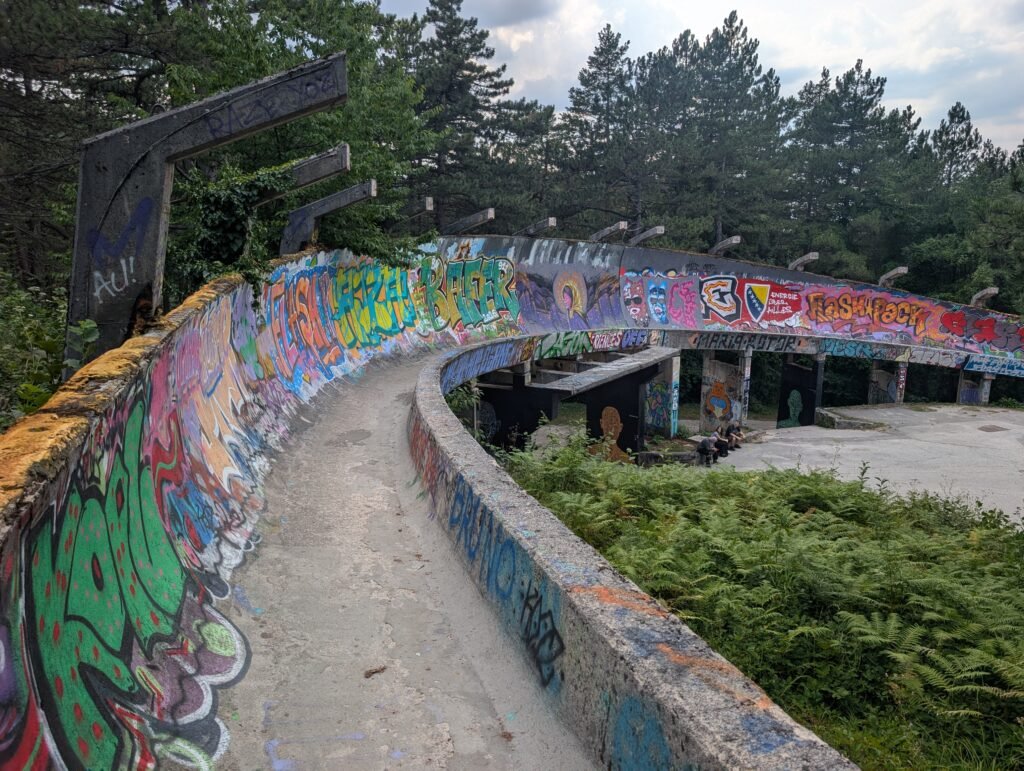
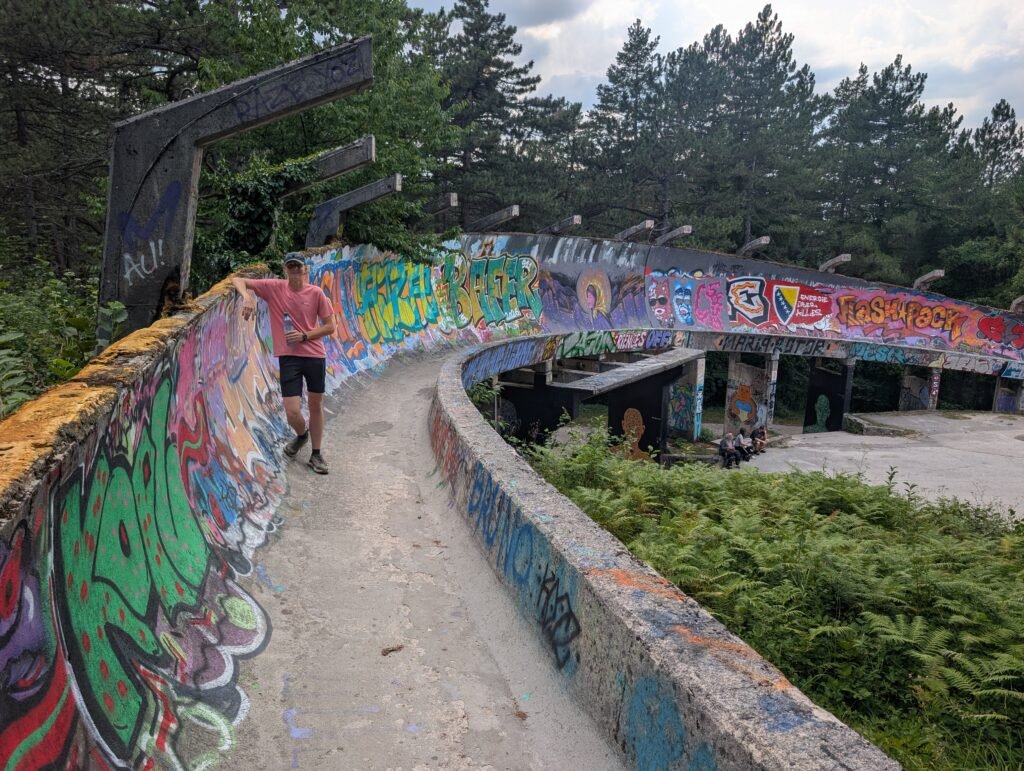
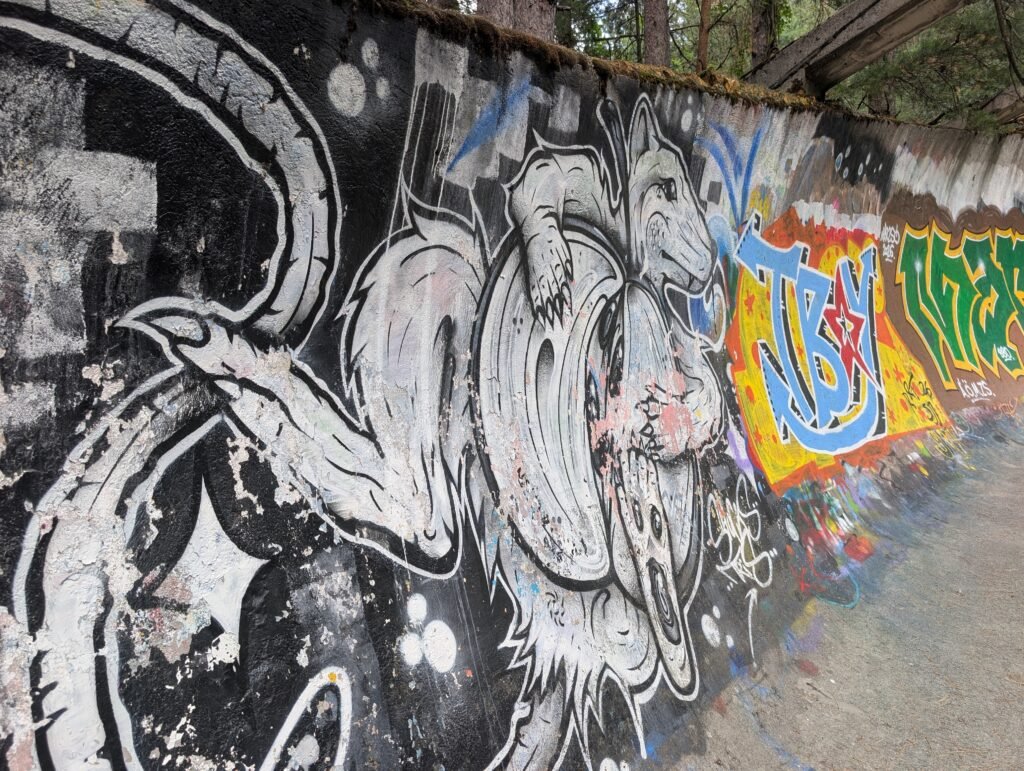
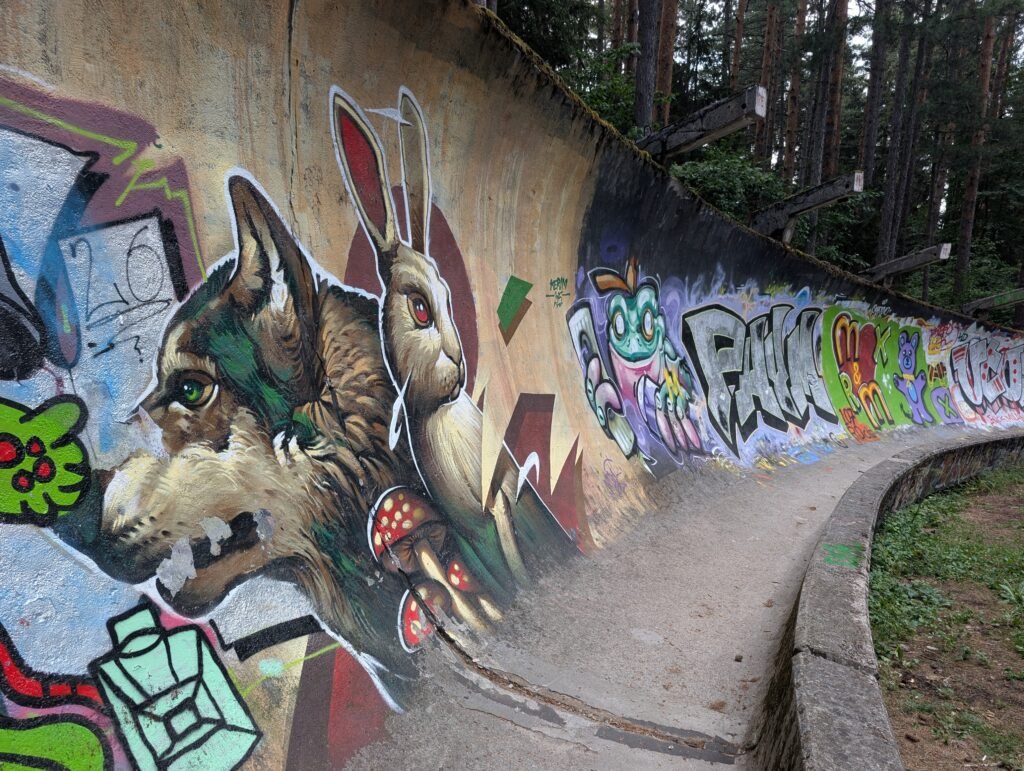
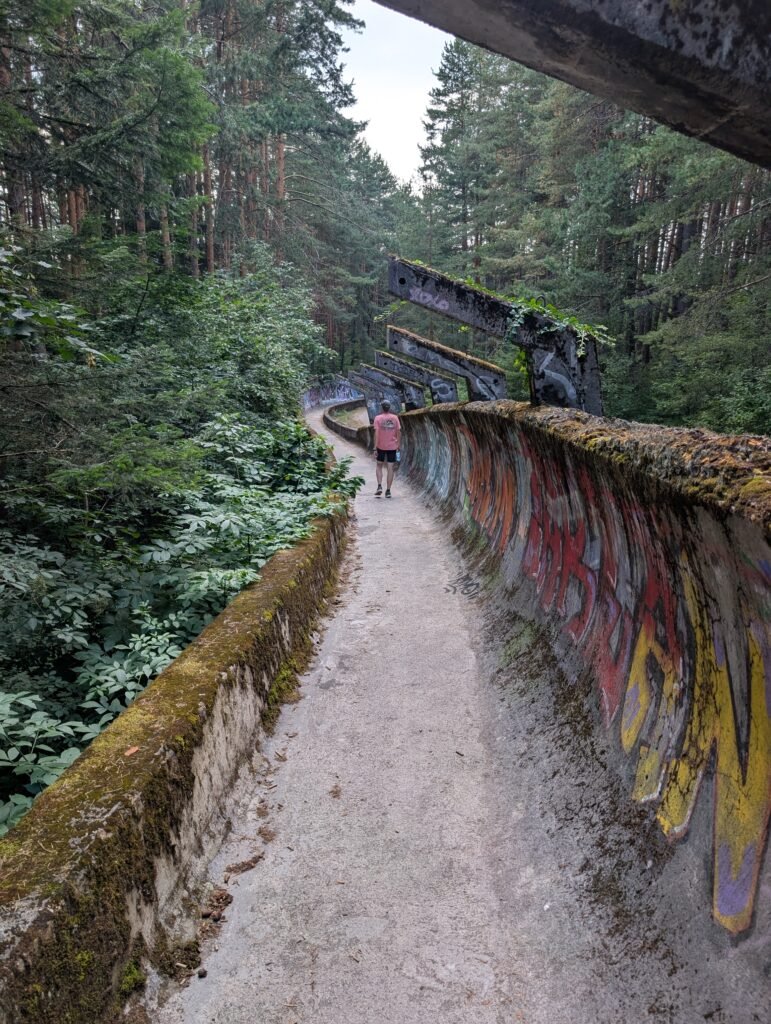
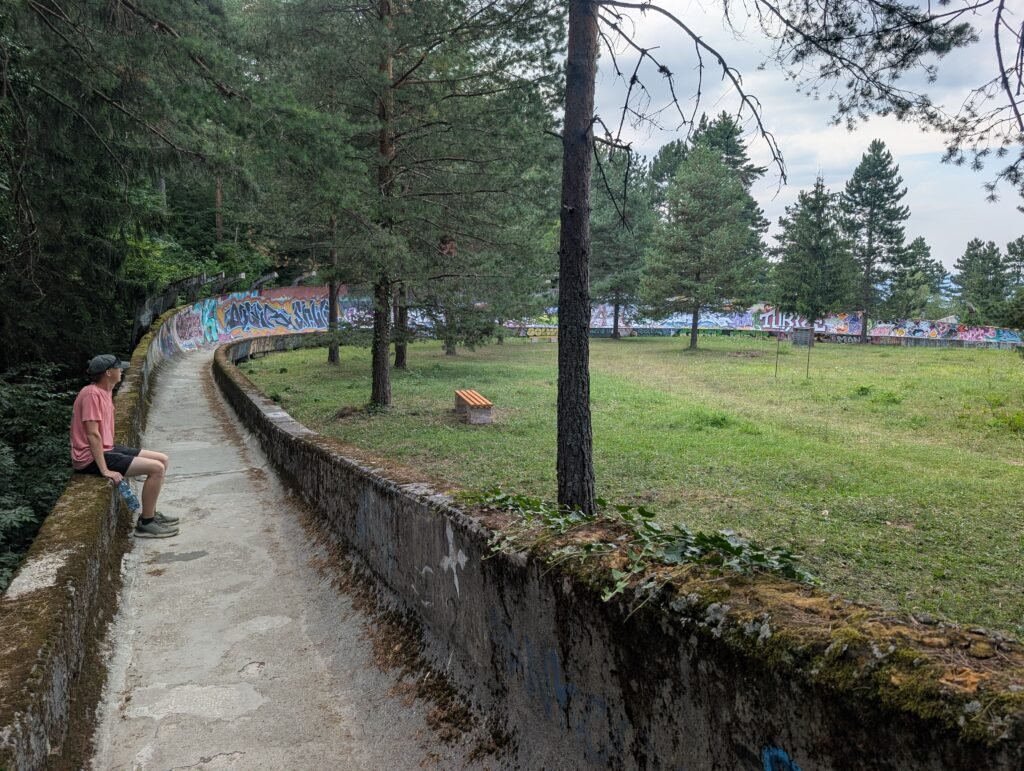
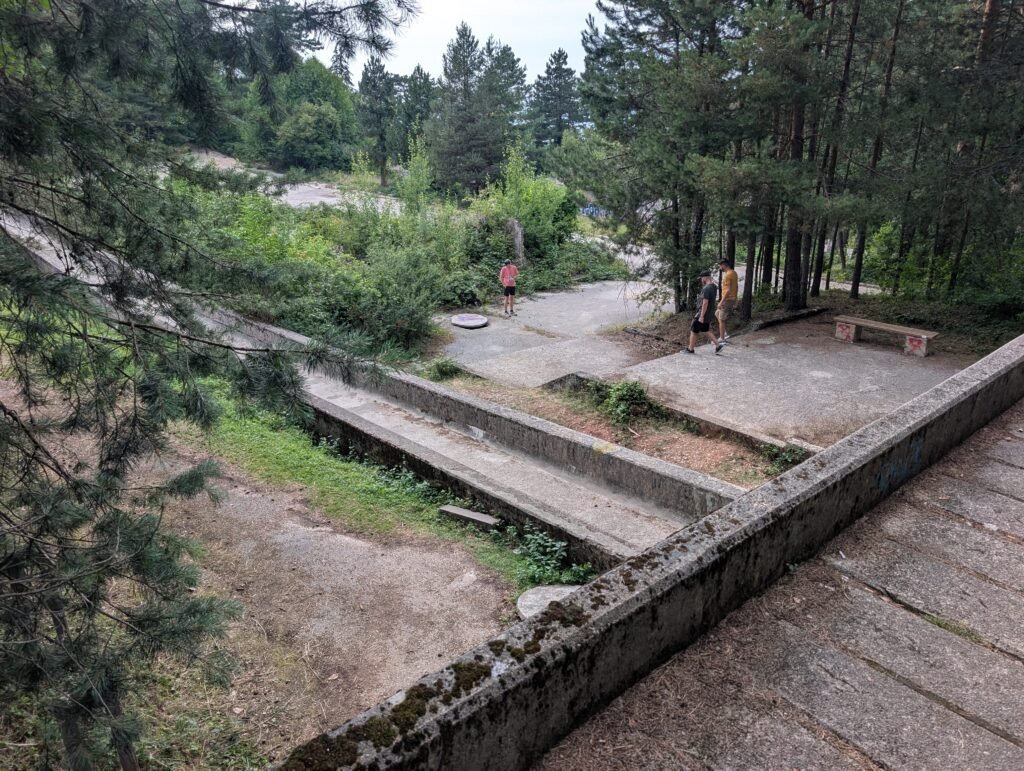
From the top of the lift, however, it is just a short walk to the abandoned luge and bobsled tracks from the 1984 Sarajevo Winter Olympics. The bobsled track is covered with intricate graffiti murals. I don’t generally appreciate this kind of street art, but many of the images on the old cement Olympic track were sharp and very well done. Quite a few tourists were doing something similar, though I think afternoon was the less-busy time to stroll the bobsled track. Some more adventurous types ride bikes down it. We stopped several times to admire and photograph the murals.
The few people we talked to on the track were planning to walk back up it to take the cable car back down. Andrew and I bought one way tickets, planning to walk down to the city. The descent was steep in places, but we followed a paved road back to town through pleasant scenery, tiny farmsteads and older suburban sprawl. The walk was pleasant, even if we did get quite a quadriceps workout on the way down.
We paused at the hostel long enough to take a brief rest and pick up my friend Elizabeth on our way to grab a pizza and watch the sunset at the Yellow Fortress. The Yellow Fortress was built during the 18th century to overlook water sources and the east entry to the town area. On my first visit to Sarajevo, Elizabeth directed me to a local eatery that made local style pizza for just 10 KM. The portion size was large, and the pizza good. It made for a nice evening to pick up the pizza on the walk to the Yellow Fortress, then eat the pizza as you waited for the sun to go down.
Both times I ascended the Yellow Fortress, there were large crowds there to do the same thing, a lot more people that I had seen on the bobsled track. We made the trip, though, and the three of us enjoyed an even larger pizza and shared stories as we walked and watched the sun go down over the mountain, casting its soft evening glow on the minarets, the old town, and the larger, more modern buildings in the distance. We met a Pakistani family who were living in Great Britain and visited with their college aged students for some time while on the top of the hill. We ran into these same Pakis later on in Pocitelj outside of Mostar.
The Pakistani girls were beautiful, well spoken, and highly decorated. Their accents indicated they had grown up almost entirely in the UK. I enjoyed visiting with them, and hearing their perspectives on Pakistan, India, Britain, and the world. They seemed to me to be products of a Western education system that is far more self-critical than you might find in other parts of the world. You could hear the echoes of Postcolonial theory in their criticisms of British Indian policy. It’s hard to gather from such a short conversation whether they really understood the complexities of the situation created by the British exit from India that led to the 1947 partition. They seemed to be especially sensitive to the division, as their family was from Punjab, a region divided between India and Pakistan in ‘47. They commented, though, on how “India was one country” before British occupation, which was, of course, absolutely not true. It is a sort of shorthand way of criticizing the British exit and partition. The reality of the matter was that India was and is exceptionally diverse. India was never a single political entity before British rule. Certain empires at one time or another controlled most of it, but there was never a sort of Hindustan in the modern sense. It had been conquered, but never united. I suppose Britain could have left India alone to determine its own boundaries between groups, but it is certain they would have also been blamed for the bloody tragedy that would have likely followed that scenario as well.
Notwithstanding any quibbles about politics, history, or British India, this interaction was pleasant. I learned about diverse educations and international perspectives. The girls definitely appreciated the diversity of the United Kingdom and the United States, and commented favorably about both. I could appreciate and agree with that. They were also aware of the dominance of people from South Asia in the select, competitive British schools they attended. They were aware that modern British sensitivities had in no way excluded them from the best Britain currently has to offer. That was refreshing. They were very impressive young ladies, and I consider it a privilege to have met them.
As we walked back toward the hostel, Andrew commented that he thought the mosque prayer calls were “creepy.” I have come to enjoy hearing them. They certainly are not as pervasive in Sarajevo as those in predominantly Muslim countries. Andrew’s comment triggered my favorite mosque clock story, which Elizabeth thought was very funny. I did not notice, but Andrew said we were walking by the Pakistanis (Muslims) as I was making the mock prayer sound of the clock and that they were staring at me. I would be truly hurt if I had offended them. I hope Andrew was just being Andrew, with his enhanced awareness of how I might be embarrassing to him or offensive to others. They didn’t seem to treat me any more distantly when we met them outside of Mostar. There really was no way that story could have been presented so well without me making the Muslim prayer sound…
(Continued)
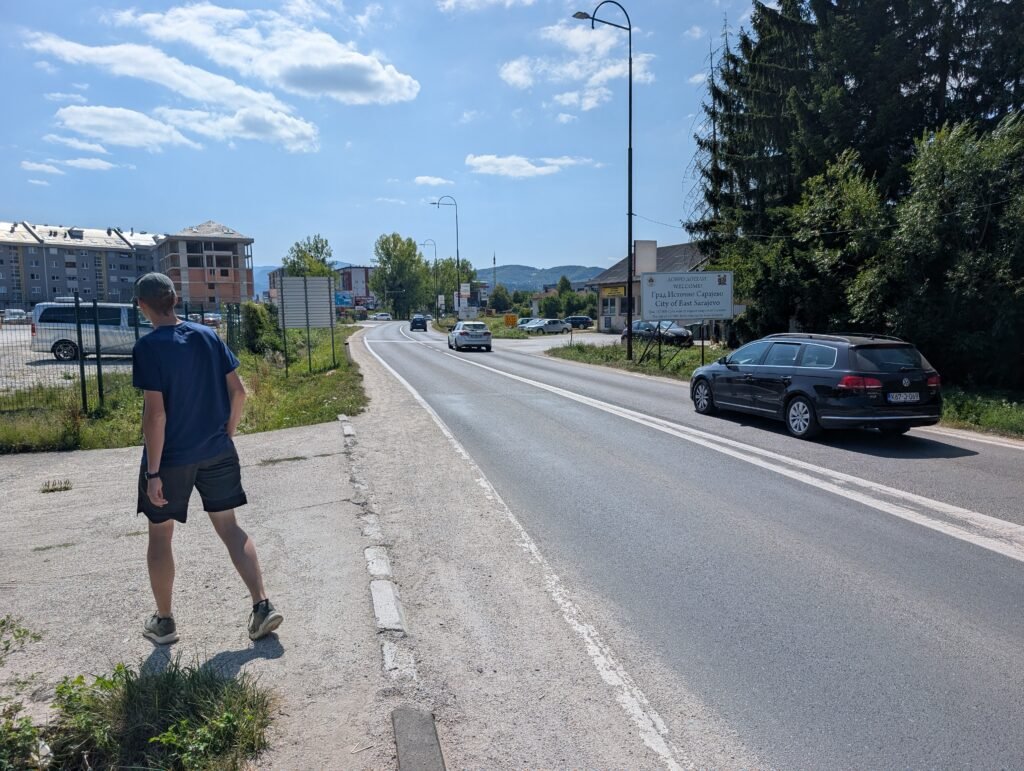
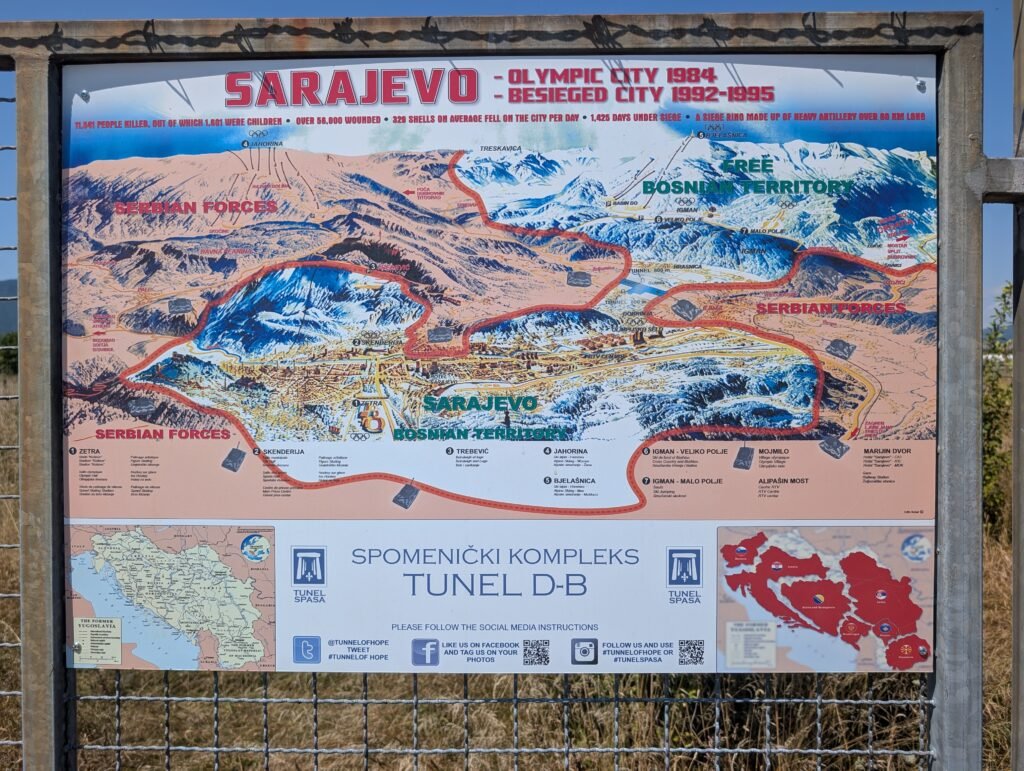
The next morning, I ran and Andrew slept in a bit. We then headed out to the Tunnel of Hope. This was clear out near the airport in East Sarajevo, so it took some time to get there. During the four year siege of Sarajevo, the area around the airport was the city’s only connection with the outside world, or what they called “Free Bosnian Territory.” The United Nations guaranteed the security of the airport. The Yugoslav People’s Army (at that point controlled by Serbia), and Bosnian Serb militia forces surrounded the city and shelled it with mortars. Snipers shot at people from distant buildings. There were no aircraft used in the Serb attacks on Sarajevo, but there was no safe way to enter or exit the city, and remaining inside wasn’t all that safe, either.
Over time, several people attempted the 500 meter sprint across the runways in the middle of the night in attempts to flee. A few even came in that way, looking for loved ones. Runners were prime targets for snipers. If you were caught inside the airport, the UN peacekeepers would just set you back off where you had started. If you made it across, you faced concrete barriers and concertina wire. Some made it through. Some were killed trying. Many more were captured by the UN troops, not having accomplished much.
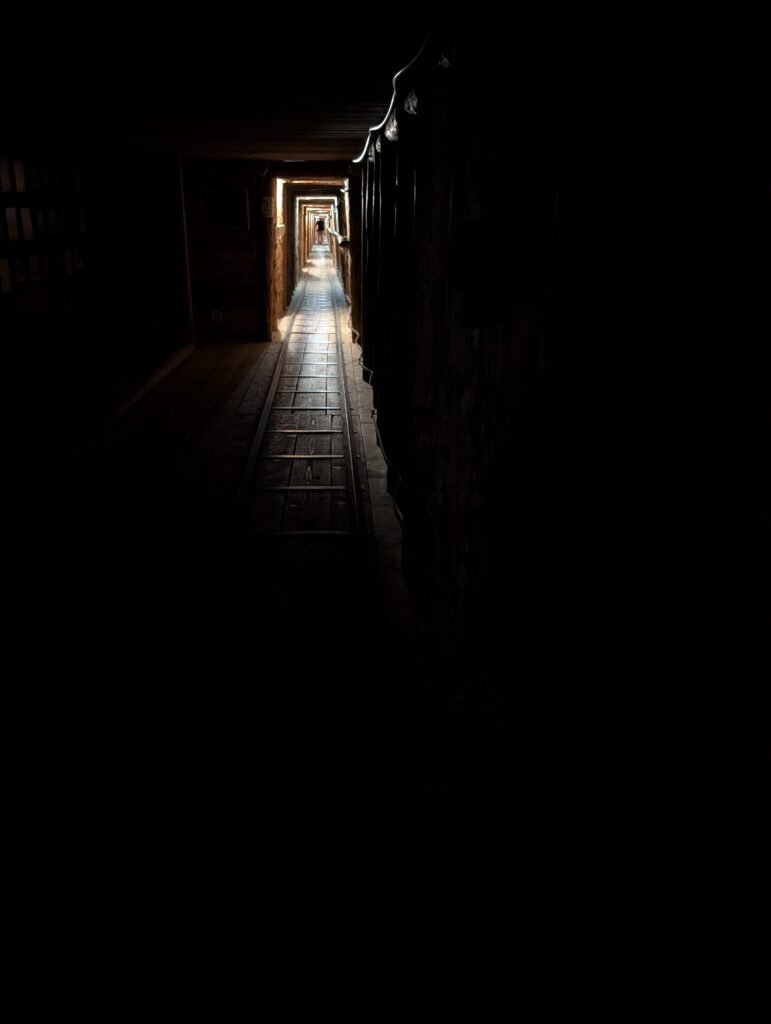
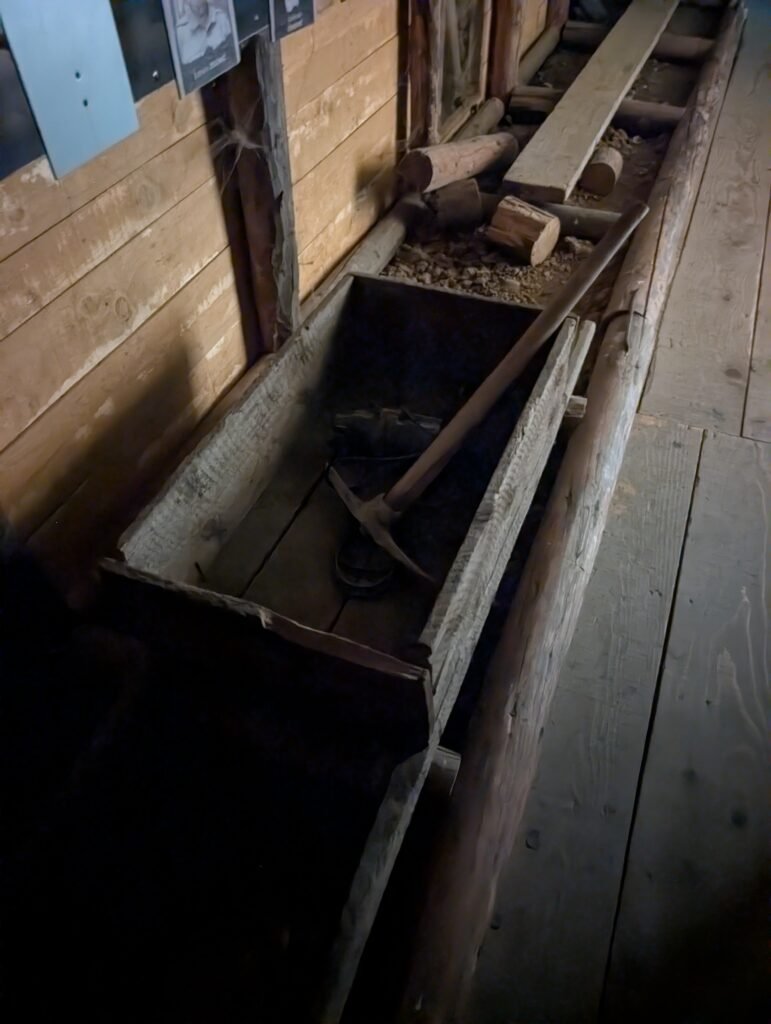
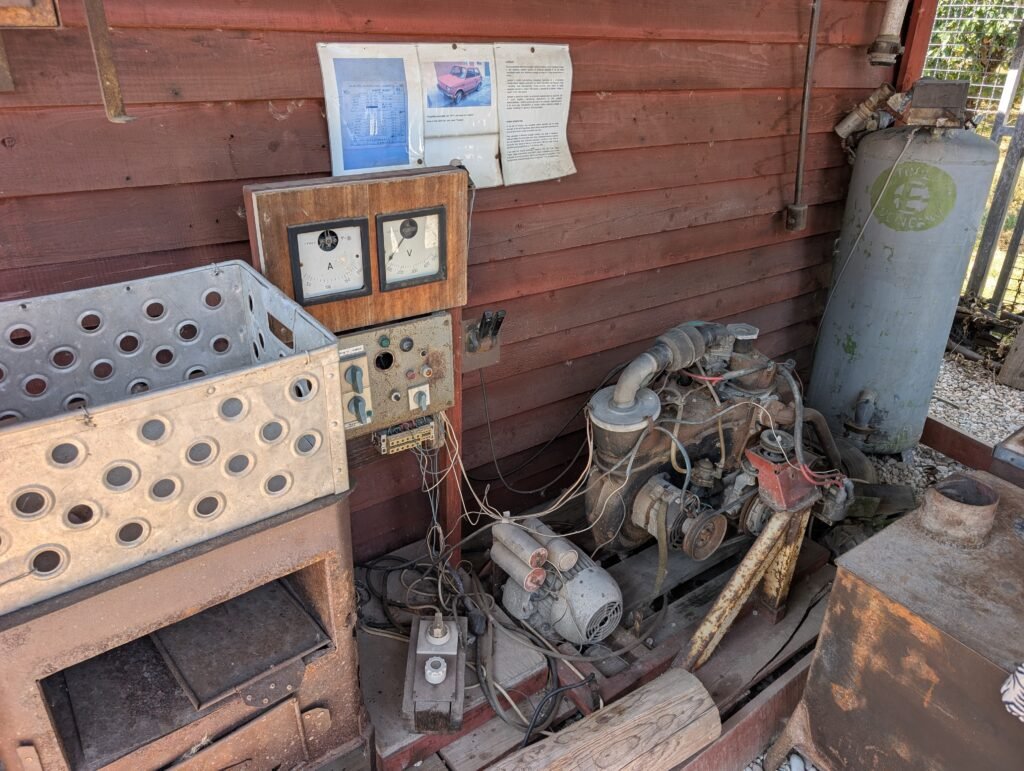
In order to get people and materials into and out of Sarajevo, Bosnians eventually built a tunnel the full lateral width of the runways and the airport grounds. This was done entirely with hand tools – picks and shovels. The tunnel ran from a house on the far side of the runway all the way under the UN controlled area toward the city. It had to be strong enough not to compromise the integrity of the runway above, which was supporting large military aircraft. The tunnel was only about 1.6 meters high and a meter wide. It was very difficult for Andrew and I to walk through. It was even more difficult to carry equipment through. As time went on, a narrow rail system was installed so carts could be wheeled down the tracks.
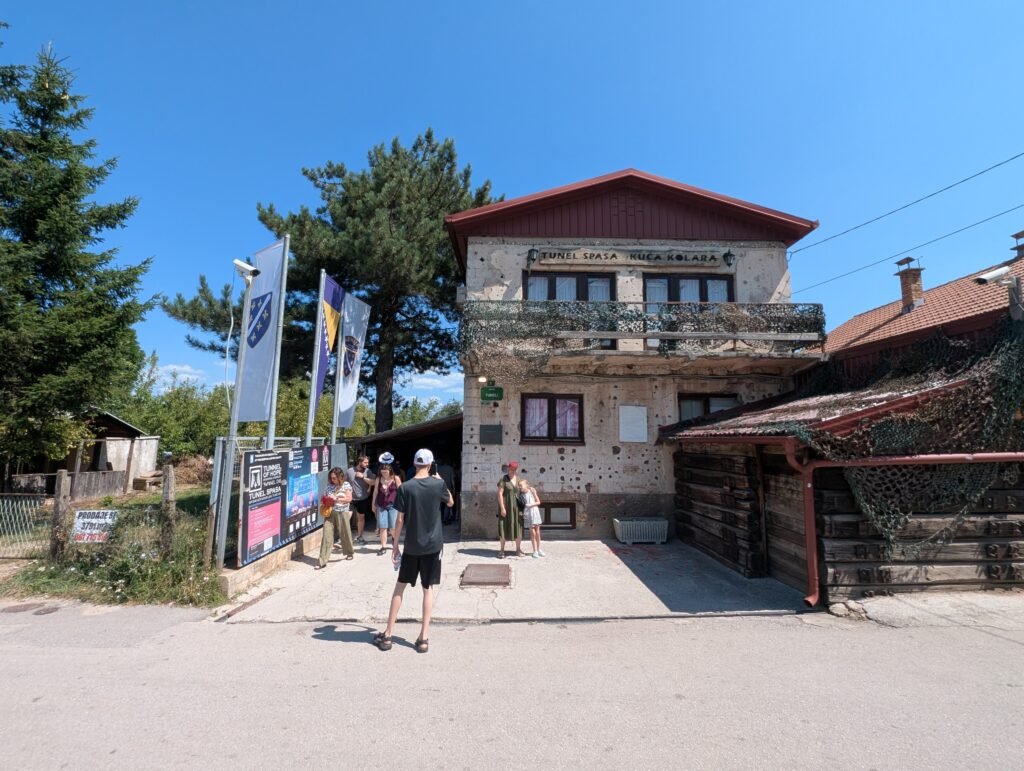
Tons of materials and a lot of people made it in and out through the tunnel during the course of the siege. A small section on the Butmir side of the runway is preserved today near the Kolar family house, as a museum and memorial to those who made the tunnel a reality and helped keep hope alive in Sarajevo until the rest of the world came to the rescue.
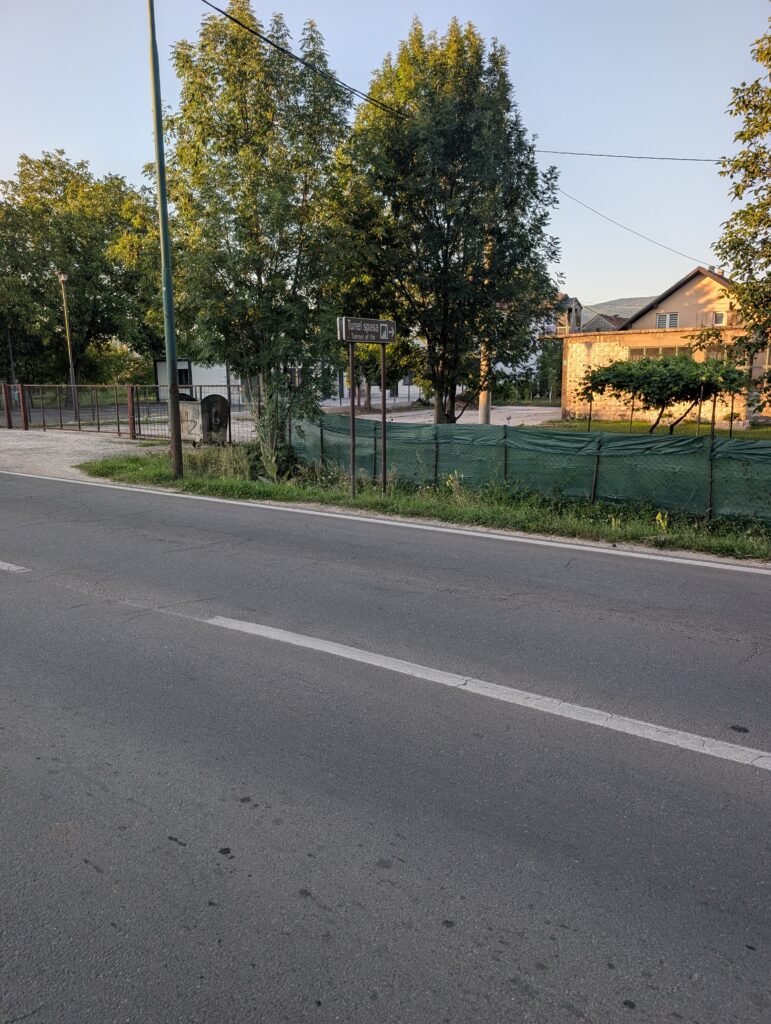
Andrew and I took a city bus to the Dobrinja neighborhood on the Sarajevo side of the airport, then walked around to the far side where the preserved portion of the tunnel is accessible. The Kolar house has been converted into a small museum, but that was closed when we visited. Information at the ticket gate indicated that a free audio guide was available with your ticket. This required downloading an app that was supposed to be available in the Apple Store or via Google Play. Only the Apple version worked, however. Fortunately for us, a Muslim family from Istanbul allowed us to listen in on the lady of the house’s iPhone. The rest of their family had Androids and were in the same boat we were.
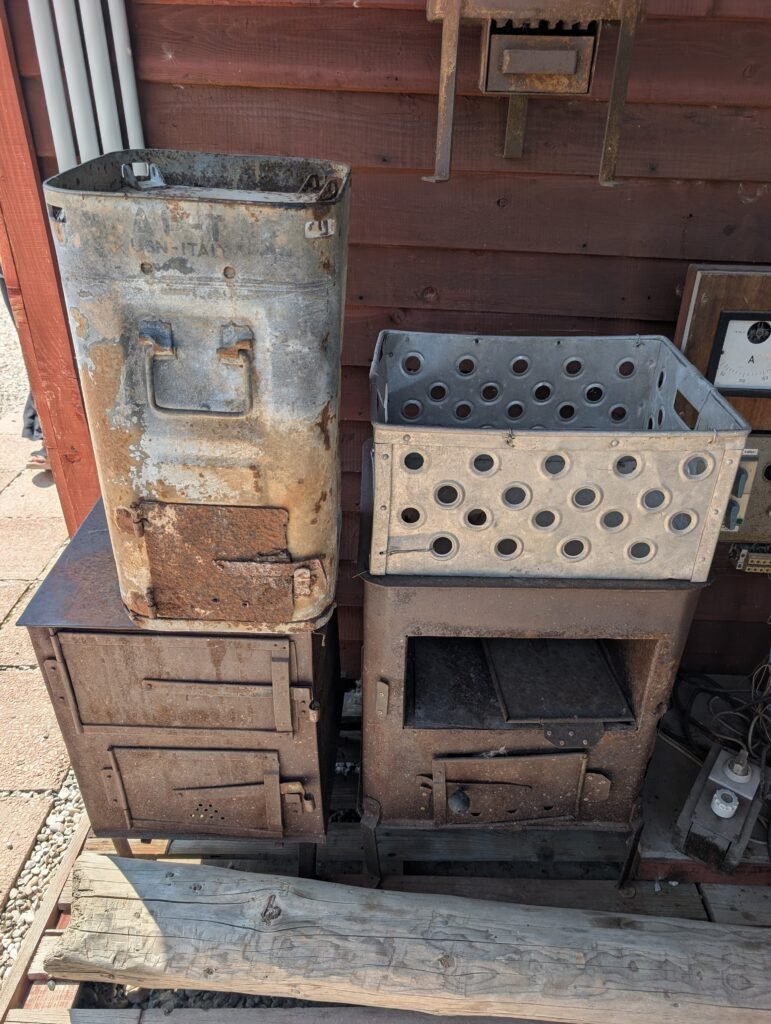
The audio guide had some good background information and some basics about the tunnel, including statistics, dates, and that sort of thing. There was a 17 minute video on loop in air conditioned rooms, but it had no volume or commentary, only some random footage from the siege. We were, however, able to walk the length of the preserved portion of the tunnel, and see some of the makeshift equipment people in Sarajevo had built and maintained to survive the siege inside. Due to the museum closure, the Tunnel of Hope didn’t take all that long to visit. We were done in less than an hour. The city bus and the walk to it took another hour to bring us back to where we had stashed our bags in the hostel.
From there, we made our way to the train station in plenty of time to catch the train to Mostar, renowned to be one of the most beautiful train journeys in Europe. Click the tile below to read about Mostar.