Slovenia
Lesser Known Alpine Europe
I arrived in Ljubljana later in the afternoon of Thursday, July 23rd. There was no effective way to get from Rimini to Ljubljana by train. The best option I found cost €120, had three transfers, and took about 12 hours. I could, on the other hand, take a pair of trains to Venice Mestre, and from there catch a bus or other wheeled transport into Slovenia. The problem with this was that it wouldn’t be on the same itinerary. If, as often happened, the Italian trains were not on time, I could miss my connection in Mestre, and Tren Italia would have no obligation to make good my onward connection. I thought it best to wait until I was confident about when I would arrive at Venice before booking the last leg of the trip. I monitored this, and the trains got me to Mestre within ten minutes of the scheduled time.
As I was within an hour of Venice, I became confident enough to search for my ride on to Ljubljana. I checked FlixBus, ItaBus, and even BlaBlaCar. BlaBlaCar had a driver offering to leave Venice just under an hour from my arrival time. That would be perfect, and much cheaper than any other option. I booked that almost two hours before he planned to depart. Apparently, that driver was just fishing for a carload of passengers. He canceled the trip within ten minutes of the slated departure, leaving me to start from scratch looking for a bus. By then, there wasn’t another bus scheduled to leave for nearly three hours. I booked it, and in the end still saved almost €80 over the train tickets and arrived sooner than the train would have even after a traffic jam delayed us another hour.
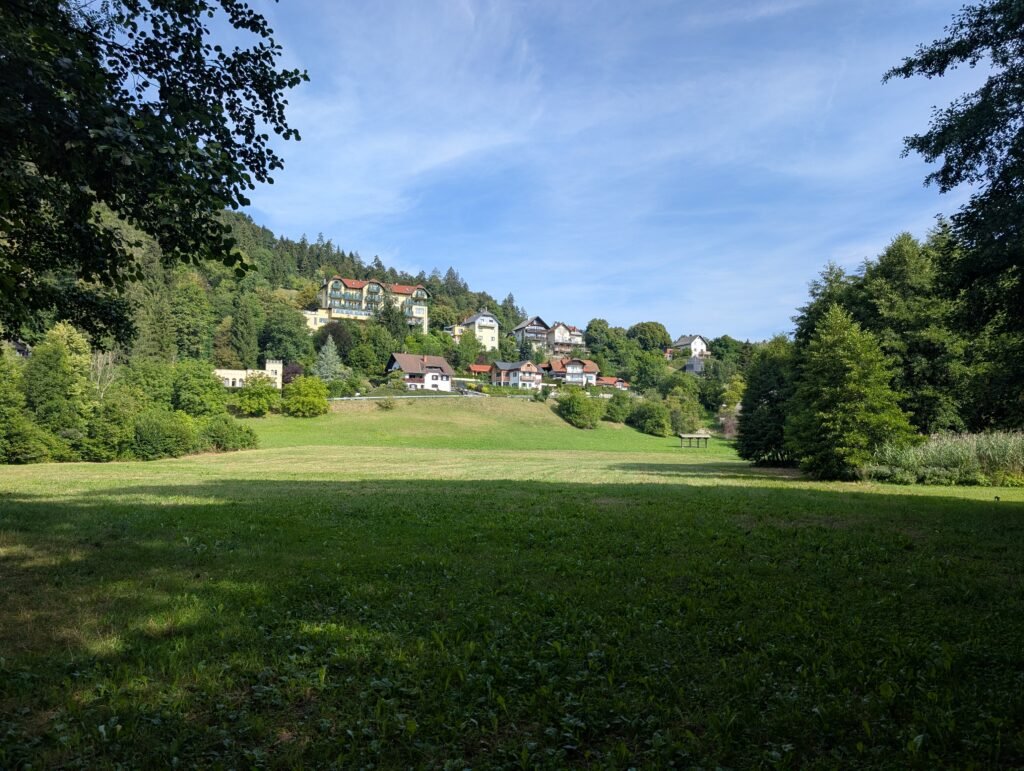
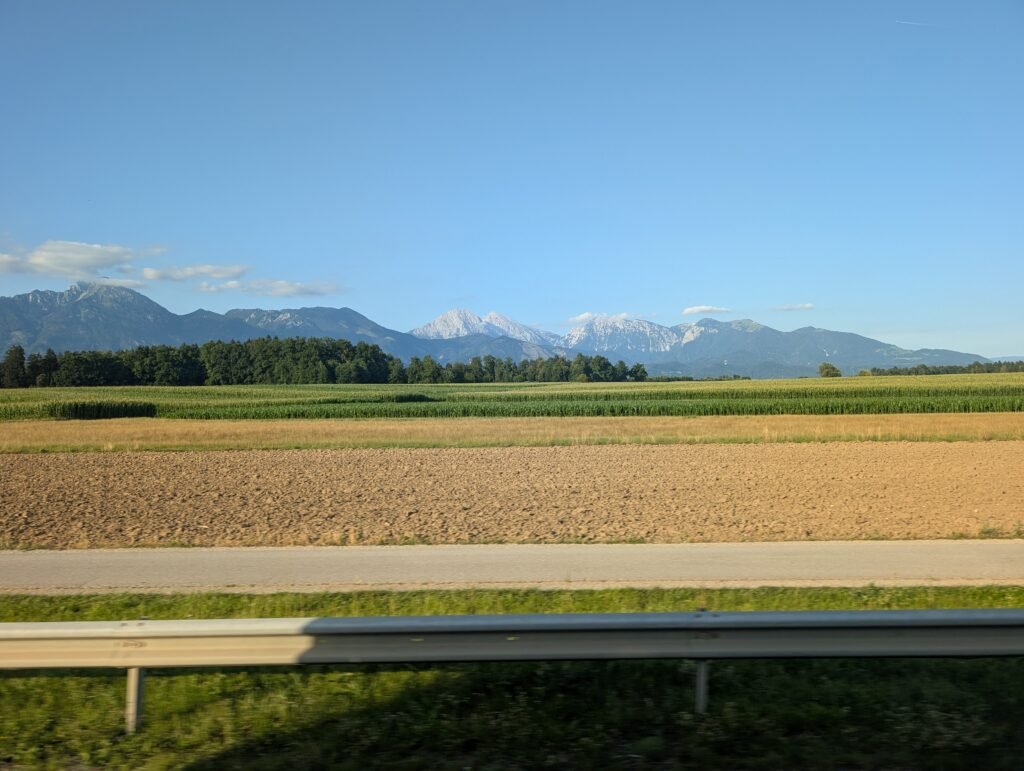
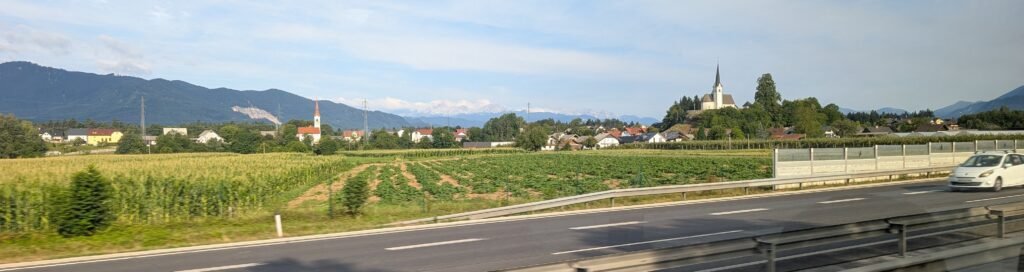
I spent most of the travel day alternating between looking out the window, writing about San Marino, and researching what to see and do in Slovenia. Slovenia has a lot to offer. First of all, it’s a beautiful place. Virtually the entire country is green. It is very much an alpine country. Much of the northwestern part of the country looks the way I imagine Switzerland and Austria would, though I have yet to visit those places. There are mountains and valleys, glacial lakes and ski lifts, chalets and lovely villages blessed with cooler weather.
I doubt most Americans know where Slovenia is. I think most people probably confuse Slovakia and Slovenia, if they have even heard of either. Both countries were parts of other nations in my lifetime. Slovakia separated from Czechoslovakia after the fall of the Soviet Union, and Slovenia was formed during the breakup of the former Yugoslavia. In fact, Slovenia, Croatia, Bosnia, Serbia, Montenegro, North Macedonia, and Kosovo (if you count Kosovo as a country) were all part of Yugoslavia when I was in school. Of these, Slovenia and North Macedonia were the only ones that avoided most of the Balkan wars of the 1990s.
I really would have liked to have stayed in Slovenia longer than the few days I was there. It was peak tourism season in July, however, and it was difficult to find accommodation at any reasonable rate. The country is small enough I decided to base myself out of a Ljubljana hostel for at least the first couple of days. Upon arriving, I searched for a grocery store and a restaurant that claimed to serve local food. I went to the restaurant first and ate a tasty meal, which included some of the potatoes Slovenia is most famous for. Slovenia has a sort of mix of Italian, Central European, and Balkan cuisine. It is pretty heavy on meats. The restaurant was Stalka Pri Vodniku, a Slovenia Kitchen. I ordered a house special. The plate included a thin steak, similar in texture to what you might expect in South America. This was accompanied by prazen krompir, a tasty if not particularly exciting dish of sauteed potatoes with onions. After I was charged table service and beverage, it wasn’t all that cheap, though I would say that in general, other than motel rooms during peak seasons, Slovenia wasn’t all that expensive.
(Continued)
My plan for the next day (Friday, July 24th) was to do two separate walking tours. There was a general walking tour of Ljubljuana at 11:00 a.m., and a walking tour of the “old town” that ended atop the hill at the castle at 3:00. Both were slated for about two hours and didn’t require preregistration. Just show up at the square and check in with the tour guide. The tours were advertised at the Sleep & Go Hostel, where I was billeted.
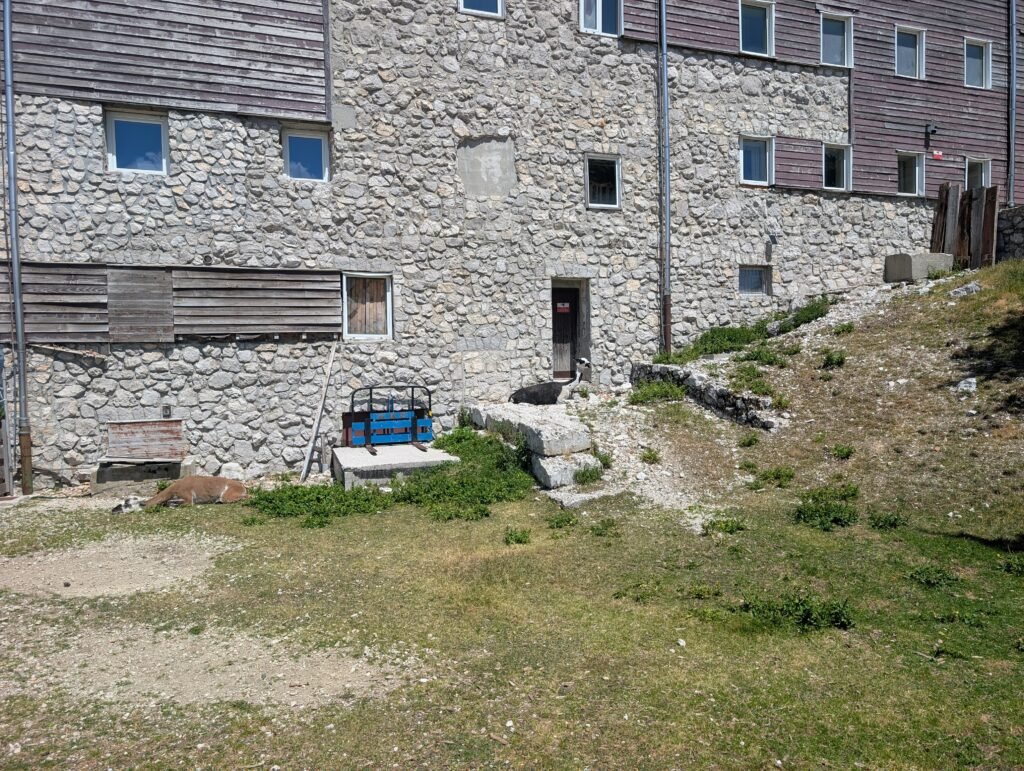
Sleep & Go was an appropriate moniker for the place I stayed. It was clean and relatively new, but there was no staff on site. There was no common area for socializing. The tiny kitchen could never have accommodated all of the people staying there. I suppose most must have been eating out. We slept in tiny compartments sort of like mailboxes that you crawled in longways from the front with a curtain for privacy. There was a small shelf, a light, and electrical outlets inside, so in some ways it was a tiny private space. The room was air conditioned, but the cubicles were not. They got a bit stuffy at night. Mostly, people respected the quite hours, though guests were coming and going at all hours. The place had no freezer and no way to change out towels since there was no staff. All in all, it was an OK experience, but it didn’t give you the warm feeling of interacting with other travelers that hostels can sometimes provide. It served the purpose, though, of providing a place to sleep from which I could explore Ljubljana.
I had ample time before my first tour on Friday, so I rose early and ran. I ended up in a pretty big nature park with trails that diverged and went all different directions. By the time I got spit out, I was totally lost. Since I had the Pixel Watch, I wasn’t carrying my phone. I thought I might be able to navigate back with the watch only, but I didn’t buy the version that connects via cell towers. It couldn’t provide navigation. I wandered around until I found a bus stop with a map on the wall, got my bearings and learned that I was a LONG way from the hostel. I alternated running and walking kilometers back, and ended up putting in a total of more than nine additional km. By the time I was done with my walking tours, I put in over 31,000 steps that day.
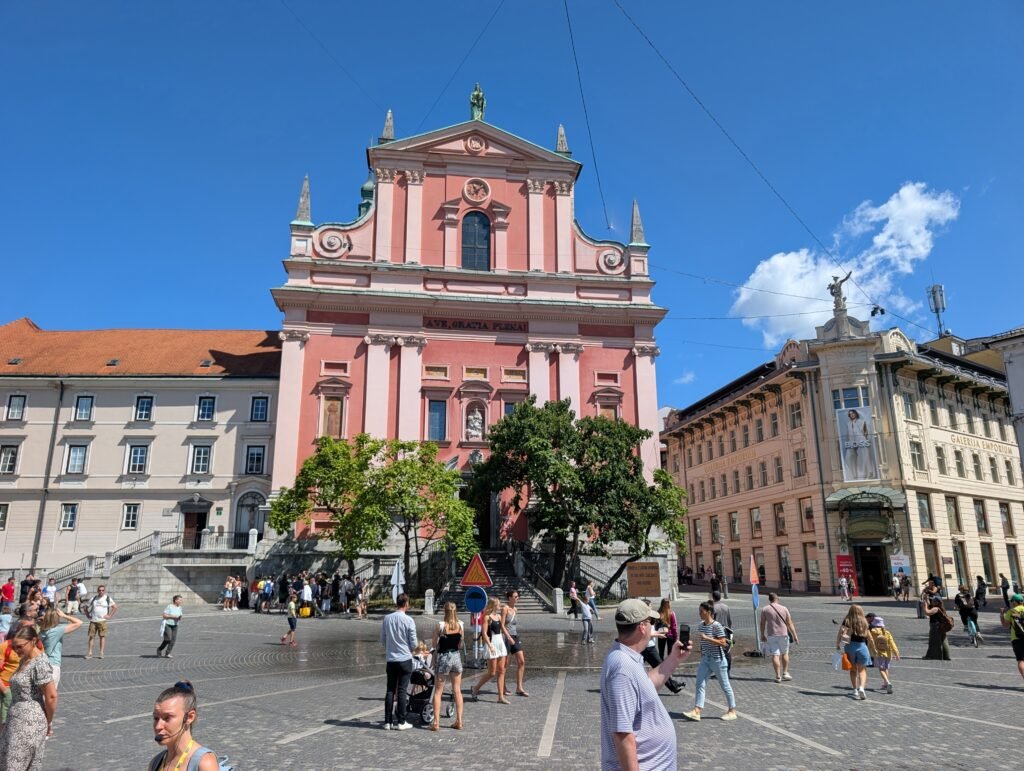
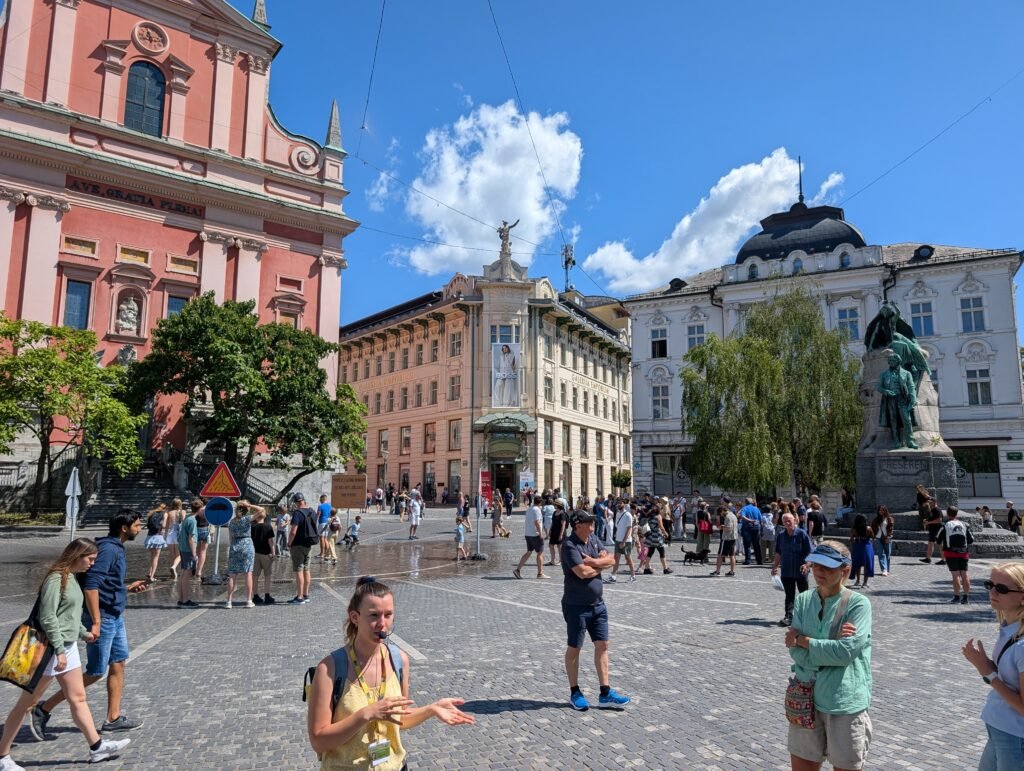
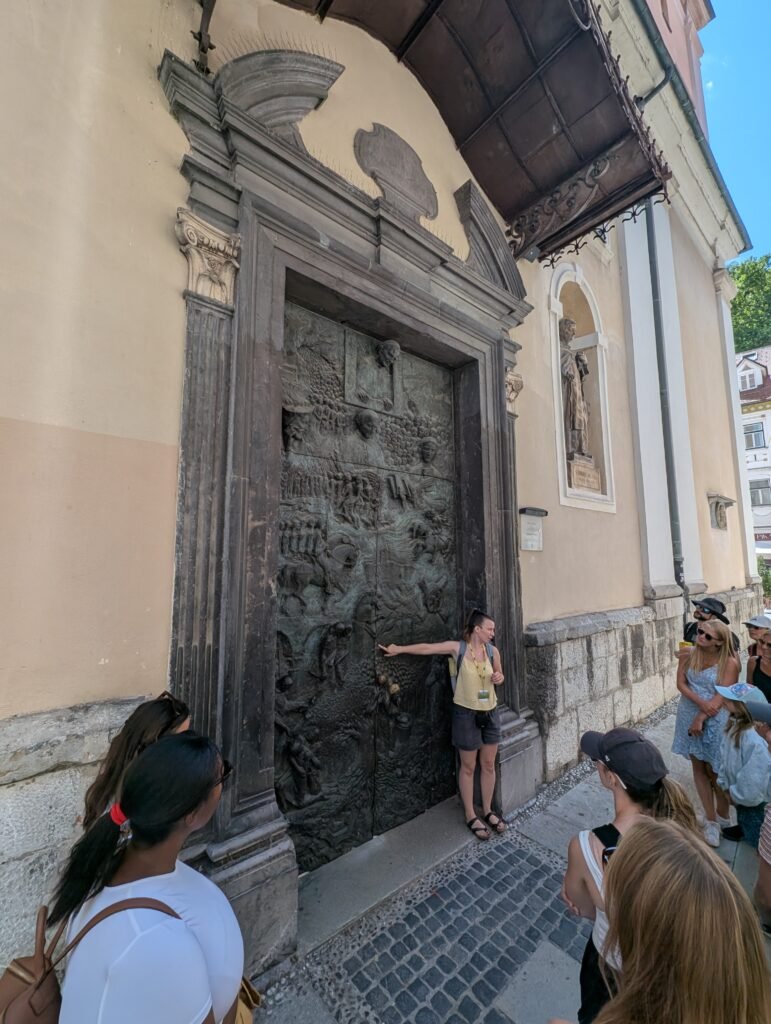
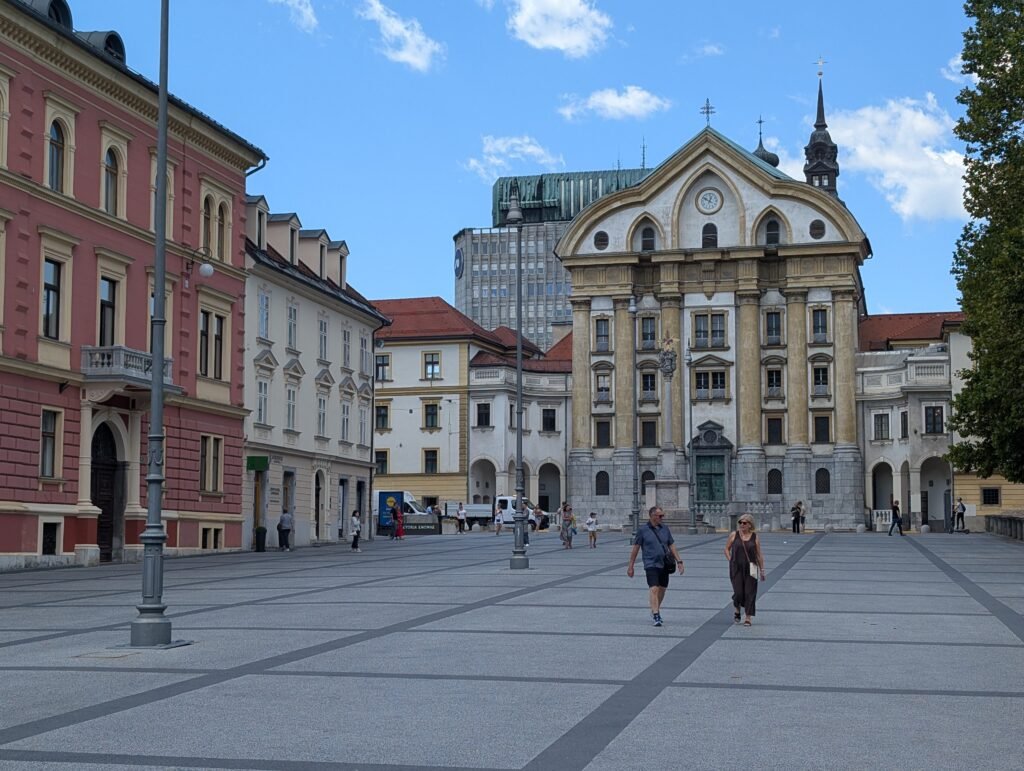
My first walking tour was a city overview. It began in a historic square in front of a pink church. The Church of the Annunciation was built in the 17th century. It was originally an Augustine church, but was later designated Franciscan. The current building dates to the 19th century. In these walking tours, I often see a number of different sites, and choose the ones I am most interested in to return to later during opening hours when I will have more time than I would as a small part of a two hour walking tour. In this case, I had seen so many magnificent churches, I decided to skip out on the inside of this one, especially considering just about everything in it had been created or recreated during the 19th century or later.
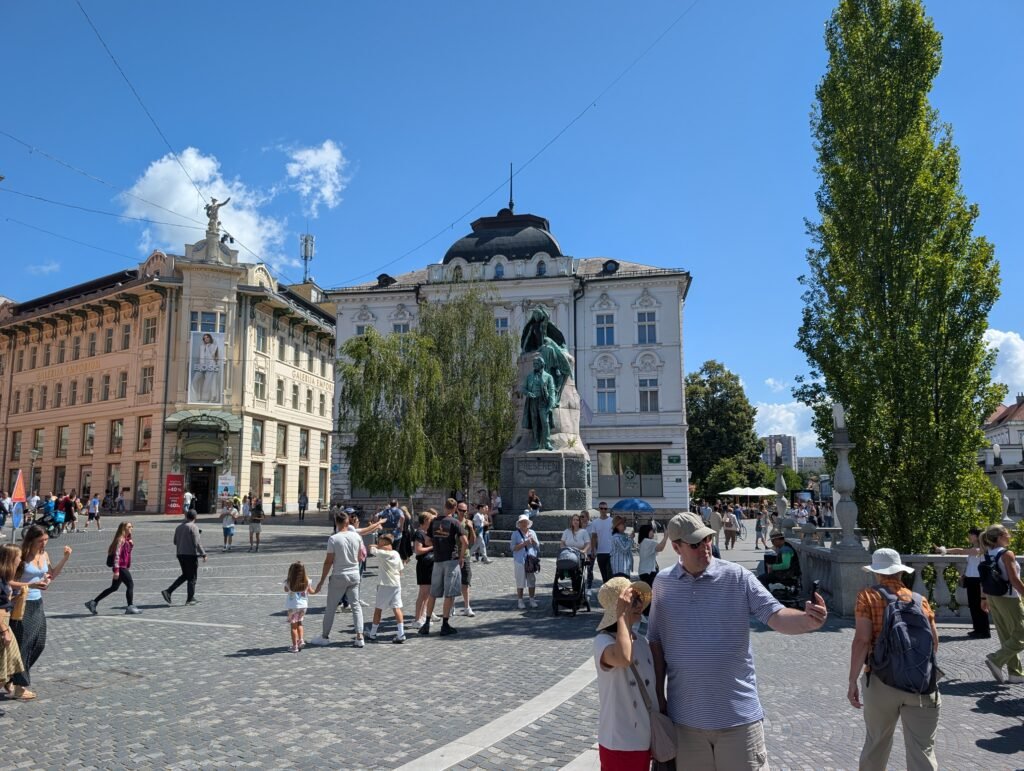
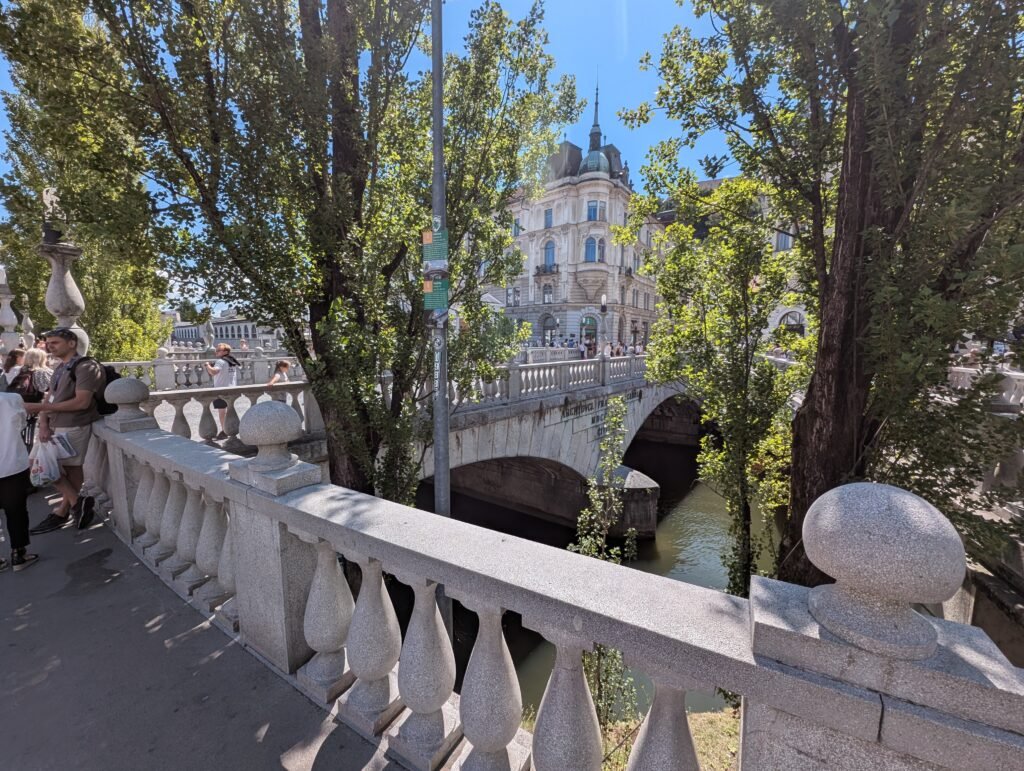
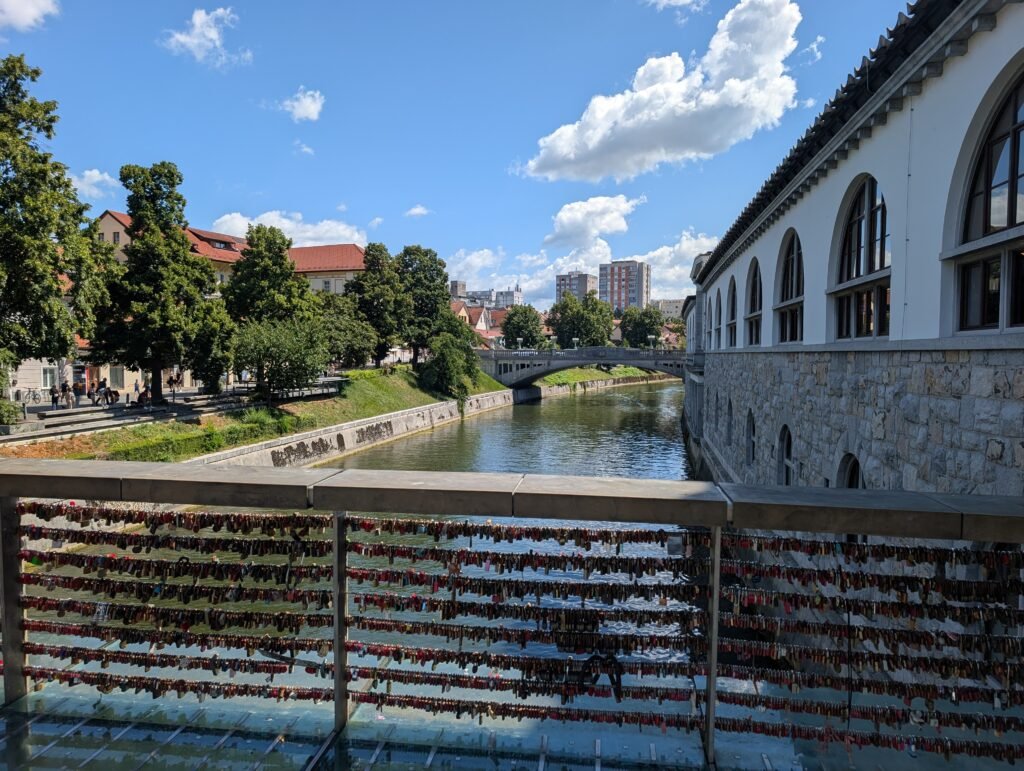
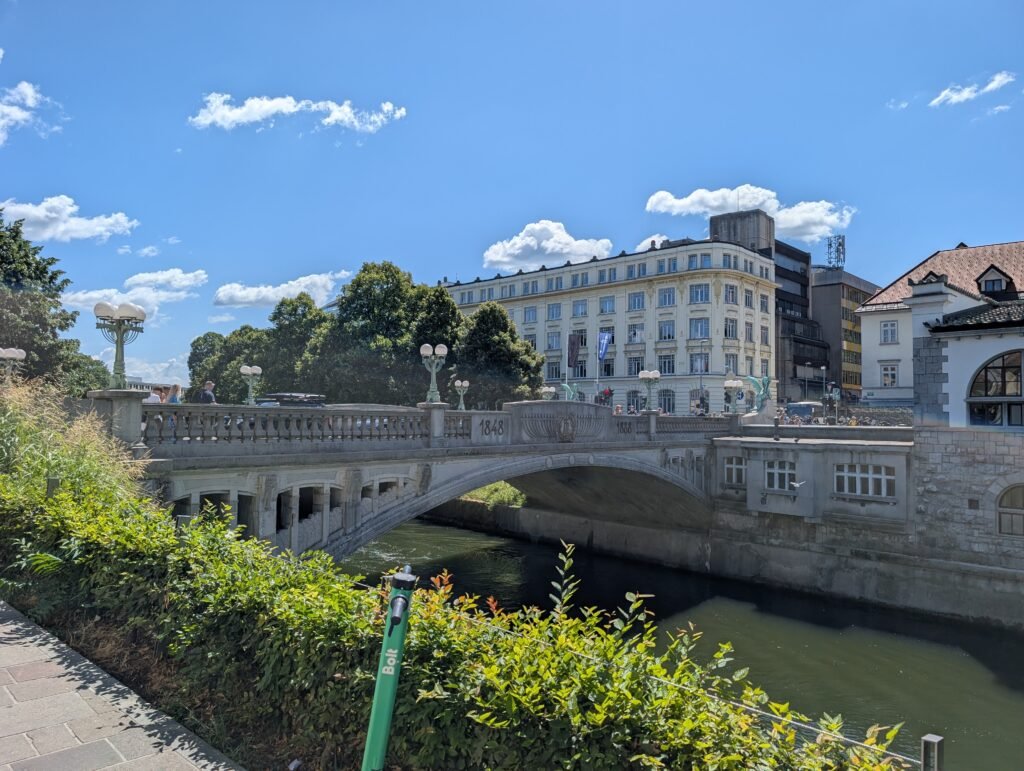
This church is on the edge of Preseren Square, where the tour began. We passed Plecnik’s Collonade, and saw several other examples of his architecture. Plecnik is a sort of unofficial state architect of Slovenia. He loved columns and nearly anything he designed has them in it. We also passed several bridges – Triple Bridge, Butcher’s Bridge, Cobbler’s Bridge, and the Dragon Bridge. They all cross a deepened channel of the Ljubljanica River. The word Ljubljana means something like “inundation.” The river used to flood often, so the channel was deepened to better manage flooding. During the medieval period, waste was cast into the streets and ran downhill toward the river through small channels in the centers of the narrow cobbled streets. The Butcher’s Bridge was so named because butchers did their killing right there near the river so the water would wash away their waste. If a butcher was caught cheating, he would be put into a cage and lowered into the river. They’d bring the guy up before he drowned. The purpose was more public humiliation than torture or death.
(Continued)
The river is part of the karst formation. This area has a lot of porous limestone. The river actually goes underground in several places. For a long time, people didn’t know if it was all the same river until at one point, someone put dye in the river before it went underground and sure enough, the dye came back up downstream when the river reemerged.
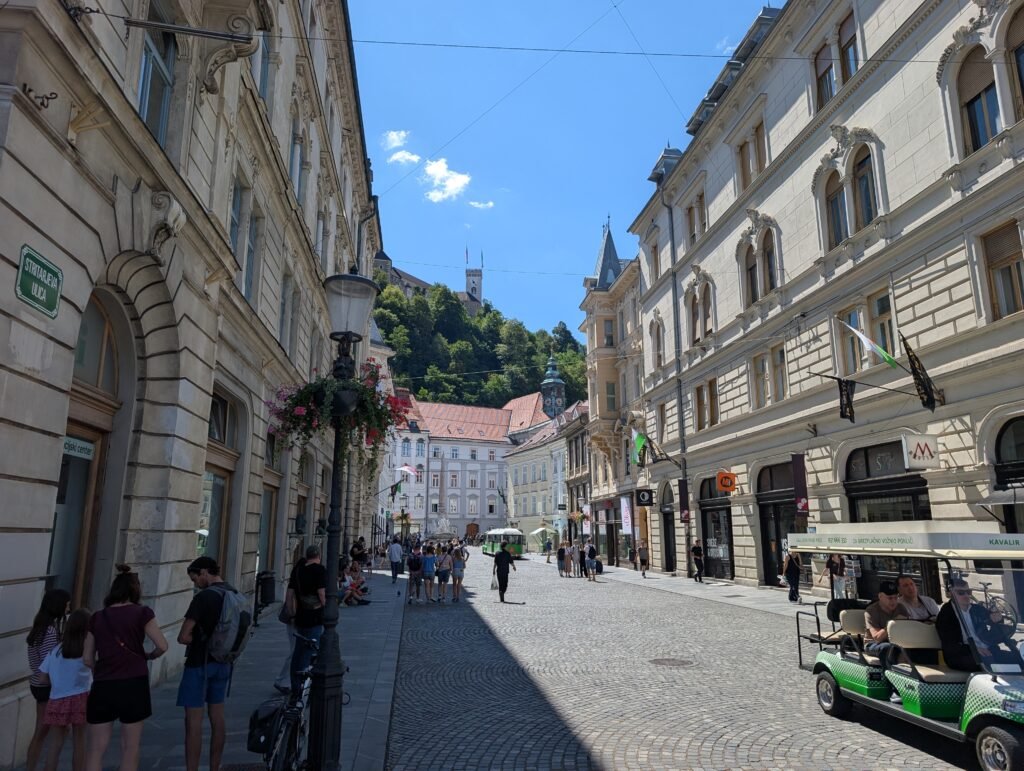
The Dragon Bridge was built in 1901. It has statues of twenty dragons adorning either end and the sides of the bridge. According to legend, Jason and his Argonauts founded the city. On their journey, they had slain a dragon. The imagery now decorates the bridge, as well as other city landmarks. It was also quite apparent as we walked the town how much influence the Austrian style had on the city. It was most obvious in the architecture, but it was also apparent in the religion, the food, and so many other subtle ways. Ljubljana has often been called a “little Vienna,” and you can see why.
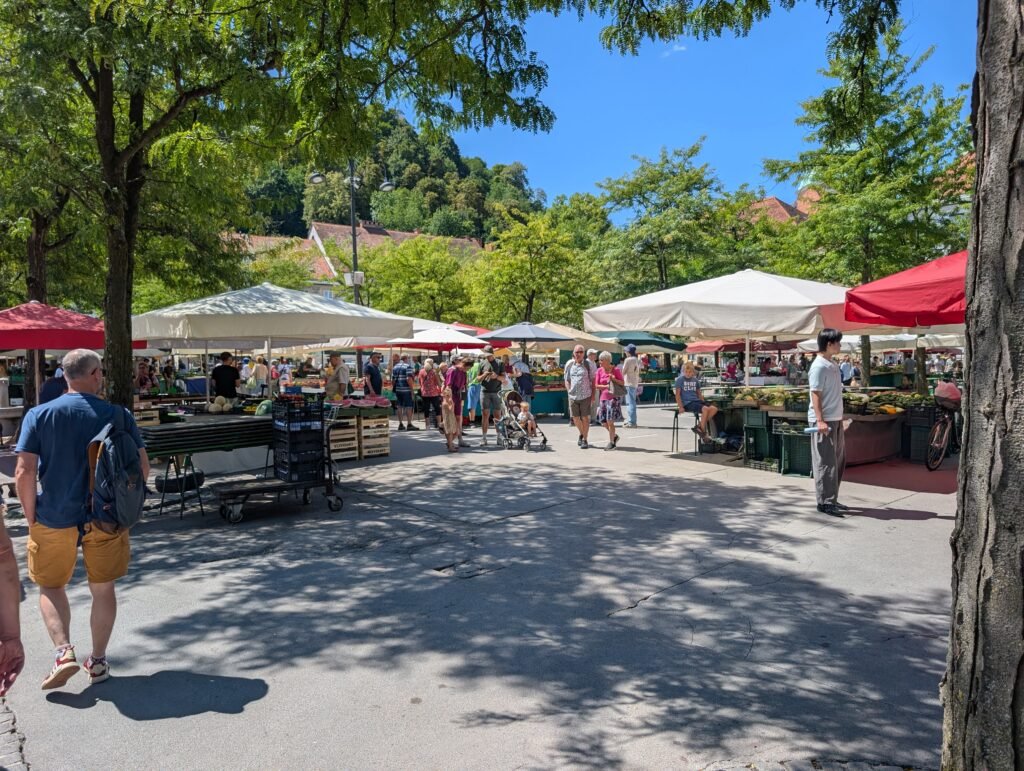
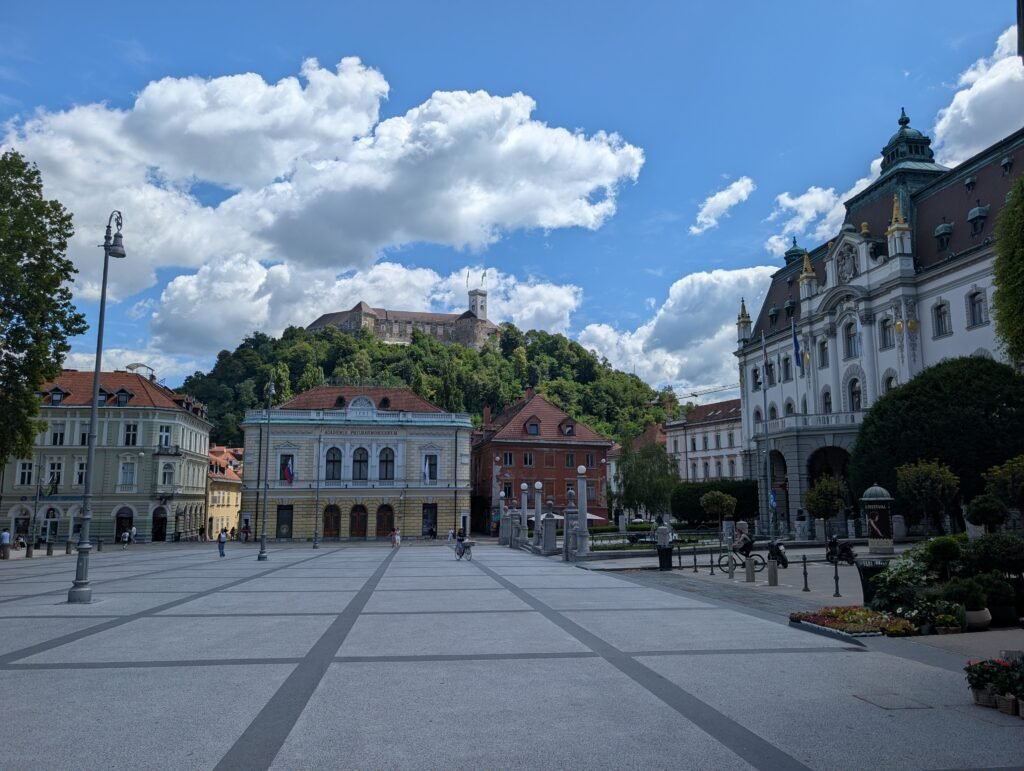
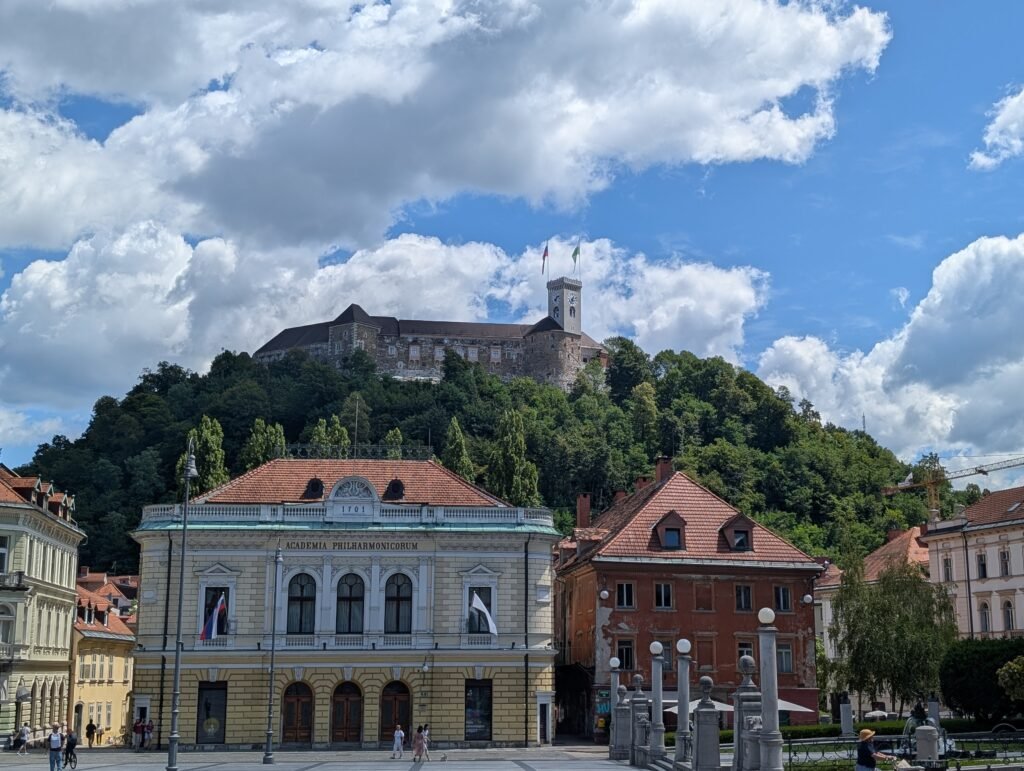
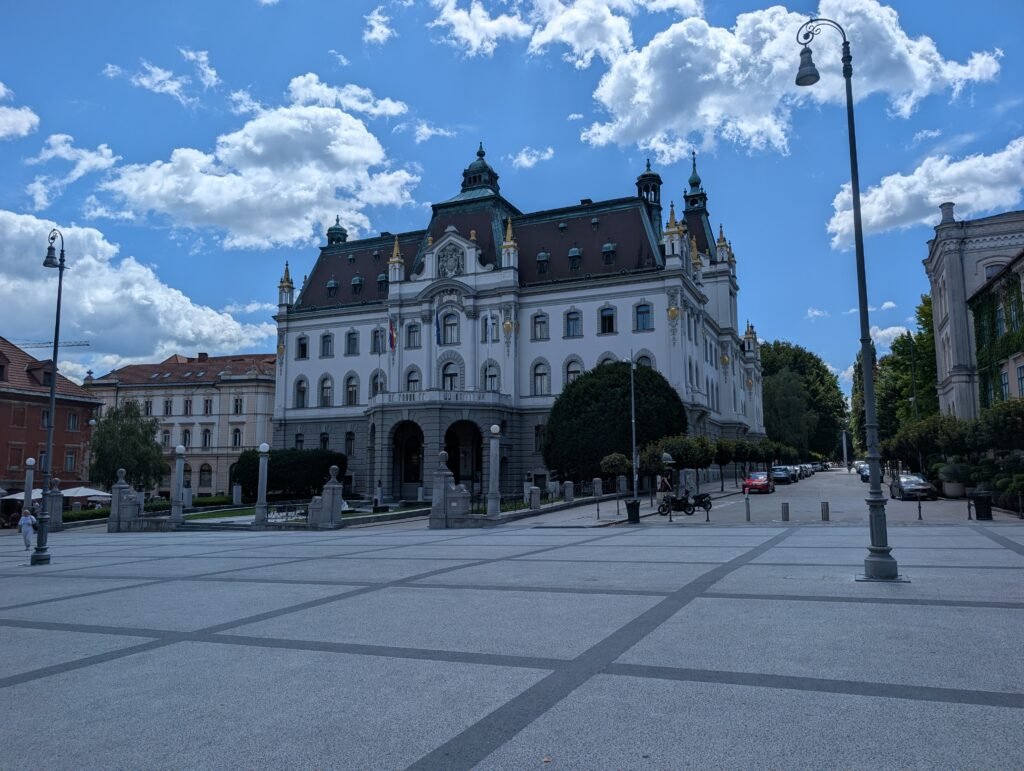
On this tour, we also visited the city library, the main market, the St. Nicholas Cathedral, the national university, and Congress Square. From Congress Square, you can see the castle sitting on a hill overlooking the city. You can also see a promenade were dictator Josef Tito gave a famous speech. While we were there, an older man, seeing that we were in a tour group, thought it important to come by our tour group twice to explain (without much English) how great the former Yugoslavia had been. He was generally positive about it. He wanted us to know that it was a “golden age” and Slovenia’s happiest and most productive time in his lifetime. Apparently, this sort of Yugo nostalgia is fairly common in older folks throughout the former Yugoslav states.
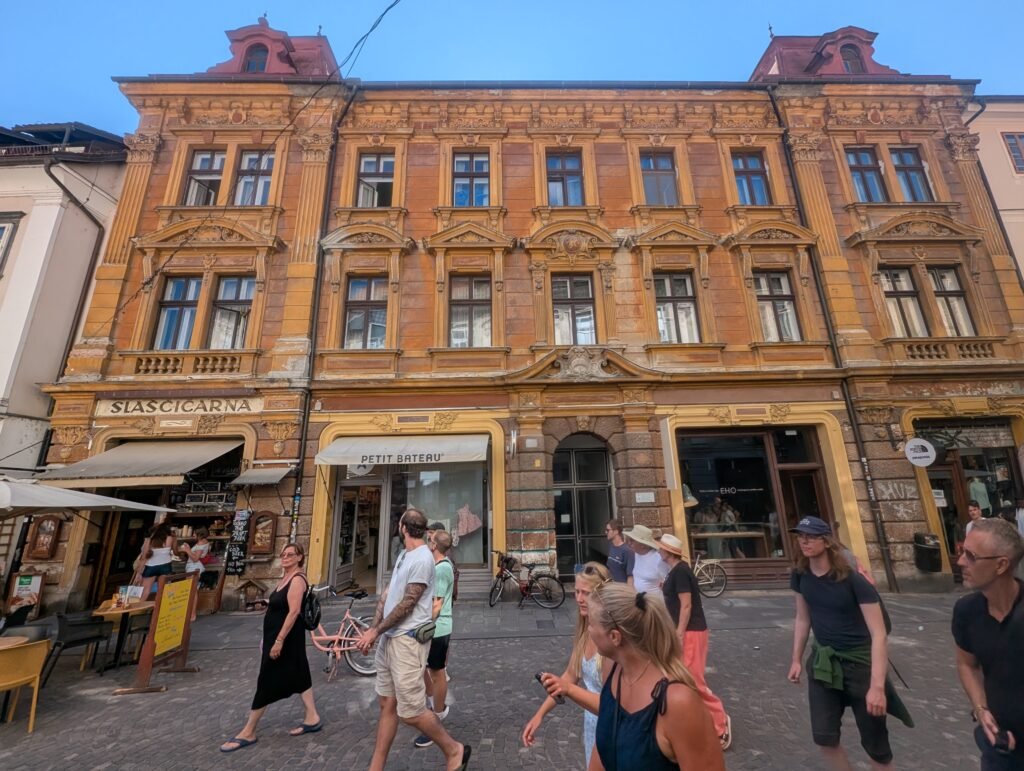
This first tour ended at Congress Square. I grabbed a bite to eat near the market, picked up a couple of postcards, and went back to the pink church to await the departure of my second walking tour as I wrote out the cards. The latter tour focused more in medieval and Austrian Ljubljana. It ended at the hilltop castle. We stopped at the locksmith alley and the fishmongers’ street. In medieval times, all of the artisans of one type or another plied their trades in the same part of town so as to be easily found in an era before other means of advertising. These streets were not only named after their respective trades, but had icons next to the names so the illiterate could also find what they were looking for.
Our tour guide also explained the means of transportation and taxation in the feudal era. At one point, Ljubljana was declared a “free city,” meaning that citizens in that town were not bound to the land as serfs were in feudal societies. It also meant that visiting the city required payment of certain taxes to enter and leave (if you were a merchant or traveler). The Austrian crown, apparently, dictated that merchants traveling the empire had to make stops in every city along the way, and they were proscribed in the city books as they came and went. They were also issued a sort of passport document that had to be stamped to ensure they visited every one and paid the appropriate taxes. Some cities would not have been profitable enough to generate revenue to justify the stop and the tax, but if they didn’t visit every city, the Austrian crown retroactively charged them the taxes at later stops for the cities they had missed. If they were going to have to pay the tax for visiting said city in any case, better to at least squeeze out what trade they could.
(Continued)
We talked about disease and hygiene in the era. We visited a couple more churches. On the way up to the castle, we visited the executioner’s house. Like most other professions in the medieval period, you got the job of hangman, generally, through heredity. However, every town needed an executioner, and sometimes no heir was produced or something else happened to them. In this case, they offered the opportunity to the condemned criminals to become the hangman in exchange for their sentence being commuted.
This wasn’t quite the reprieve it seemed. The condemned simply went from a life condemned to end early, to a life of being persona non grata. No one wanted to dine, visit, or sit near the executioner at church. No one wanted to live next to him either. As such, his house was always on the edge of town. Eventually, citizens of Ljubljana had petitioned the local governing body to force his removal to a place about halfway up the hill toward the castle, where it stood as we passed it.
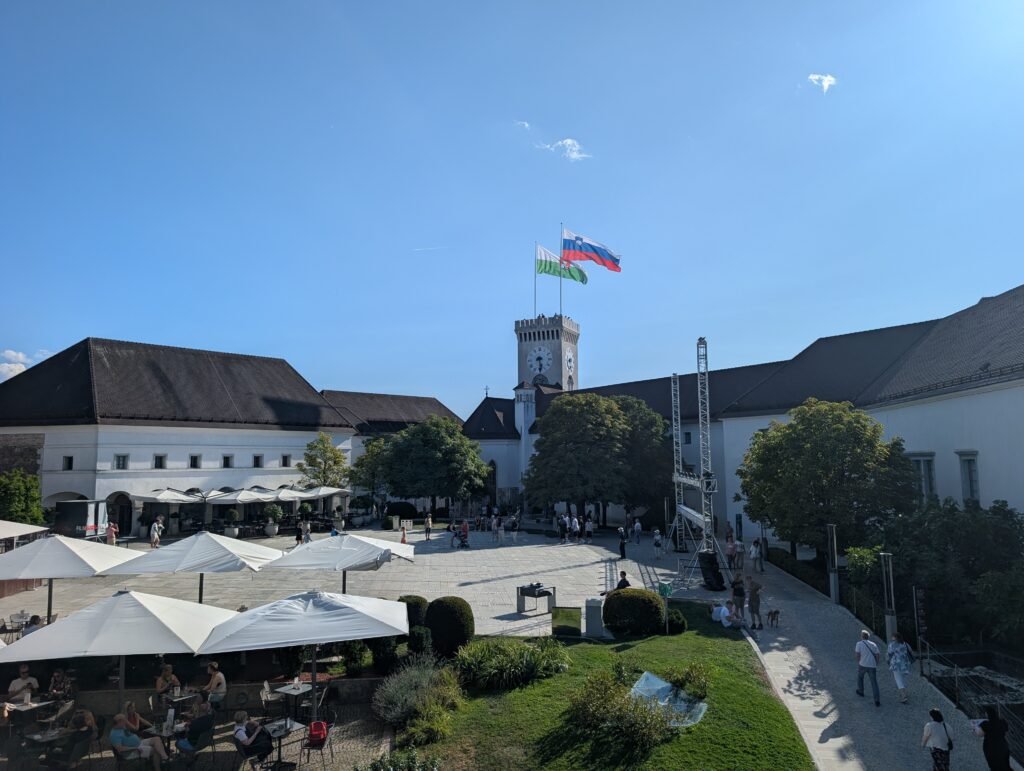
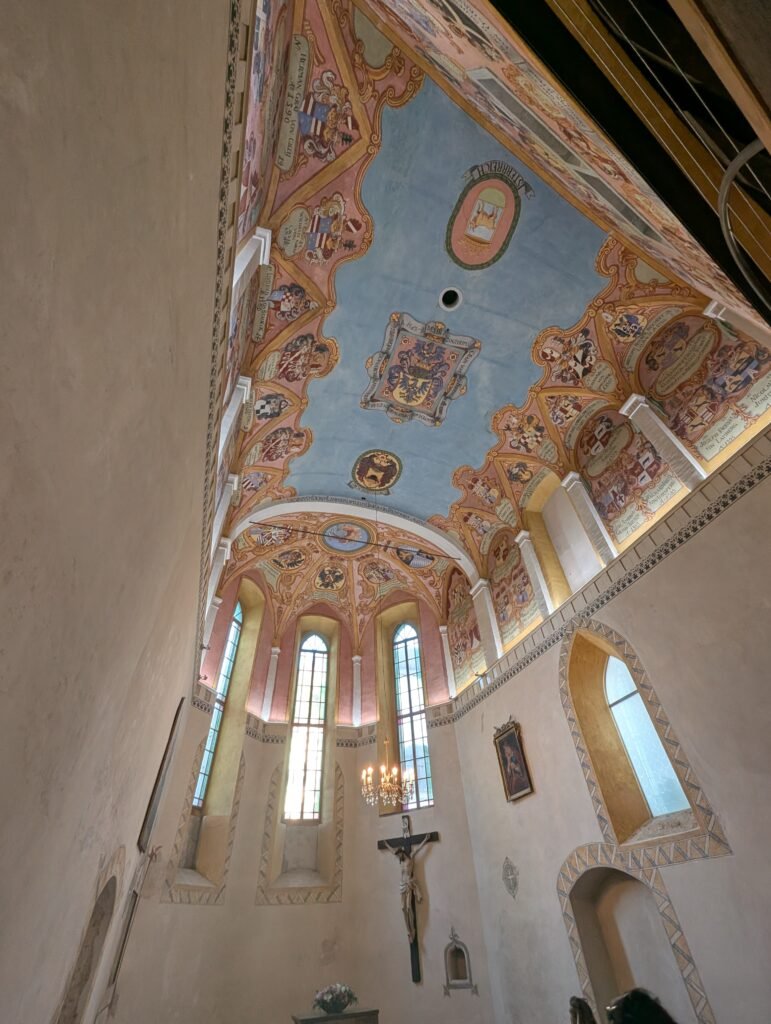
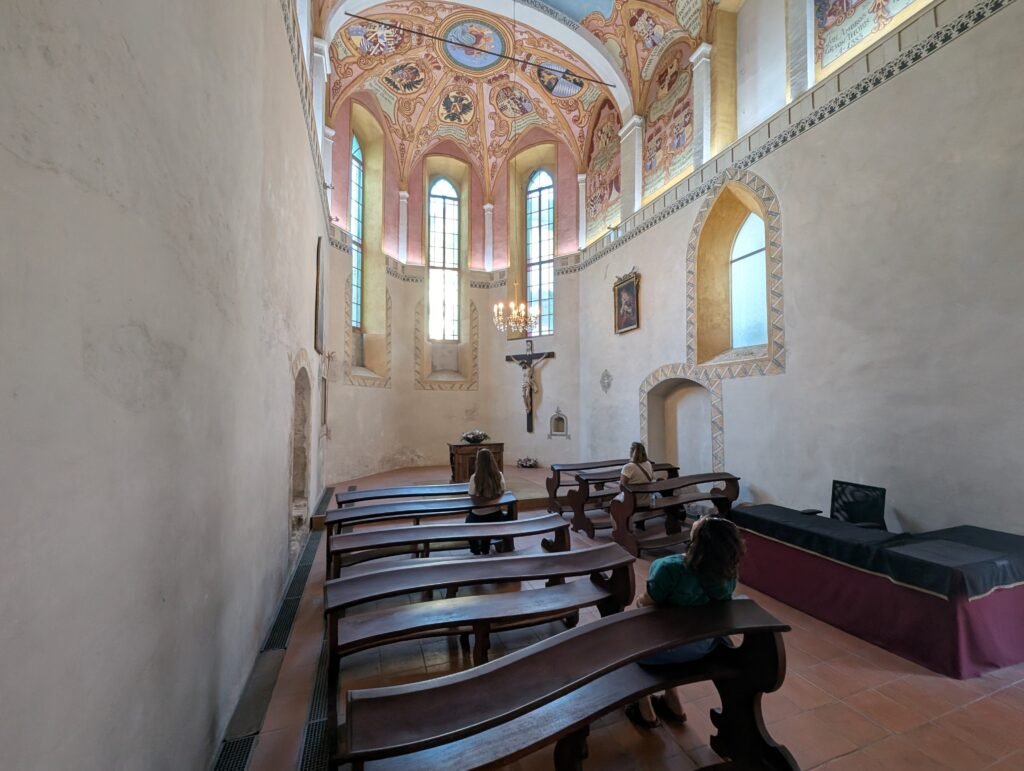
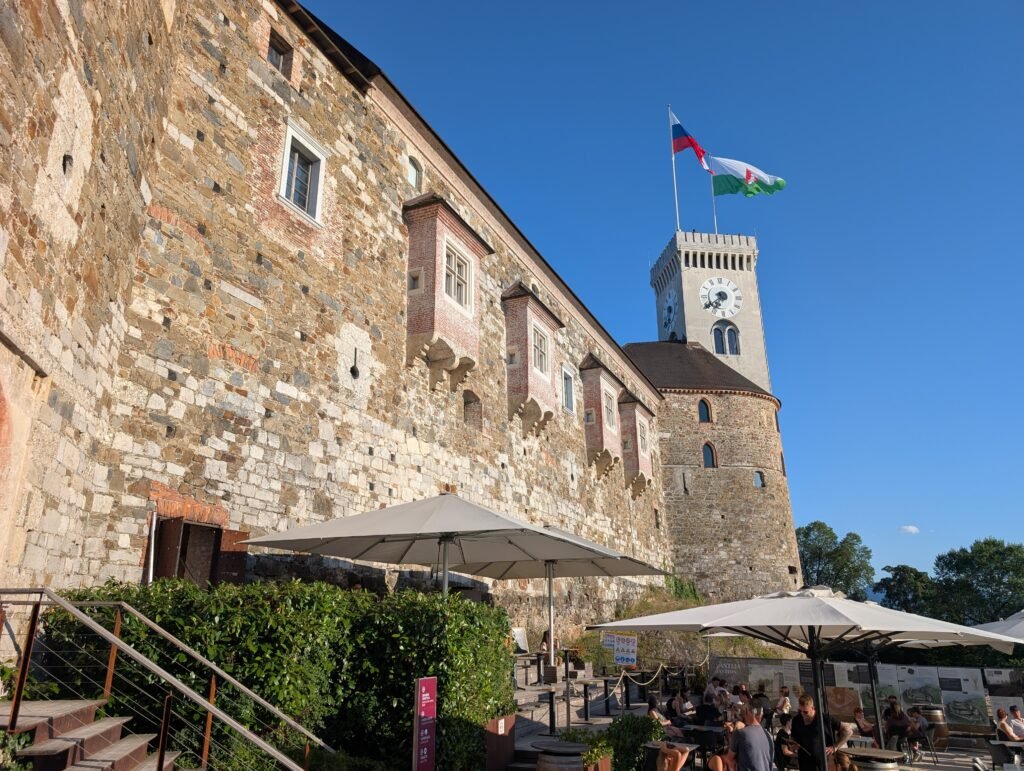
The tour ended at the castle. The original Ljubljana castle had been built in about the 12th century by the Spanheim family, nobles ruling the area. At different times, it was part of the small kingdoms of Carniola and Bohemia. Ultimately, possession passed to the Hapsburgs as happened to much of the area. The Hapsburg monarchy reinforced the castle and gave it a similar appearance to what can be seen above the city of Ljubljana today. It wasn’t the seat of a national government of course, but it was a stronghold where powerful leaders could stay when they paid visits to the area. As is the case with many European castles, the one at Ljubljana underwent major stylistic renovations in the 19th century after periods of disuse or inactivity. The idea was to make it usable, attractive, and maintain the ambiance of the Hapsburg era castle.
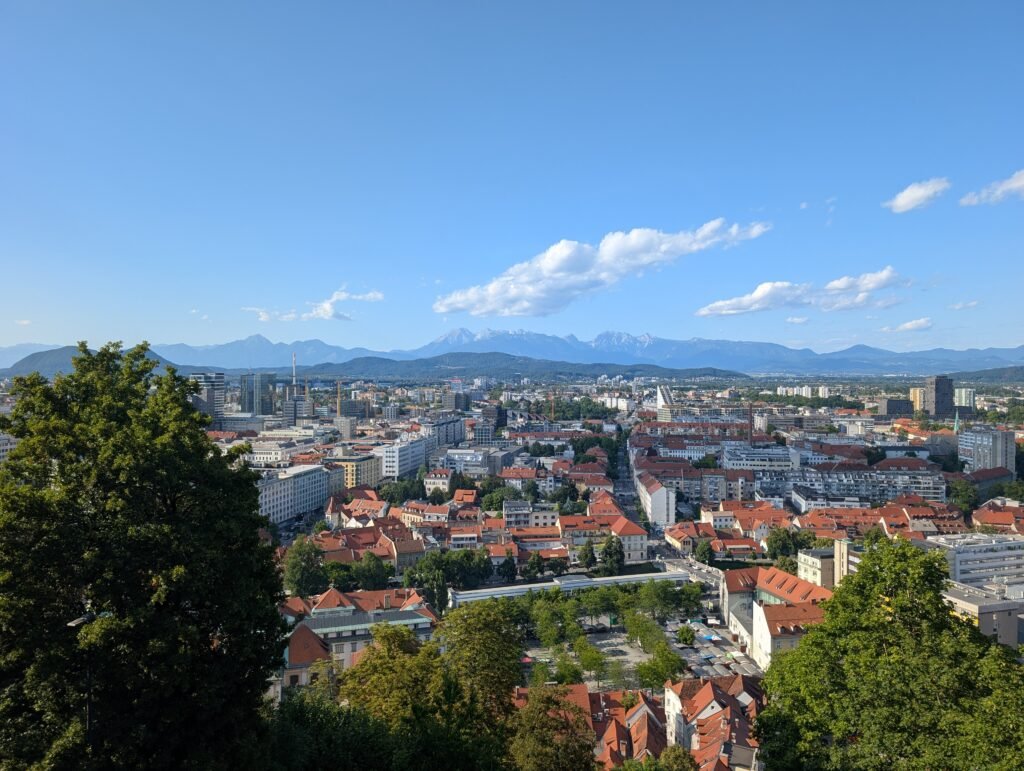
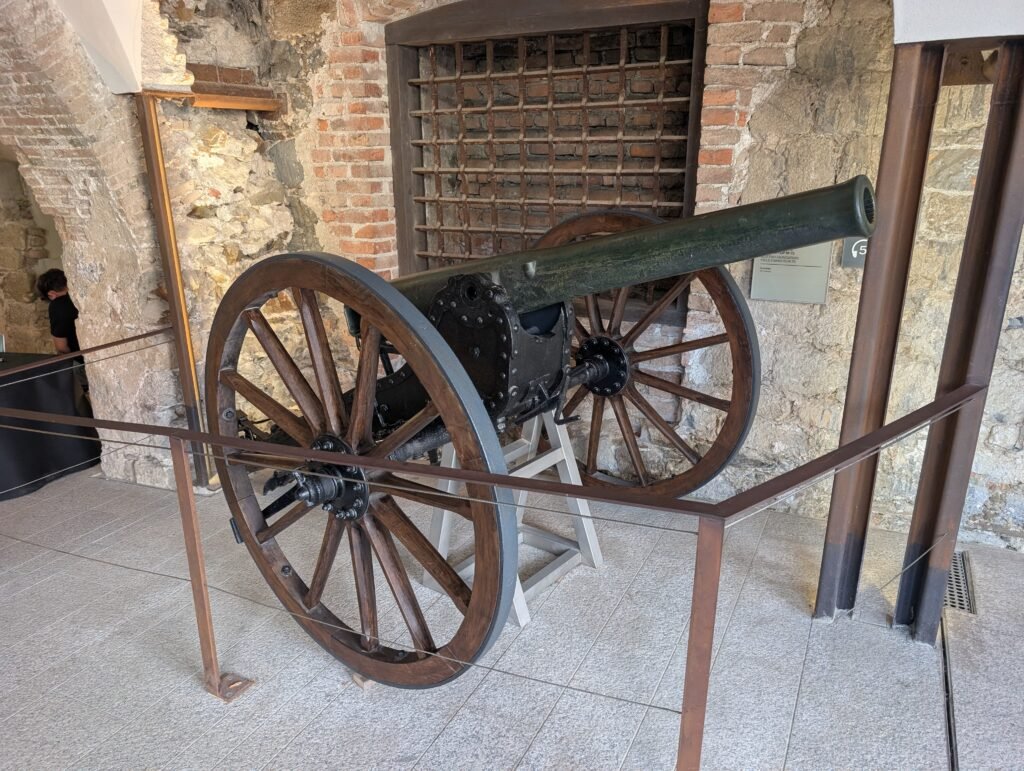
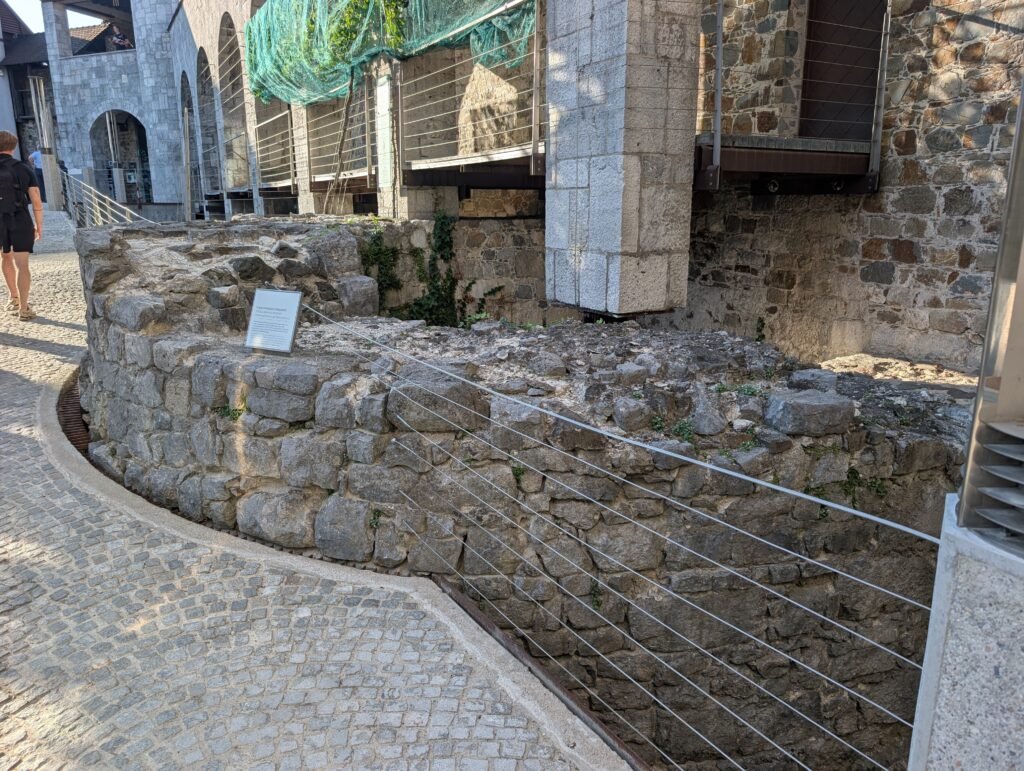
Surprisingly, you can visit the castle free of charge. There are a few small areas that require ticketed entry. There are a couple of small, seemingly inconsequential museums, and a clock tower that you can only climb or enter with a fee. I opted not to climb the tower, as I was able to walk the walls free of charge, and the castle was already atop the highest hill anywhere near. I had great views all the way up the hill, let alone on top of the castle walls. I was able to observe the few remaining bases of walls from the Spanheim castle. I saw the area once used as a prison, and the Kazemates. I don’t think I missed much by not paying the fee.
To be honest, more of the castle space has been dedicated to Michelin star restaurants and gift shops than historical interpretation. I suppose that is at least in part due to the fact that the castle just isn’t all that historically significant. It is cool to walk around and take pictures from, though. It was worth hiking the hill, and I enjoyed both tours I did that day. It was a solid overview of the main older part of Ljubljana. I stayed in that night for dinner since I had eaten lunch out in the market.
(Continued)
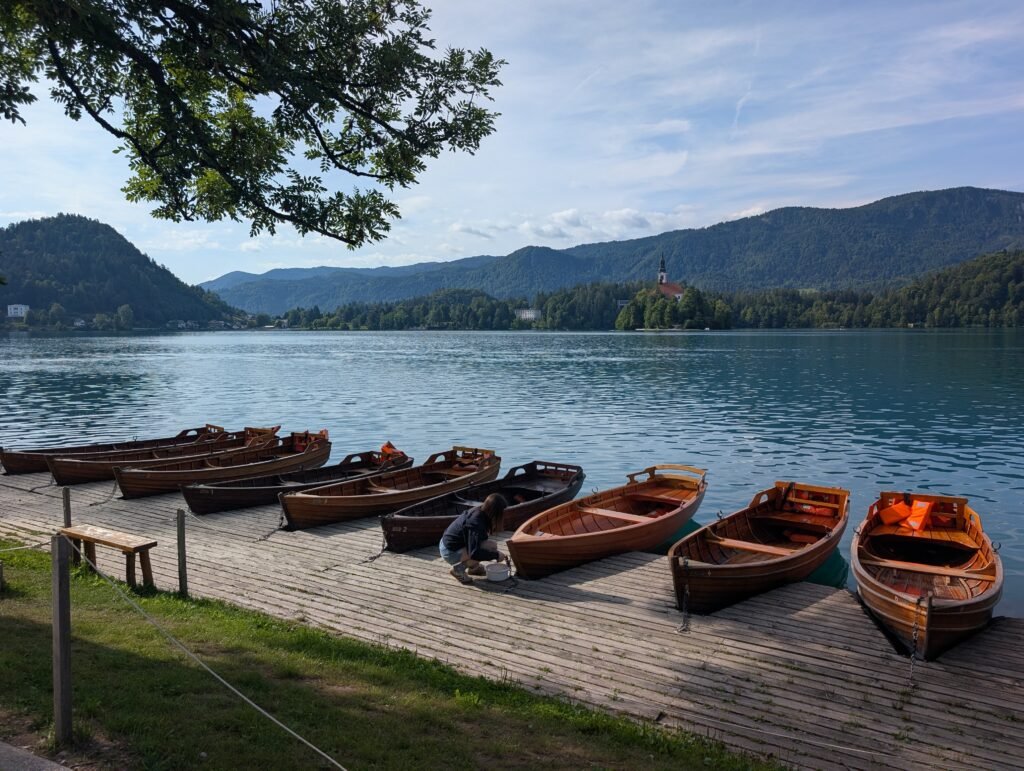
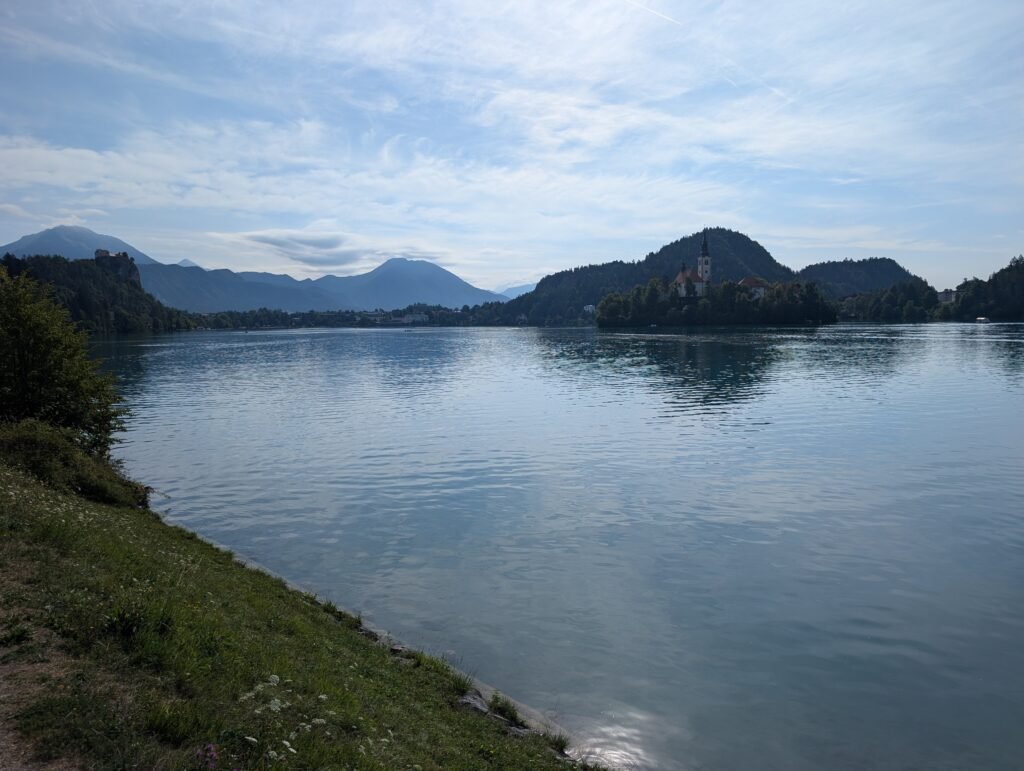
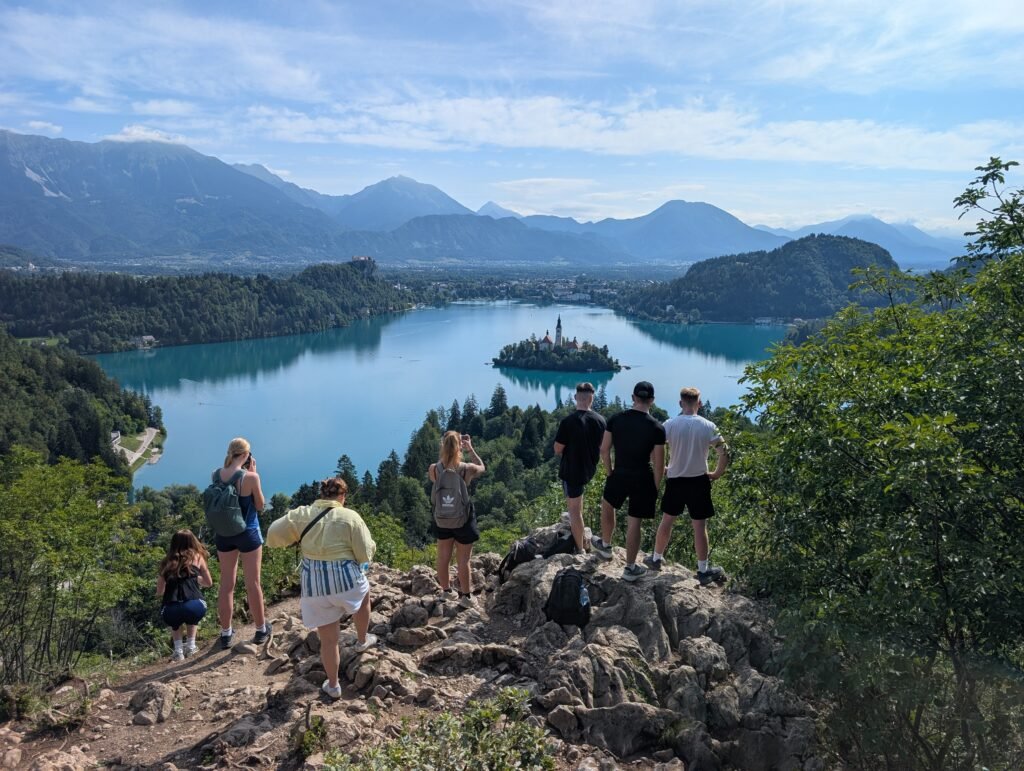
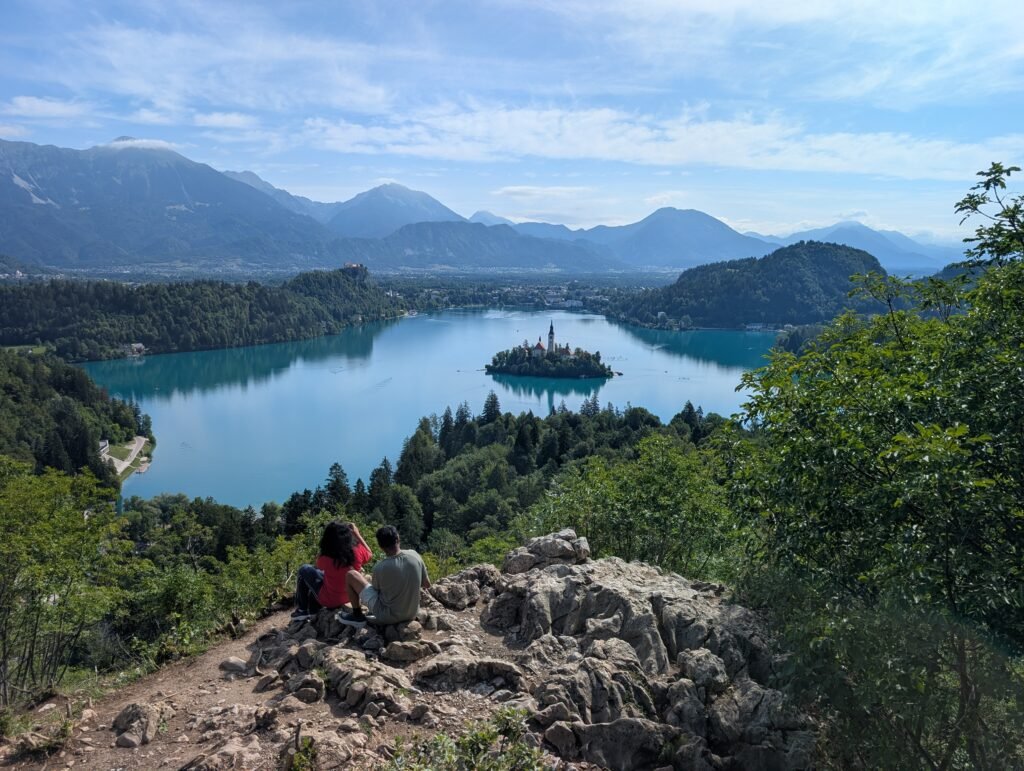
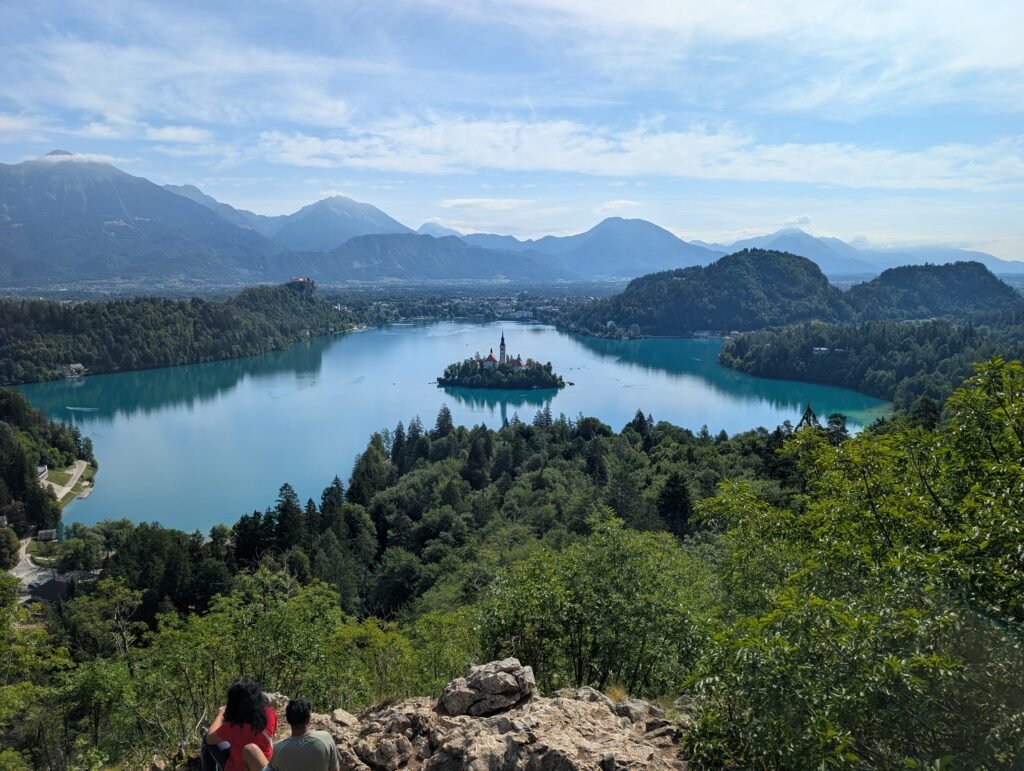
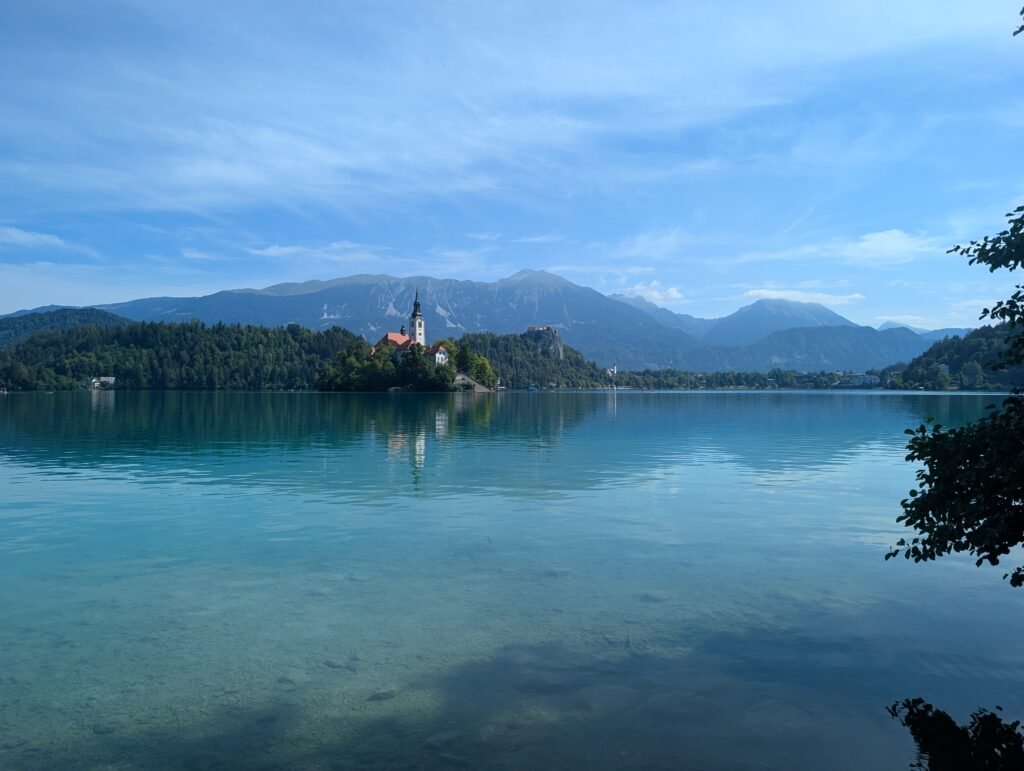
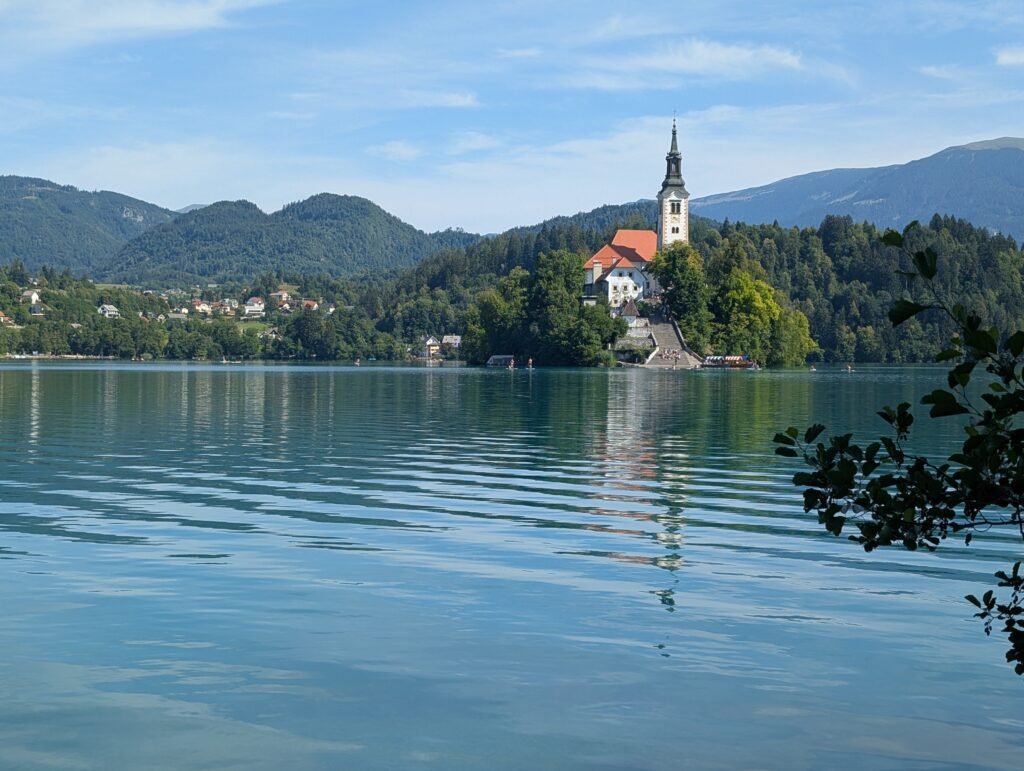
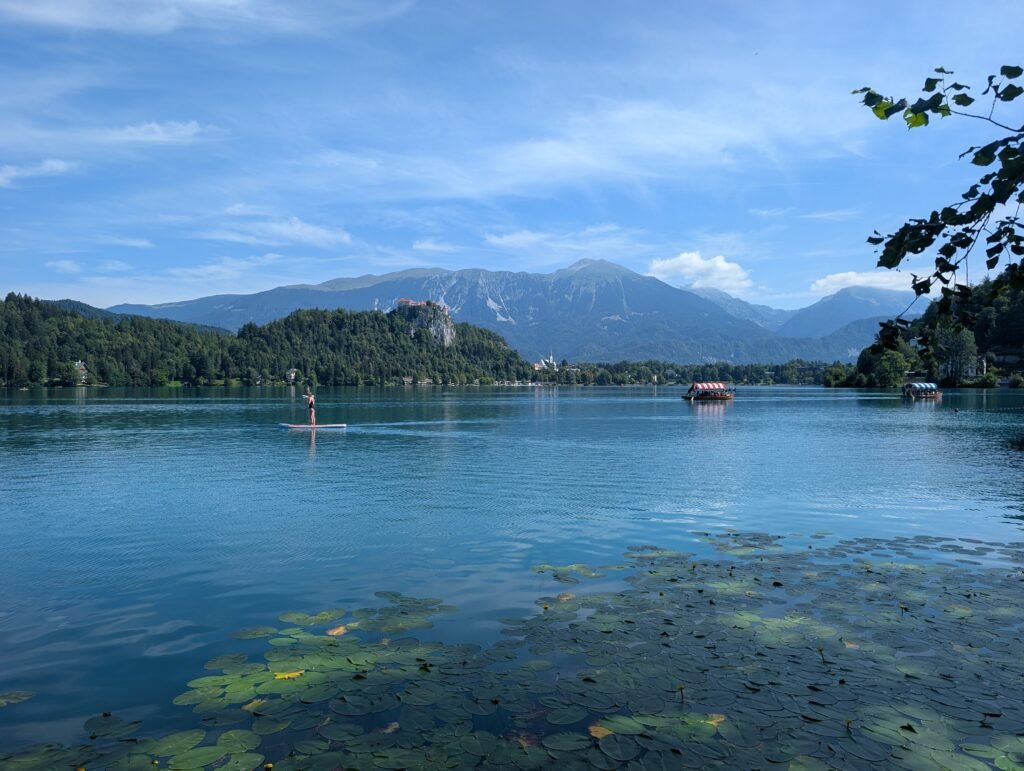
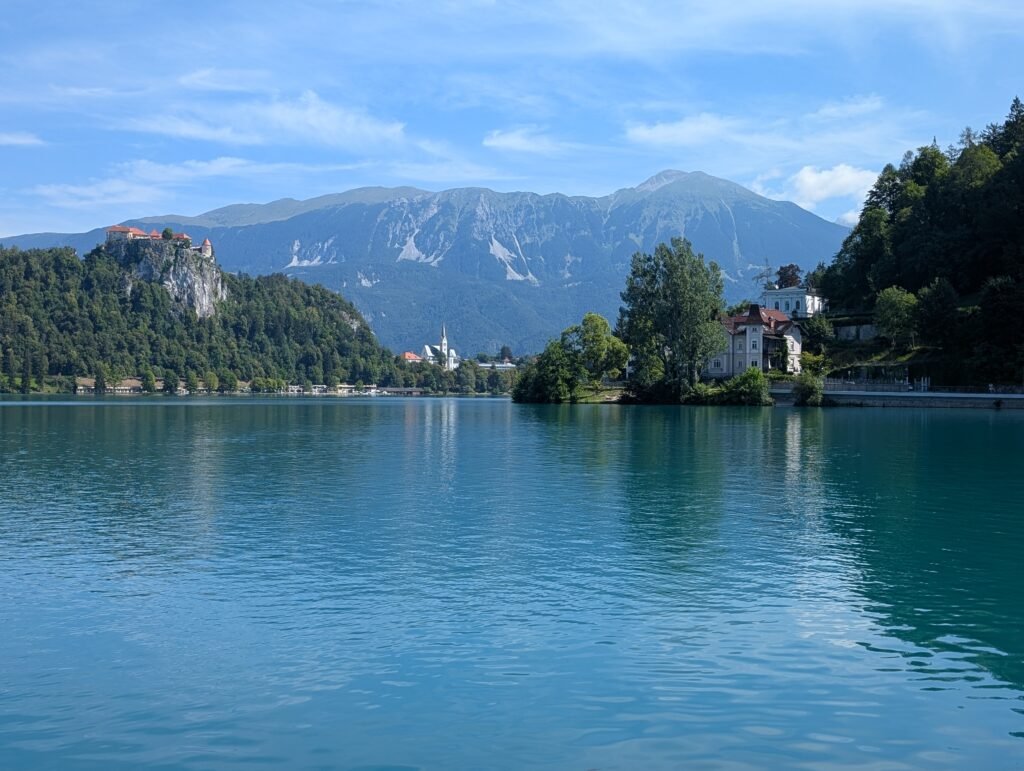
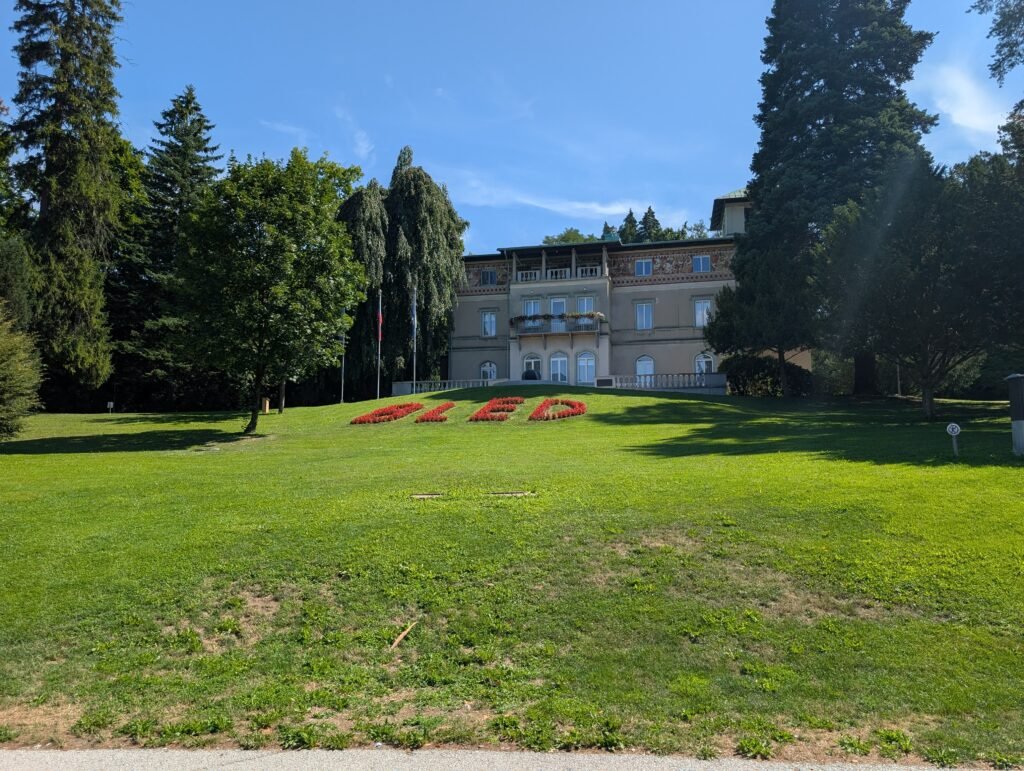
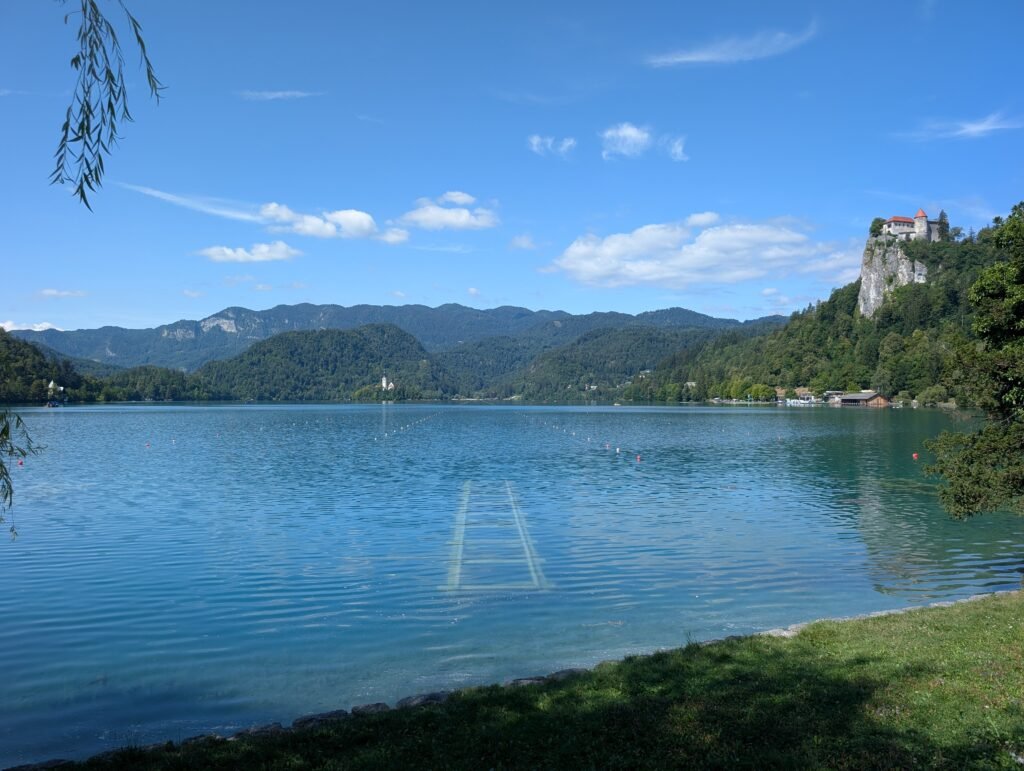
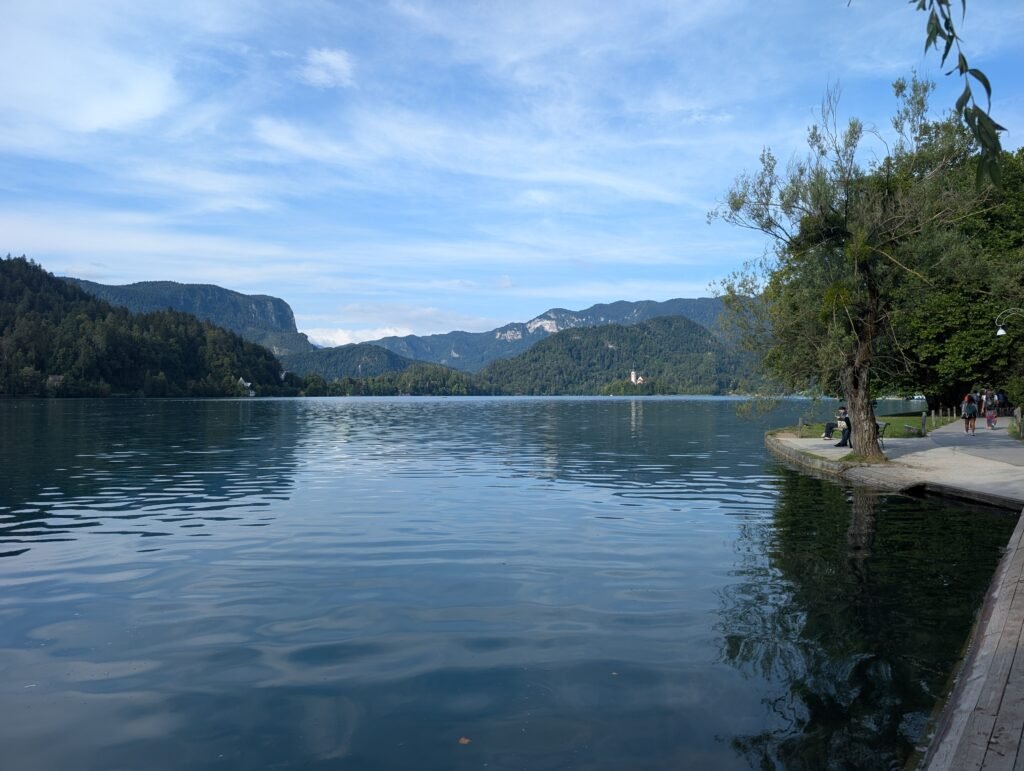
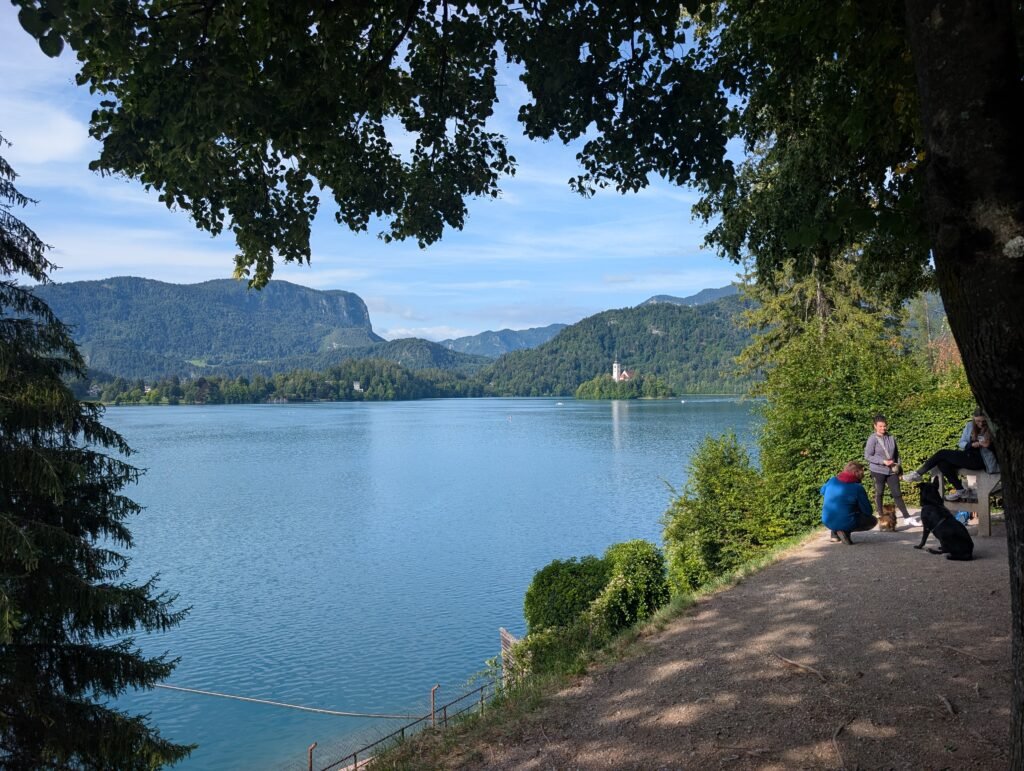
On Saturday the 25th, I decided to do a “mountain day.” You can take organized day tours to some of the mountain areas around Slovenia, but these were expensive, and if you read this page regularly, you already know that I’m often hesitant to take organized motor tours based on the time constraints placed on the members of the tour. Instead, I opted to get up pretty early in the morning and catch a public bus to Bled. This only took about an hour to an hour and a half. I was able to walk the entire perimeter of Lake Bled, and climb the hill behind it for sweeping views of the lake. If you have ever seen a single picture of Slovenia, it was likely of Lake Bled, with its iconic tiny island on which sits a picturesque church. Tito himself had a vacation home on Lake Bled.
This was truly the alpine area of Slovenia. The majestic Julian Alps served as a magnificent backdrop to both lakes I visited Saturday. There is a paved walking trail around Lake Bled. I walked this, and took a short detour to climb up to an overlook at the far end of the lake. I rested atop the hill and absorbed the view for quite some time. As the morning wore on, a few more tourists arrived. For being high season, I was surprised at how few tourists I had seen when I first arrived. There were a few joggers out for their morning exercise, but it really wasn’t all that crowded. The journey around the lake was about six kilometers, plus the hike up and down the little peak at the back of the lake. The whole stop took me somewhere between three and four hours.
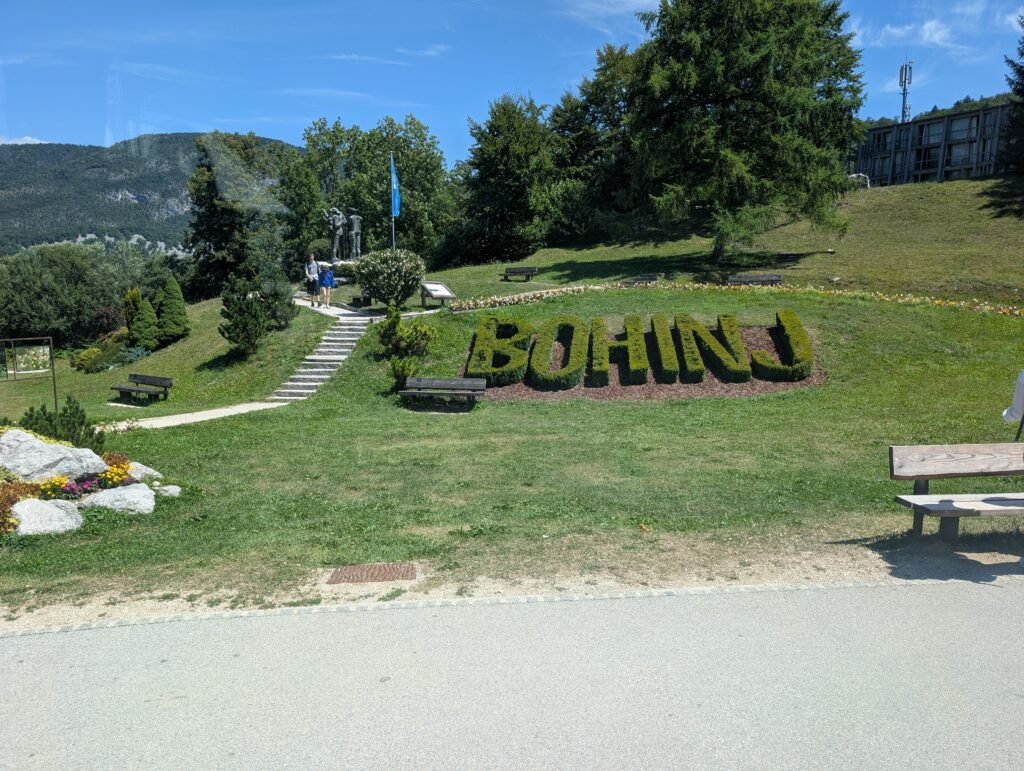
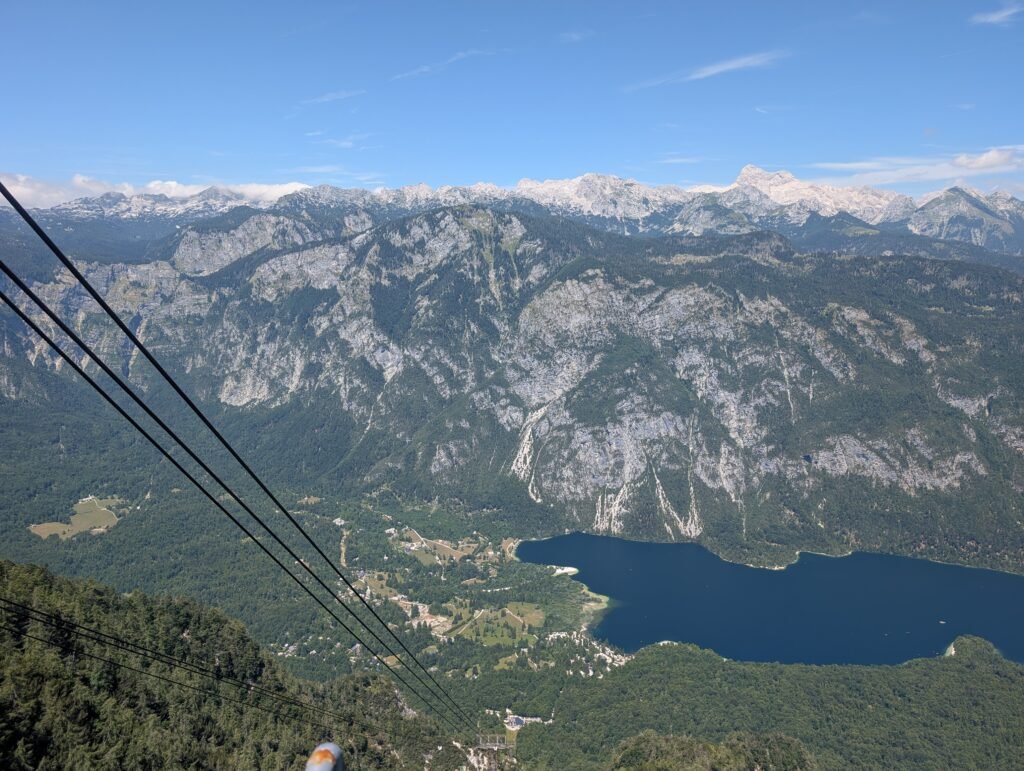
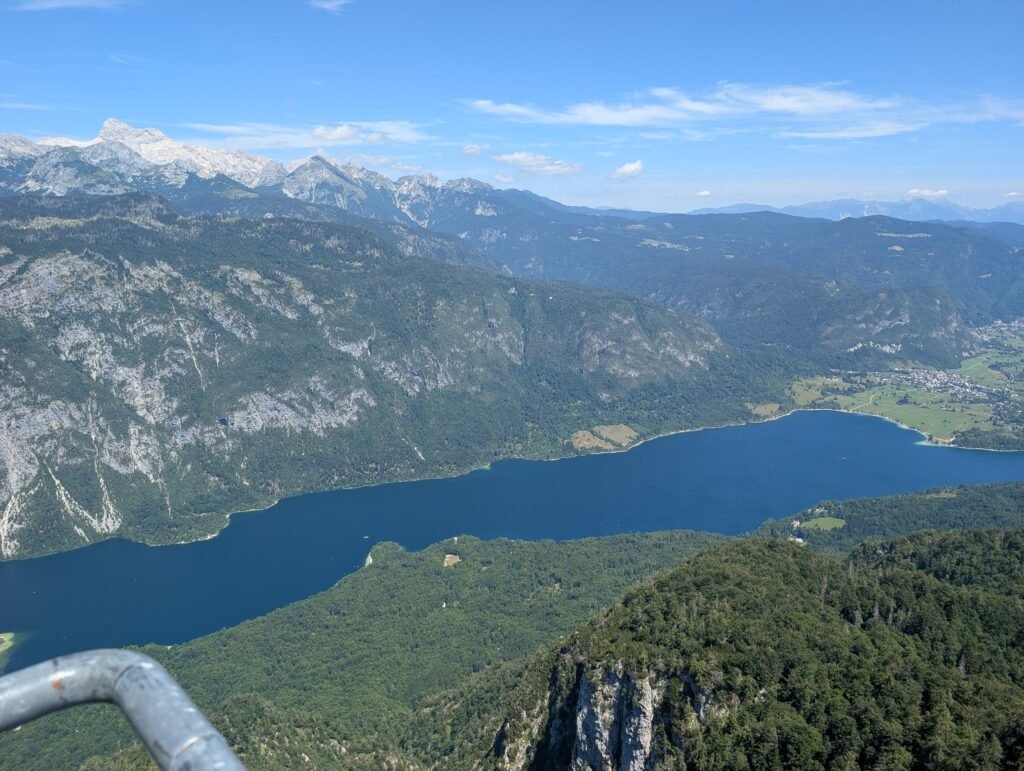
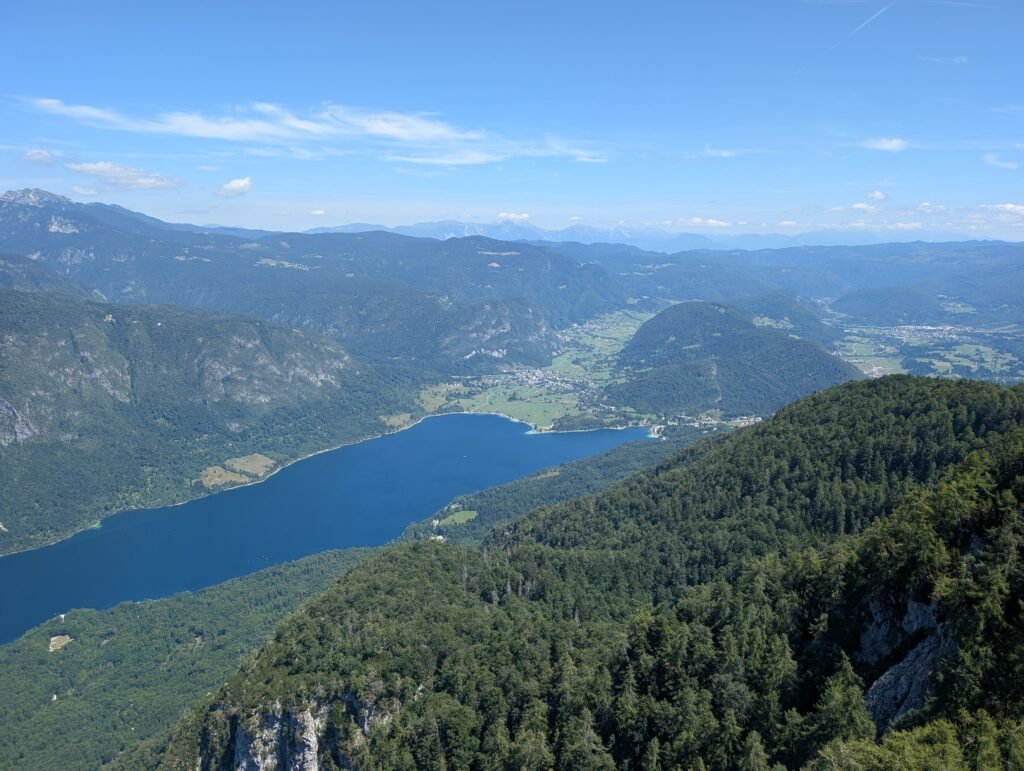
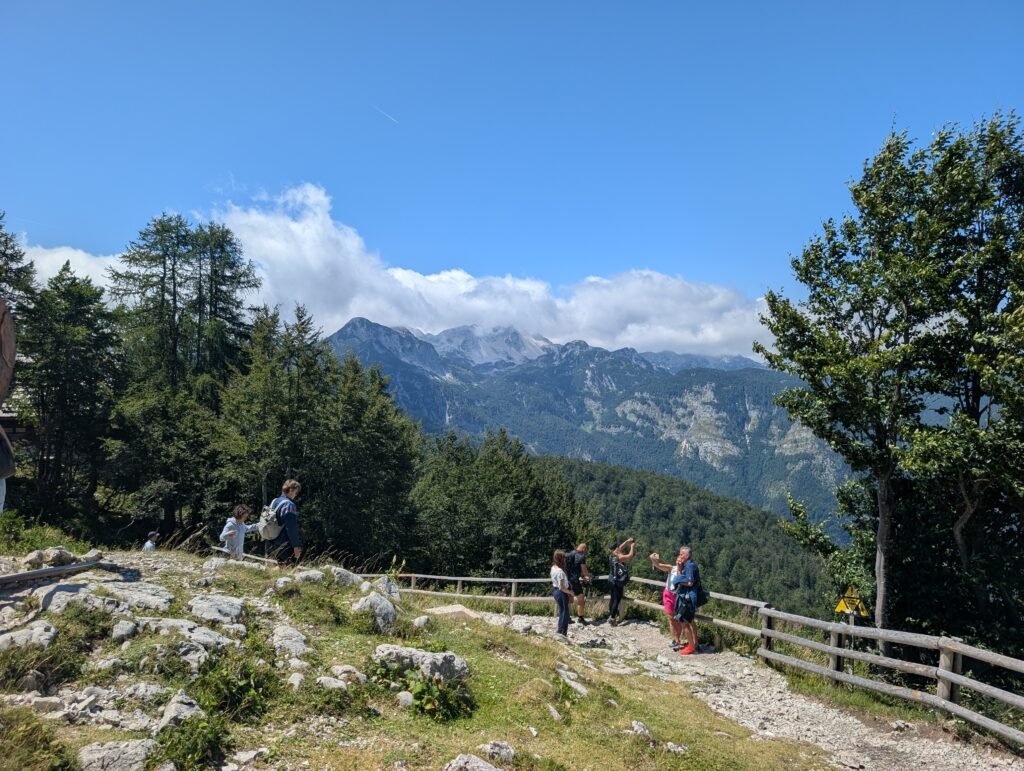
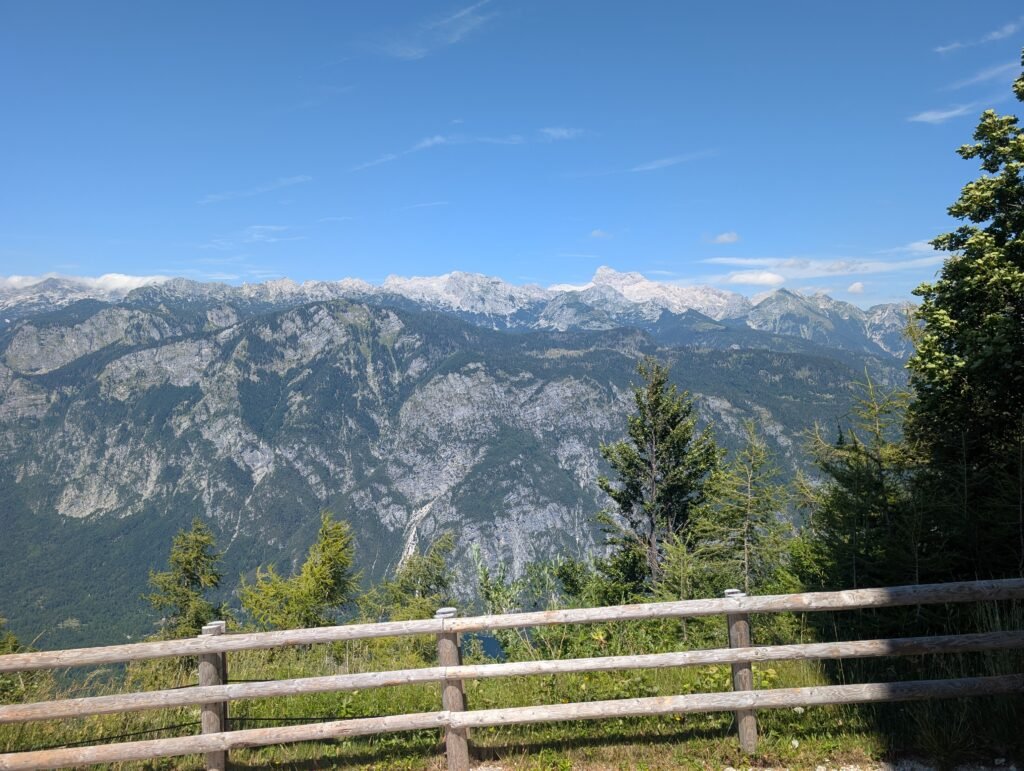
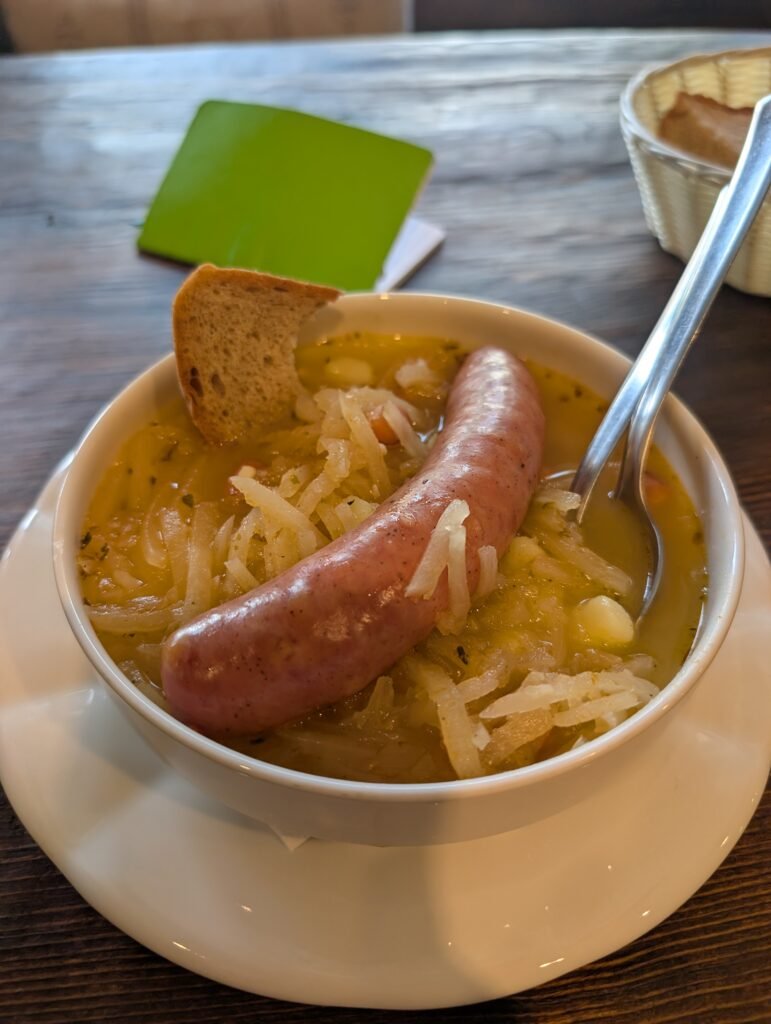
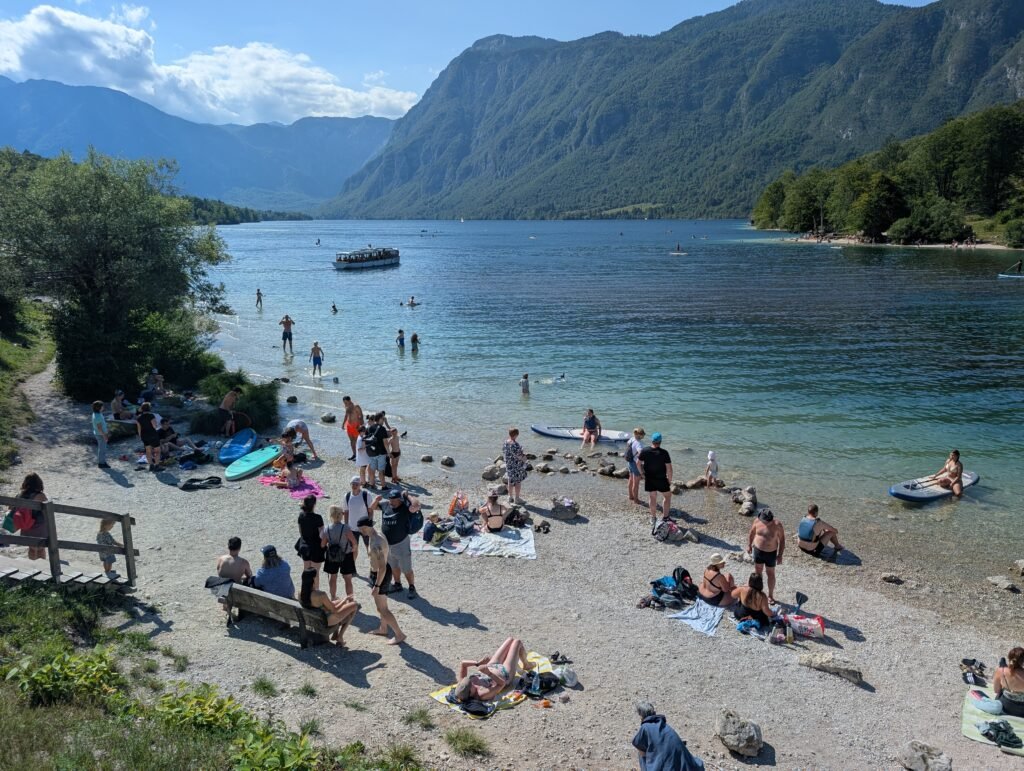
Sometime around midday, I caught another bus to Lake Bohinj. Bohinj is sort of the more rustic version of Slovene alpine lakes. There are more adventure sport opportunities and no storybook island. It is perhaps three times the size of Bled. I took the bus all the way to the upper end where a seasonal ski lodge operates a lift taking you up on a steep and towering peak overlooking the lake and offering stunning vistas of the Alps in the distance. This lift was pretty expensive – €35 round trip – and I didn’t really have time to take advantage of activities on the top of the mountain. I did thoroughly enjoy the views, and I was able to sample one of Slovenia’s best known dishes, a stew called Jota. It has a lot of beans and sauerkraut in it – and of course, sausage. I liked the sausage, and I generally like sauerkraut, but this stew wasn’t really my favorite. I was glad to have tried it, though. I walked around and absorbed the view for as long as I could. I didn’t have time to walk to the more distant huts or displays. You can also hike some great trails from there clear to other towns, lakes, and mountain ranges. That would have to wait for another trip.
I hopped a local bus back to the other side of the island. I walked around the little village on that side of the lake. I got a snack and a drink. I took more pictures. I noted other things I’d like to do on a later trip. The mountain region of Slovenia is an area I know others in my family would enjoy returning to, and thus I will save some of my to-do list for a trip when they join me.
This latter decision was aided by the fact that Slovenia isn’t the easiest country to get around, and it isn’t the cheapest or easiest place to book rooms in during July. The rooms I found were all a few hundred dollars a night, and it seemed I would need to rent a car to get to the other mountainous destinations beyond Bled and Bohinj. As much as I really wanted to do those things, I just didn’t want to spend the money they would cost. Further, I was not able to find a single Church of Christ in the entire country. I was, however, able to find a Church of Christ that met in Zagreb, just two hours by bus to the south. If I got up early enough in the morning, I could catch a bus to Zagreb, and use their city trams to get to the building in time for worship. That’s what I decided to do. Click the tile below to read about what I did – besides going to church – in Zagreb.