Algeria
Devoutly Muslim, Sparsely Visited
As of this writing, I have visited 49 sovereign nations, and 60 TCC countries and territories. Of these, Algeria is almost certainly the least visited, and most difficult. Not that I found it difficult to access – but other travelers often do. To acquire my Algerian visa, I had to visit that country’s consulate in San Francisco for an in-person interview with the consular official. The visa cost $160 which is a bit on the expensive side as visas go, though certainly nowhere near the $15,000 bond the United States demands of visiting Algerians.
The consular official was kind and helpful. I had to produce proof of reservations and tickets for the entire time I planned to be in Algeria, though as my consular official informed me, I could cancel those as soon as I had the visa in hand and plan my visit however I wanted. I had noticed on the initial application that there was an option to request a multiple entry visa. Since this was the same price as the single entry option, I ticked that box, and again requested this during my consular interview. I also provided the consular official with a self-addressed priority mail envelope that I could track for the safe return of my passport. The consulate kept my passport until the visa was approved. I received it in the mail a little over a week after I dropped it off in San Francisco. When my visa arrived, I had been granted a two year, multiple entry visa.
None of this was particularly difficult. I imagine most travelers don’t really know what to expect from Algeria, and are not inclined to make a trip the Algerian consulate in San Francisco to visit a country they know nothing about. Only a few travel influencers have made content about Algeria. Despite being the largest country in Africa, there isn’t nearly the trove of information in guidebooks for that country as there is for even the smallest European nation. Stephanie asked me before I left why I would want to visit Algeria. For me, the most basic answer will always be, “Because I haven’t been there.” That might be sufficient to encourage a brief stop, but the more I researched Algeria, the more excited I grew about visiting. Once I experienced the crowded casbahs of Morocco, I anticipated that Algeria might be something like a tourist-free Morocco. That was true to some extent, but of course Algeria is proudly unique in many ways.
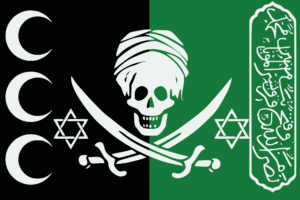
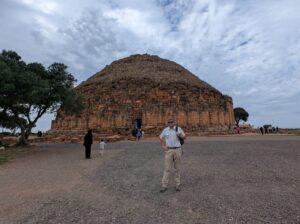
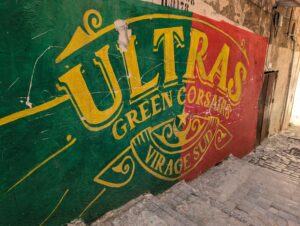
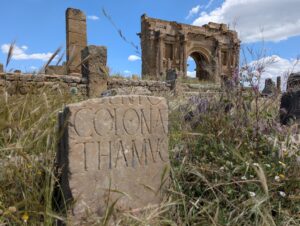
Of those few foreign visitors brave the trip, the majority seem most interested in visiting Algeria’s part of the Sahara desert. Similar trips can be made in Morocco or probably even Libya or Tunisia, I suppose. Those simply checking countries off of lists may be inclined to visit this way as often a full on visa isn’t necessary. Algerian tour agencies are granted special dispensation to allow tourists in to explore the Sahara with them sans the traditional visa requirement. I was less interested in desert, though. By far, the biggest attraction for me were the massive, sparsely visited Roman ruins. I could not find much information about sites associated with the Barbary Wars in my pre-trip research, but I supposed I would at least find ports or palaces of the local Beys and Deys subject to the Ottoman caliphate during the period. These proved much harder to find, as Algeria is not as enthusiastic about publicizing this era of their history, and when they do, the state position isn’t exactly transparent about their role in the privateering.
Not surprisingly, I did not run in to many foreign visitors in Algeria. I often had the Roman sites nearly to myself, despite the tiny admission fee. What tourists I did encounter were mostly French. Even the French visitors I met were often of Algerian ancestry – people whose ancestors had left for the greener economic pastures of France, while still holding tight to animosity over French colonialism. One French ENT doctor was spreading dinars around like they bits of confetti. I wondered sometimes how the native Algerians felt about this.
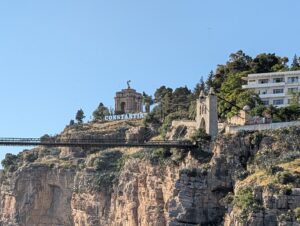
The Roman ruins did not disappoint. They were magnificent, accessible, and the entry fees were a pittance. Most Algerians were quite friendly, once I learned a bit more about how the Arabic hospitality mandate operates in practice. Economically, Algeria may well be the least expensive country I have visited, even more affordable than places like Cambodia, Peru, and Nicaragua. It was relatively easy, if not always luxurious, to navigate the Algerian public transportation network. The climate was spectacular. I had worried a bit about visiting Algeria in mid-May, but the weather was spectacular, and the landscape north of the Atlas mountains just as beautiful as it had been in Morocco. Some spots like Constantine were uniquely striking in their natural beauty.
I was mildly surprised to note that Algeria seems to be the most devoutly religious country of all those I have visited. Most European and North American societies range from a bit apathetic to completely post-Christian. I have visited some distinctly Islamic countries though. I’ve been to Malaysia, Bahrain, the Emirates, Qatar, and Oman in addition my stops in Morocco and Tunisia on this trip. Of all these, Algeria stands out as being ardently Muslim.
I often noticed women in traditional Muslim garb in Morocco and Tunisia. It was common to see middle aged and older mothers dressed in robes obscuring any views of their figures and burkas that didn’t cover the entire face, but hid the hair and neck. Younger ladies and the children of these mothers in Morocco and Tunisia often sported something more akin to standard Western dress. I didn’t see a lot of shorts worn my men or women anywhere in North Africa, but most men and many young women and girls in Morocco and Tunisia eschewed traditional garments. In Algeria, though, almost all of the women wore the garb, with a few even donning black burkas that covered the entire face – peeking out only through a small divided eye slit.
Friday prayers were attended so assiduously that men spilled over four abreast on the sidewalk outside of the mosque grounds to prostrate themselves when the speakers broadcast those prayers at midday. More than one Algerian sought to convert me while I was there. Islam may be the state religion in Algeria, but that doesn’t mean people are not taking it seriously. The state could never mandate that level of dedication.
Readers probably know that my time in Algeria was cut short by a family tragedy. I of course do not regret coming home as soon as possible. I am, however, grateful that I was able to secure a multi-entry visa. I have yet to explore Annaba, site of St. Augustine’s bishopric. I could also spend some more time in Constantine, visit some of the smaller ruins, and perhaps even pay a visit to the yawning Sahara that many country-counters seem to enjoy visiting. My plan as of this writing is to return to finish my visit at some point before that multiple entry visa expires. Algeria is truly worth the small hassle involved in securing permission to enter the country. Click the tiles below to learn what I saw at each of my stops in Algeria.