Barbary Coast
Morocco, Algeria, & Tunisia
My favorite American history trivia question is this: “Which was the first country to recognize American independence?” Predictably, most people guess France. This is a reasonable, but incorrect response. The correct answer is Morocco. Why on earth would Morocco be the first to recognize American independence? It seems surprising that 18th century Morocco would even know there was a struggle for independence in British America. Nevertheless, in December 1777 the sultan of Morocco became the first foreign head of state to recognize the United States as a sovereign country. Most sources reflect on this as a magnanimous act of friendship toward a fledgling neighbor. While this did lead to an even stronger friendship treaty a decade later, the sultan likely had ulterior motives.
From the 15th century through the early 19th century, Tunis, Algiers, and Tripoli functioned as semi-autonomous vassal states. They paid tribute and operated under some control of the Ottoman Empire. While Morocco technically never directly subordinated to the Ottomans, their policies were still heavily influenced by the strong influence of the Turks. All of these North African states had a local ruler – a bey, dey, or pasha – who acted as a head of state and often had a high degree of autonomy. Then as now, none of these states had vast, burgeoning economies. Their primary economic activity was piracy. They all supported fleets of corsairs. They attacked shipping in the Mediterranean and anywhere else they could access it.
The Barbary states gleaned significant revenue from plundering European shipping, but this wasn’t the only way they capitalized on piracy. Between them all, the Barbary states captured well over a million European slaves during their period of piratical activity. Poorer European seafarers captured by the Muslim pirates were forced into labor often even more demanding and under worse conditions than victims of the transatlantic Africa slave trade. Aristocrats on the other hand were held hostage until ransomed if this would be more profitable than subjecting them to forced labor. Finally, tribute – protection money – was extracted from foreign powers who were willing to pay in exchange for harassment-free passage of their ships.
Britain had the most powerful navy in the world for much of the period of the Barbary pirates’ activity. France and sometimes Spain also had navies that surely could have crushed the likes of Morocco and Tripoli. Why, then, would they elect to pay tribute? The tribute asked by the Barbary chiefs was a tiny fraction of England’s budget. Smaller nations that were potential economic competitors found it far more difficult to shoulder the economic burden of paying tribute. The tribute paid at times by the fledgling United States government could amount to a quarter to half of the entire federal budget. The captains of European trade, then, found it expedient to pay small (to them) tributes to the Barbary states, leaving them free to sail the seas harassing their smaller competitors in the world of mercantile economics.
It was in Morocco’s interest, then, to recognize American independence. As long as British American ships sailed under the British flag, American shipping was protected under British tribute. Moroccans understood that an independent United States of America meant a new “customer” – either a new source of tribute, or a new source of slaves, plunder, and ransom. During the first few decades of American independence, the United States fought two undeclared wars against the Barbary states. Ultimately, it was the tiny, new, U.S. navy that ended the terror of the Barbary pirates to American merchants and travelers. French colonization of Algeria in 1830 permanently ended the threat, making shipping and travel safe for Europeans and Christians traveling the Mediterranean and around the Eastern Atlantic.
These so-called Barbary Wars are one of my favorite parts of Early American history. They are filled with swash-buckling stories, acts of heroism, adventures better than anything you’d read in fiction. Needless to say, I was excited to visit the scenes of some of these American military adventures. I would not make it to Tripoli, but I planned to visit Morocco, Algeria, and Tunisia en route to a rendezvous with Stephanie, Kimberly, and Caleb in Egypt.
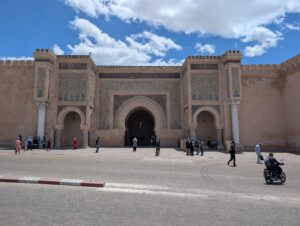
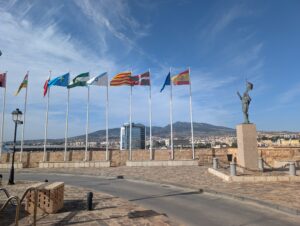
The old Barbary states are home to amazing casbahs, markets, madrasas, colorful villages, Portuguese forts, Spanish exclaves, and French colonial architecture. As a historian, I was also very excited to visit the numerous Roman ruins along the North African coast, not to mention the ancient city of Carthage. None of that even mentions Egypt. It was easy to sell Kimberly and Caleb on seeing the pyramids. Stephanie took a bit more convincing, but eventually was won over when I found her a business class seat. Egypt’s history is so long that when Cleopatra ruled Egypt, the pyramids were already ancient. Cleopatra was 500 years nearer in time to us, than she was to Egypt’s Old Kingdom. Egypt has the sphinx, obelisks, temples, the Valley of the Kings, not to mention old Coptic and Muslim Cairo.
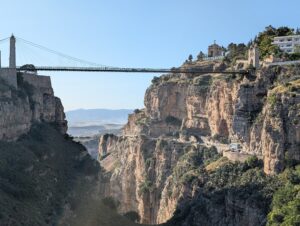
The plan, then, was for me to fly to Marrakesh. I would arrive May 3rd, and make my way across North Africa. Stephanie and the children would arrive in Cairo May 27th. So I would spend a bit over a week each in Morocco and Algeria, then a few days in Tunisia before bypassing Libya and flying into Cairo the night before the family to pave the way for them. Sadly, I never made it to Egypt on this trip. Stephanie’s mother had been battling cancer on and off for several years. While I was in Algeria, the cancer suddenly turned aggressive. We canceled all the reservations for Stephanie and the children, and I immediately returned from where I received the tragic news in Constantine, Algeria.
As I planned my agenda for Morocco and Algeria, I had difficulty narrowing down my lists of things to see. As usual, it seemed I needed more time in each place. There is never enough time to see everything. I opted out of any trips to the Sahara. I would go to the historic sites along the coasts. Stephanie asked me why I would want to go to Algeria. Initially, I just wanted to go because it was there and it was between Morocco and Egypt. The more I researched it though, it seemed like a place that I could easily spend a couple of weeks exploring. Getting the visa took a bit more effort than some others I had applied for, but the Roman ruins in Algeria looked spectacular. The church father Augustine was bishop in Hippo, the ruins of which are in eastern Algeria. There would be at least as much to see as in Morocco, but without the tourism.
It would be hot, for sure. The time away from Stephanie would be longer than I’d like. She agreed to join me, though, and the time apart would be less than it had been on other trips. Egypt would have been my 50th country. Africa was my 5th continent. I would see new places, ancient wonders, eat new foods, and meet new people. I was excited. Join me to see what I discovered in this venture across North Africa.